

Executive branch
This page lists agency profiles, application advice, fellowships, and resources for understanding and working in US federal agencies or the White House.
Federal agency profiles
These profiles provide information on specific federal agencies working on issues relevant to AI, bio, and related emerging tech policy, including lists of major policy developments and relevant offices.

Executive branch AI policy overview
This guide is a starting point for exploring AI policy careers in the executive branch. It reviews key policy areas and agency roles and highlights key considerations to inform your career planning.

Executive branch biosecurity policy overview
This guide helps you explore biosecurity policy careers in the executive branch. It reviews key policy areas and agency roles and highlights key considerations to inform your career planning.

Advanced Research Project Agencies (ARPAs) [AI+bio]
ARPAs are specialized R&D funding entities designed to accelerate technological breakthroughs across national defense, intelligence, energy, and health.

Executive Office of the President (EOP) [AI+bio]
EOP is a group of offices and councils that support the president in executing their agenda domestically and internationally. EOP advises the president, coordinates policy development among federal agencies, and guides policy implementation.
EOP > National Security Council (NSC) [AI+bio]
NSC coordinates the government’s national security enterprise and advises the president on national security matters. It designs short- and long-term national security strategies and coordinates national security policy implementation among agencies.

EOP > Office of Management & Budget (OMB) [AI+bio]
OMB oversees the implementation of the president’s vision across the executive branch. It develops the president’s annual budget proposal, manages agency processes, reviews significant agency regulations, and supports presidential actions, including executive orders.

EOP > Office of Science & Tech Policy (OSTP) [AI+bio]
OSTP is the president’s chief advisory body on science and technology. It provides strategic guidance for policymaking and government R&D spending, evaluates federal programs, and coordinates federal science and technology policy initiatives.
EOP > National Economic & Domestic Policy Councils (NEC & DPC) [AI+bio]
NEC and DPC advise the president and coordinate policymaking processes for economic and domestic issues. Both have supported the development of major AI or biosecurity policy initiatives.

Department of Commerce (DOC) [AI+bio]
Commerce promotes US economic growth and competitiveness through roles in data, innovation, and industry support. It plays key roles in AI and biosecurity, overseeing standard-setting, semiconductor and bio-manufacturing, and exports.

DOC > Bureau of Industry & Security (BIS) [AI+bio]
BIS is the lead agency tasked with administering and enforcing export controls on dual-use items and technology. It’s central to US AI and biosecurity policy efforts since it controls the export of high-performance semiconductors and biological equipment and materials.

DOC> National Institute of Standards and Technology (NIST) [AI+bio]
NIST develops standards, measurements, and technology to support US economic competitiveness, technological progress, improved product reliability, and technical security and safety.

Department of Defense (DOD) [AI+bio]
DOD’s mission is to “provide the military forces necessary to deter war and ensure the nation’s security.” DOD shapes AI and biosecurity policy through multiple levers, such as funding for research, procurement, and strategic guidance and policy documents.
DOD > Office of the SecDef (OSD) [AI+bio]
OSD is responsible for policy development, planning, resource management, and program evaluation. OSD runs several AI and biosecurity-relevant efforts, including investing in research, purchasing equipment, drafting strategies, and more.
DOD > US military departments [AI+bio]
The military departments—Army, Navy, and Air Force—organize, train, and equip the US armed forces. They play central roles in AI and biosecurity through large-scale R&D programs, operational testing, and technology adoption for national defense.

Dep. of Energy (DOE) [AI+bio]
DOE oversees energy policy, scientific research, and the nuclear arsenal, being the largest US government funder of physical science research. It significantly contributes to science and tech development and policy, including via its national labs.

DOE > National Nuclear Security Administration (NNSA) [Nuclear + AI]
NNSA maintains and secures the US nuclear weapons stockpile, works to prevent nuclear proliferation and terrorism, powers the US Navy through nuclear propulsion, and responds to nuclear and radiological emergencies domestically and abroad.

Dept. of Health & Human Services (HHS) [Bio]
HHS plays a crucial role in healthcare, public health, medical research, and social services. The department is responsible for preparing for and responding to biological threats of any kind, including via agencies like CDC, ASPR, NIH, and FDA.

HHS > Administration for Strategic Preparedness & Response (ASPR) [Bio]
ASPR’s mission is to “assist the country in preparing for, responding to, and recovering from public health emergencies and disasters.” It runs the Strategic National Stockpile, BARDA, and other programs.

HHS > Centers for Disease Control & Prevention (CDC) [Bio]
CDC’s mission is to protect America from health, safety, and security threats, both foreign and domestic. The agency provides public health expertise, conducts research, and plays a central role in biosecurity, responding to disease outbreaks, pandemics, and biological threats.

HHS > Food & Drug Administration (FDA) [Bio]
FDA ensures the safety, efficacy, and security of drugs, biological products, and medical devices, and it oversees food safety and tobacco regulation. The agency mainly contributes to biosecurity by regulating vaccines, treatments, and medical countermeasures.

HHS > National Institutes of Health (NIH) [Bio]
NIH is the primary federal agency for biomedical and public health research and is the largest funding source for medical research globally. It supports various research initiatives aimed at advancing health, preventing disease, and ensuring biothreat preparedness.

National Science Foundation (NSF) [AI+bio]
NSF is an independent federal agency that advances US science and engineering progress through competitive research grants, partnerships, education, and workforce development. NSF investments drive developments across AI, biosecurity, and other emerging technologies.

Dept. of Homeland Security (DHS) [AI+bio]
DHS is integral to US national security, handling cybersecurity, counterterrorism, border security, disaster response, and critical infrastructure protection. DHS’s role in emerging technology policy is growing, including dealing with AI, bio, and cyber-related threats.

DHS > Cybersecurity & Infrastructure Security Agency (CISA) [AI]
CISA is the nation’s cyber defense agency and national coordinator for critical infrastructure security and resilience. CISA has emerged as a critical player in AI policy, particularly in AI security.

Intelligence Community (IC) [AI+bio]
The IC consists of 18 government agencies and offices that collect, analyze, and deliver intelligence to senior US leaders to support decision-making on critical issues. This work is crucial for informing US government policy and safeguarding national security.

Department of State (DOS) [AI+bio]
State oversees US foreign policy, negotiating treaties, managing diplomatic missions, and representing the US in international bodies. In this capacity, State contributes to technology policy, which is becoming increasingly important in diplomacy.

Federal Trade Commission (FTC) [AI]
The FTC is an independent federal agency of the US government with a dual mission to promote fair competition and protect American consumers from predatory or misleading business practices. It will likely play a major role in AI regulation.

US Department of Agriculture (USDA) [Bio]
USDA develops and executes federal policies on agriculture, forestry, and rural economic development, aiming to support farmers and ensure a safe food supply. USDA contributes to biosecurity and advances food innovation to enhance food security and sustainability.
If you’re interested in seeing how different government agencies use AI, see these lists of AI use cases. If you’re interested in biosecurity, check out this interactive tool mapping biodefense activities in the executive branch and this biodefense budget breakdown.
Federal agency research and application advice
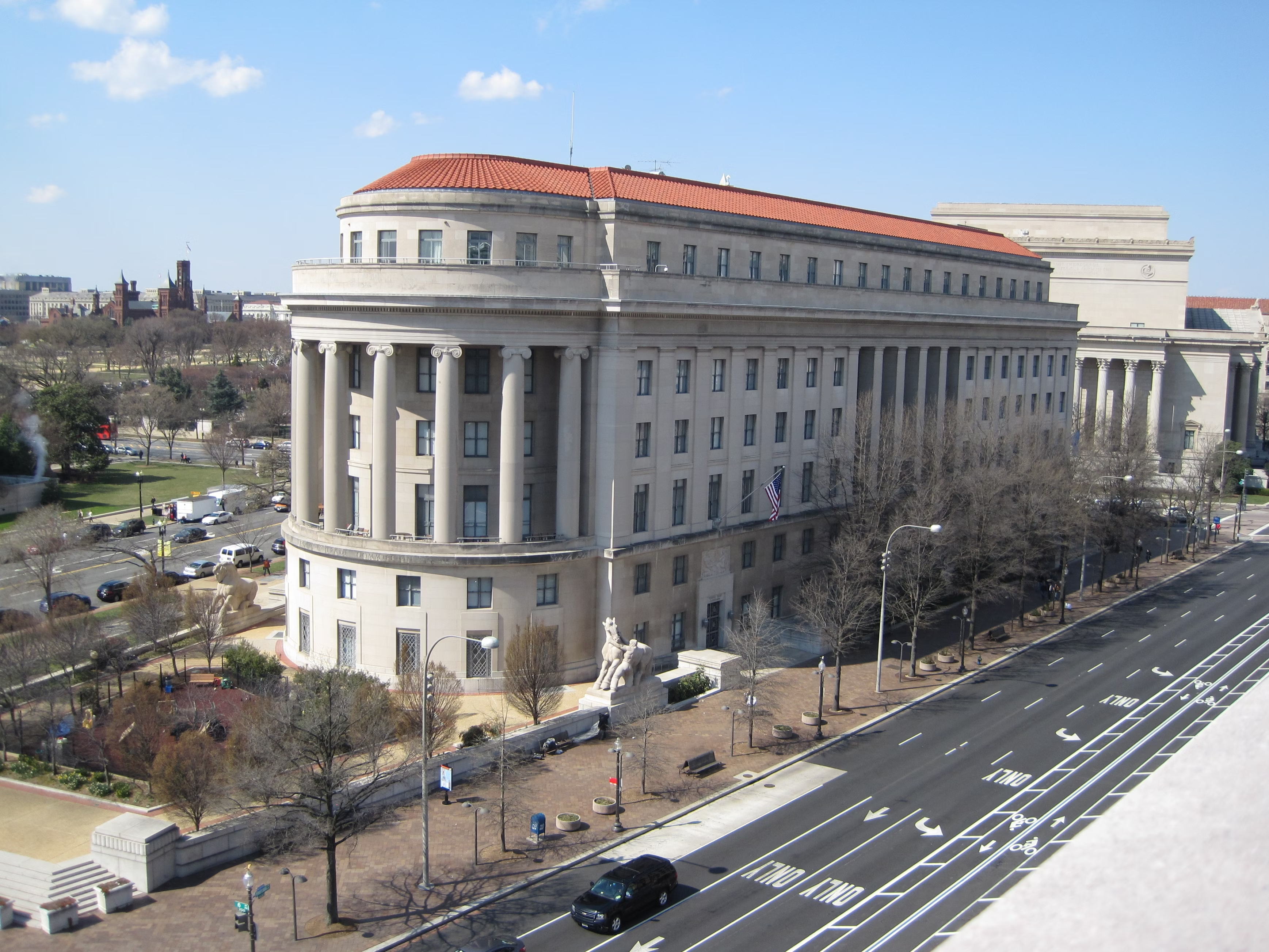
Researching federal agencies and offices
This guide helps you research and pursue agency roles that match your policy interests and career goals. It walks you through a 4-stage process: brainstorming options, conducting research, informational interviews, and creating an action plan.

Interviewing for federal positions
Job interviews with federal agencies differ significantly from the private and nonprofit sectors. This article covers interview preparation, the scoring system, common mistakes to avoid, and what to expect during and after the interview.
Understanding federal job announcements and USAJOBS.gov
- How to Use USAJOBS, GoGovernment
- USAJOBS Help Center, USAJOBS.gov
- Federal Government Hiring Playbook, Tech Talent Project
- Hiring, Digital Policy Guide
- r/USAJOBS, Reddit
- Navigating USAJOBS to Land a Federal Role, Arizona State University
Federal resume advice
- What should I include in my federal resume?, USAJOBS.gov
- Writing a Federal Resume, GoGovernment
- How to write a government resume, 18F (aimed at technologists writing resumes for government)
- The Federal Resume Guide, The National Archives and Records Administration
- Dear Mr. Kupor: Please fix federal hiring, Jennifer Pahlka (highlights challenges with federal hiring and the importance of federal resume optimization)
Executive branch fellowships
The following fellowship programs conduct placements in the executive branch (see also our full fellowship database for >50 opportunities and this agency-specific fellowship database with >150 opportunities):
- Horizon Fellowship (Horizon Institute for Public Service) – a 6-24 month full-time US emerging technology policy fellowship facilitating job placements in the US executive branch, Congress, and think tanks for early- and mid-career individuals. (Note that this website is a project of the Horizon Institute for Public Service, which also runs the Horizon Fellowship.)
- AAAS Science and Technology Policy Fellowships (American Association for the Advancement of Science) – a 12-month fellowship in DC for STEM PhD holders with four separate tracks, placing fellows within the executive branch, judicial branch, legislative branch, or in a nonprofit.
- Presidential Innovation Fellowship – a 1-2 year full-time fellowship for mid-to-senior-level technology experts.
- US Digital Corps – a 2-year full-time fellowship for early-career technologists.
- Epidemic Intelligence Service (Centers for Disease Control and Prevention) – a “2-year post-graduate fellowship in applied epidemiology…EIS officers help public health officials investigate and control infectious disease outbreaks”
- Health Policy Fellowship (Robert Wood Johnson Foundation) – a 1-year full-time executive branch job placement program focused on health and biosecurity policy for mid-career professionals.
- Graduate Fellowship Program (National Nuclear Security Administration) – a 1-year, full-time nuclear security fellowship in the executive branch for graduate and postgraduate students or early-career individuals.
Executive branch resources
Job boards
- USAJOBS.gov, the government’s job board for federal agencies (see these guides)
- USAJOBS Early Career page: a hub for information and resources aimed at students, recent graduates, and other early-career individuals. It offers details on federal government employment benefits, guidance for navigating the federal application process, and recommendations for crafting effective federal resumes. It also links to the Federal Internship Portal and the Recent Graduate Portal, which list many early-career opportunities.
- USAJOBS Career Explorer: a tool to identify federal government positions that match your career interests. You answer a set of questions, generating a customized list of relevant federal occupations. This list provides clear, jargon-free descriptions of various roles and direct links to current job openings. The tool encompasses more than 300 occupations within both the General Schedule and Wage Grade pay scales, offering a comprehensive overview of federal career opportunities.
- Federal Internship Finder, Partnership for Public Service
- Federal Jobs Coach, a custom GPT agent trained to summarize USAJobs postings and review your resume
- Paid: Tom Manatos Jobs, focus on DC policy (e.g. Congress, agencies)
- Tech and Innovation Public Sector Job Board (weekly)
- DOD Emerging Technologies Talent Marketplace
Websites
- GoGovernment resources, Partnership for Public Service
- Department of Defense Civilian Careers
- TechToGov, Tech Talent Project
- Digital Policy Guide, a guide to US information technology law and policy
- B-SPAN: Interactive tool mapping US biodefense activities in the executive branch and in the legislative branch, Bipartisan Commission on Biodefense
Articles
- What It’s Like to Work at the White House
- Policy Entrepreneurship at the White House: Getting Things Done in Large Organizations
- Career review: Diplomacy
Newsletters
- GovExec Today, Government Executive
- Politico’s newsletters, especially Playbook, West Wing Playbook (White House), and National Security Daily
- Partnership for Public Service newsletter
- Statecraft, Institute for Progress
Books
- The Great Courses: Understanding the US Government (Audible) (2020)
- Recoding America: Why Government Is Failing in the Digital Age and How We Can Do Better (2023)
- Hack Your Bureaucracy: Get Things Done No Matter What Your Role on Any Team (2022)
- The Art of Policymaking: Tools, Techniques and Processes in the Modern Executive Branch (2016)
- The National Security Enterprise: Navigating the Labyrinth (2017)
- Rulemaking: How Government Agencies Write Law and Make Policy (2019)
- Executive Policymaking: The Role of OMB in the Presidency (2020) (JSTOR)
- Running the World. The Inside Story of the National Security Council and the Architects of American Power (2006)
- The Federal Budget: Politics, Policy, Process (2000)
Podcasts
- Gov Actually, FedScoop (not active anymore, but with a 50+ episode archive)
- Watchdog Report, Government Accountability Office
- Transition Lab, Partnership for Public Service
- Stories from the Backchannel, Center for a New American Security
- The 80,000 Hours Podcast has in-depth episodes about policy work and career tips with former executive branch officials Beth Cameron, Andy Weber, Tom Kalil, and Bonnie Jenkins