

Policy cover letters
This guide explains how to write effective cover letters for US policy positions (e.g. congressional offices, think tanks, state legislatures). Your cover letter should strategically complement your resume, providing color to your most relevant experiences and connecting your professional trajectory to the organization’s mission. Policy cover letters generally follow standard guidelines but should emphasize policy-relevant skills—writing, research, project management, interpersonal skills, etc.—even if you don’t have prior policy experience.
Format: How to structure your cover letter
Reference examples like these, and follow these guidelines:
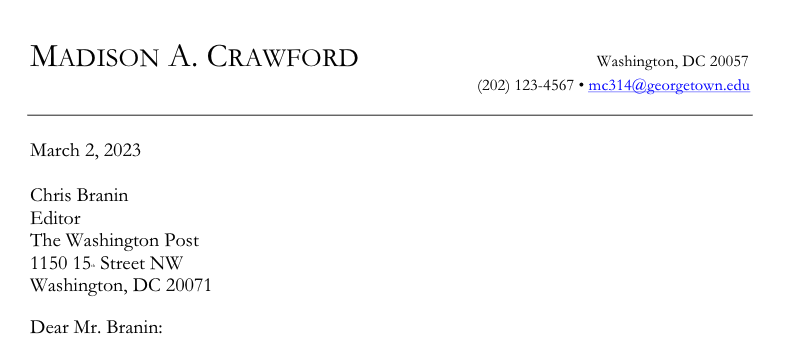
- Use a business letter format with your contact information at the top (same header as your resume)
- Include the date and the recipient’s information (name, title, organization, address)
- Keep to one page (3-5 concise paragraphs)
- Align all text on the left margin (don’t indent paragraphs)
- Set the margins between 0.75” and 1” (ideal) and no less than 0.5”
- Use the same font as your resume (Calibri or Times New Roman, ideally size 11)
- Save as PDF (unless otherwise specified)
Sections
Your cover letter should include these sections (in order):
- Heading: Include the same heading as used for your resume, which should include your name, phone, email, and (optionally) your city, state, and LinkedIn profile
- Employer information:
- Date
- Hiring manager name
- Address to a specific person when possible (research the hiring manager or relevant role, e.g. by looking at the organization’s “Team/About Us” page if available, using LinkedIn, or asking personal contacts)
- For congressional offices, consider addressing the Chief of Staff, Legislative Director, or the Member
- If no name is provided, consider calling the organization to learn who is on the hiring team
- Skip the name if not able to find
- Title (e.g. Legislative Director, Human Resources Director, Hiring Manager)
- Organization Name (e.g. Office of Senator [X], Department of [X])
- Street Address
- City, State Zip Code
- Dear [Hiring manager name or position title]:
- Use a colon, not a comma
- Opening paragraph: Introduce yourself (including education status), state the specific position, mention how you heard about it, and explain your interest
- Body paragraphs (1-2):Highlight relevant education, skills, and experience that connect to the role requirements
- Optional: Brief bullet points (2-3) for standout achievements
- Closing paragraph:Refer to your resume, request an interview, reaffirm interest, and thank the reader
- Professional sign-off:“Sincerely,” followed by your typed name and optional signature
Content: What to include
Opening paragraph:
- Introduce yourself, express your interest in the position, and demonstrate your appreciation of the organization’s mission, i.e. “I am interested in contributing to X organization’s mission of Y.”
- If you’re a graduating student, consider referencing your major and your upcoming graduation.
- End with a “thesis statement” to guide the reader through your letter (see examples below).
Body paragraphs:
- Select 2-3 experiences (professional, academic, leadership) that demonstrate policy-relevant skills relevant to the position (e.g. research, writing, stakeholder engagement, project management, analysis)—focus on adding depth and context to these
- For policy transitions: explain how your non-policy experience translates to policy work
- For students: emphasize education, relevant coursework, research projects, fellowships, language skills, and/or study abroad experiences
- Only say what you do or have done—don’t focus on areas where you lack experience
- “Connect the dots:” explicitly link your background to key terms from the job description
- Quantify achievements where possible (e.g. “managed a research project with five team members”)
- Demonstrate alignment with the organization’s mission and values
- Focus on what you can contribute to the organization, the team, and/or its mission (rather than what the job can do for you)
- For each qualification or skill you mention, provide evidence (ideally a relevant illustrative example) from your experience (avoid general claims without supporting evidence)
- Consider using one section of 3-5 brief bullet points for key achievements, if appropriate
Closing paragraph:
- Reaffirm your interest, summarize your core value proposition, and express appreciation for the reader’s time and consideration
- Demonstrate enthusiasm for joining a community, network, and/or learning from others
- Project confidence without presumption
- Keep the ending brief, positive, and action-oriented; end on a note that invites further conversation
Writing: Tone, word choice, and style
- Write in a natural, professional tone that reflects your authentic voice
- Use clear, concise language, and vary your sentence structure throughout
- Project confidence in your abilities and genuine enthusiasm, but avoid language that could feel presumptuous or desperate (e.g. “I’m the perfect candidate,” “This is my dream job,” “I’ve applied to 20 congressional offices,” “Please give me a chance,” etc.)
- Use active voice (e.g. avoid “be,” “is,” and “was” when possible) and strong action verbs to describe your accomplishments
- Avoid:
- Write out numbers under 10 and use numerical values for 10 and up (e.g. nine books; 10 books)
- Frame your experience in terms of contribution to the organization’s mission
- Always proofread, proofread, proofread! (typos can tank your application; AI/software tools can help spot mistakes; see the section below)
Strong cover letter examples
Opening paragraph:
I am a senior studying [topic of study] at [University], and a student in the [AI research program]. My academic and professional experiences focus on the intersection of human cognition and artificial intelligence, driving my interest in ethical and regulated new technologies.
Connecting your experience:
Emerging technologies are developed and regulated amidst significant uncertainty regarding their consequences and best regulation levels. During my internship with [DC-based think tank], I evaluated [AI-related research project]. My work at the [University-affiliated research center], where I coordinated policy advisory boards, further honed my skills in translating research insights into policy-relevant actions.
The interdisciplinary nature of my activities has prepared me to tackle the multifaceted challenges at the intersection of public policy, science, and technology. With [University] Law School, I engaged in [technology policy topic]. My team and I have been invited to present our research at conferences and meetings, including with [US policy research centers and government officials]. Writing for and speaking with audiences of different backgrounds, I have practiced synthesizing technical information to communicate across disciplines.
Leading a policy hackathon at the [University policy organization] featuring distinguished speakers and judges from think tanks, the military, and government sectors, significantly enhanced my organizational and project management skills. This experience also deepened my ability to foster interdisciplinary collaboration and innovation. My internships at the [US federal department] and the [US intelligence community agency] further developed these skills, broadening my expertise in policy analysis and understanding stakeholder engagement.
As a journalist and editor for international, national, and student publications, I have tackled subjects like algorithmic decision-making and the governance of tech companies. My investigative work in [City] explored the socio-economic impacts of AI-related policies. A policy proposal I authored on AI development and rare mineral extraction, recognized by the UN Development Programme, exemplified my ability to translate research insights into practical advocacy.
Closing paragraph:
I am eager to apply my interdisciplinary background in [topic of study], my passion for technology policy, and my proven analytical and communicative skills to the innovative work being done at [Organization].
Opening paragraph:
I am writing to express my great interest in the position of Managing Director for Europe, Asia-Pacific, and Latin America. As demonstrated in my resume, my functional and geographic professional experiences, my foreign language capacity, and relevant skills and interests position me well to contribute to the work of Millennium Challenge Corporation to reduce poverty through economic growth.
Connecting your experience:
I have spent over a decade committed to furthering the institutional capacity of countries’ criminal justice sectors through the development, implementation, and oversight of tailored programming. At the U.S. Department of State’s Bureau of International Narcotics and Law Enforcement, I have worked on high-level U.S. initiatives in some of the most unstable and insecure countries throughout Africa, Asia, and the Western Hemisphere to include the Office of the Special Representative to Afghanistan and Pakistan under Richard Holbrooke, Plan Colombia, the Merida Initiative, the Alliance for Prosperity in Central America and most recently, the U.S. Strategy for the Sahel. In these various roles, I have worked alongside the inter-agency, in coordination with U.S. embassies, to respond to emerging threats and respond to as well as inform U.S. policy I have extensively drafted, analyzed, and presented briefing papers, memoranda, bilateral and multilateral agreements in accordance with and in support of bureau and department programs.
As the Team Lead for North Africa and the Sahel, I mentor a team of eight Foreign Service Officers, Civil Servants, and Contractors managing diverse programming in complex implementing environments. I work with the team to problem-solve program and project issues, develop and administer regional and bilateral budgets across a dozen embassies, and navigate complex human management capital plans. Working with the team, we represent the bureau at domestic and international meetings and in bilateral and multilateral negotiations; negotiate policies across the department and inter-agency; and brief and present plans, communication strategies, and solutions on controversial policy and programming issues to senior Department officials, Congress, and the National Security Council.
Through these experiences, I have developed a great appreciation for the importance of being resourceful and creative, maximizing limited financial and personnel resources to create long-term, relevant, and sustainable programming. Strong communication skills and an ability to be nimble, flexible, and compromise are integral to developing achievable solutions that represent the interests of all stakeholders involved. These skills have contributed to what I believe has been a very successful and rewarding international affairs career.
Closing paragraph:
I am confident I would bring this enthusiasm and dedication to Millennium Challenge Corporation as I am similarly inspired by its mission to partner with countries committed to good governance on the development and implementation of tailored, impactful interventions. I have considerable experience working and problem-solving throughout Europe, Asia, and the Western Hemisphere, and am prepared to take on the challenges of operating amongst those cultural, political, and logistical challenges. Importantly, I have strong management skills – as a supervisor, over small and large programs and projects, and of complex, multi-year, regional and bilateral budgets. I believe I would be a great asset to Millennium Challenge Corporation and would be honored to work and grow alongside its talented team.
Using AI to improve your cover letter
Software tools like ResumeWorded and Grammarly and AI models like ChatGPT and Claude can significantly aid your cover letter writing by proofreading, reviewing, and helping connect your experiences to policy-relevant skills. Ensure that your writing still reflects your own voice—carefully review AI outputs and use these tools to supplement your judgment.
When working with AI models, consider uploading your resume, your draft cover letter, the job description, and this cover letter guide (or other guides and example cover letters you want to emulate), using prompts like:
- How can I tailor my cover letter to this job description? What specific skills or experiences should I highlight?
- What keywords from this job description should I incorporate into my cover letter?
- I want to showcase my experience from [describe position]. How can I describe this effectively in my cover letter?
- How can I condense this paragraph while maintaining the content most relevant to the position?
- How can I showcase my transferable skills from [previous industry/role] to this new position in policy?
- Review my cover letter for overuse of passive voice and suggest stronger action verbs.
- Review my cover letter against the specific advice included in the cover letter guide I uploaded
Further resources
- Writing Effective Cover Letters, Harris School of Public Policy
- Cover Letters, Georgetown Cawley Career Education Center
- Guides, Princeton University
- How to Write a Policy Analyst Cover Letter (With Template), Indeed
- Cover Letter Guide for Careers Beyond Academia, Princeton University
- See if your school’s (past or present!) career services office or writing center offers cover letter or resume review sessions.
- Consider asking friends, mentors, or warm professional connections for a peer review.










Notes
-
Give the file a simple filename for sharing (e.g. “John Doe Cover Letter – June 2019”). Do this before hitting “Export to PDF” to ensure the PDF’s internal document title is professional and matches the file name. When you export a document to PDF, it carries hidden metadata including a “document title” that comes from your original file name. This title can be visible in PDF readers, email clients when attached, and other contexts.
↩︎ -
Calling to identify a hiring manager shows initiative but risks appearing presumptuous or disruptive to established processes. This approach works better with smaller organizations, less formal hiring structures; avoid it with large corporations, government agencies, or highly competitive positions with structured HR departments. If calling feels appropriate, do so during quieter periods (10 a.m. Tuesday) with a concise script: “Hi, I’m finalizing an application for your [position] and want to address my cover letter correctly. May I confirm who oversees hiring for this role?”
↩︎ -
If applying for a political role, you can consider implying your political positions, including any advocacy work,if these closely align with the organization’s values and mission. Frame these experiences in a factual, positive light, without any charged rhetoric, and express your alignment through your work, not adjectives. For example, you might say that you “advanced legislation to expand renewable energy incentives” or “supported free-market solutions in healthcare policy research” to professionally indicate your position on these topics.
↩︎ -
If applying to many jobs, consider creating a “Project” in ChatGPT/Claude where you can upload these documents and a custom prompt (e.g. about the industry you’re applying to, relevant details about your background/voice). This can save you time if you need to frequently tailor your cover letter to new positions.
↩︎