

Security clearances
Passing a background check and receiving clearance is among the biggest barriers to federal employment. This can make holding an active clearance (or being eligible for one) one of the most valuable assets for advancing your federal career.If you can get a job that confers a clearance, you’ll often be able to move into subsequent cleared roles without repeating the full investigation process, which makes you much more competitive for future government roles.
This guide explains how the clearance system works, which roles require clearances, and how to navigate the process successfully. This is especially relevant for emerging technology policy, where national security considerations make clearances particularly common and valuable.
Levels of background checks and security clearances
All federal jobs and most contractor positions require background checks. There are three progressively more intense levels of vetting, depending on the position:
- Credentialing:Basic identity, background, and criminal history checks confirming you’re who you say you are and are legally eligible for government work. Required for all federal employees.
- Suitability:Deeper check demonstrating honesty, reliability, and financial responsibility for “Public Trust” positions, which involve sensitive but unclassified information (low, moderate, or high risk).
- Security Clearance: Required for positions that involve accessing Confidential, Secret, or Top Secret classified information. Involves extensive background checks that can include interviews with you and your contacts and, in rare cases, a polygraph exam.
For security clearances, there are three levels of classified national security information and corresponding security clearance levels:
Clearance level | Description | Distribution of Clearances by Level | Processing Time |
|---|---|---|---|
Confidential | Unauthorized disclosure could cause damage to national security | Less than 10% of all clearance are granted at this level | Average Case: 4-5 months; Complex cases: 6-12 months |
Secret | Unauthorized disclosure could cause serious damageto national security | About 65% of all clearances are granted at this level | Processing times are the same as Confidential clearance |
Top Secret (TS) | Unauthorized disclosure could cause exceptionally grave damageto national security | About 25% of all clearances are granted at this level | Average: 8 months; Complex cases: 12+ months |
Confidential clearances are rarely issued because they require the same investigation as Secret clearances. (It’s more practical to issue Secret clearances to personnel who primarily need Confidential access but may occasionally require Secret access.)
Beyond Secret or TS clearances, some positions require access to:
- Special Access Programs (SAPs) – particularly sensitive 1) Intelligence, 2) Acquisition, and 3) Operations/Support projects.
- Sensitive Compartmented Information (SCI) – an Intelligence SAP, access to which generally occurs within a secure office space, known as a “Sensitive Compartmented Information Facility” (SCIF) or a “vault.”
These aren’t separate clearance “levels” but rather additional formal access authorizations that impose stricter safeguarding and access requirements. In practice, this means you may need both a clearance and a specific authorization for SCI or other SAPs to work on certain projects. Some SCI and other SAPs require a polygraph examination.
Depending on the position and agency, you may receive an interim clearance (also known as temporary eligibility) based on a preliminary investigation. This allows you to perform most classified work temporarily until the full background investigation and final clearance determination are completed. Interim clearances can often be granted within weeks of submitting your SF-86, provided no unmitigated disqualifying issues surface during the preliminary investigation. Agencies may withdraw interim clearances at any time if new concerns emerge during the full investigation. Failure to receive or withdrawal of an interim clearance is not considered a clearance denial or revocation.
What’s the process for getting a security clearance?
The security clearance process begins when you are sponsored by an employer (typically a federal agency or government contractor) for a position that requires access to classified information. You cannot apply for a clearance on your own. Once sponsored, you’ll complete the Standard Form 86 (SF-86),an extensive questionnaire that covers your personal history, finances, foreign contacts, and more.
After submission, your application goes through several stages:
- Review and Initial Determination: If you’re applying for a contractor position, your company’s Facility Security Officer (FSO) will review your SF-86 for completeness and forward it to a government security office. Federal applicants submit directly to a government security office, where preliminary record checks and SF-86 review are conducted for completeness and potentially disqualifying information. Based on this review, an agency may:
- Approve and initiate a background investigation, or
- Approve, initiate a background investigation, and issue an interim clearance, or
- Reject the application due to errors or omissions and return it to the applicant for corrections.
- Background Investigation:
- For Secret clearances, this stage typically involves mailed inquiries and computerized record checks, including credit reports. If issues arise, investigators may conduct in-person subject interviews, reference interviews, and additional record checks.
- For TS and SCI, this stage is much more intensive: in addition to the Secret clearance checks, investigators conduct a subject interview with you (often 1-3+ hours) and interviews with employers, coworkers, school associates, neighbors, and personal references from the past 7 years to corroborate your SF-86.
- This stage can also include a polygraph examination (a “poly”), which is often required for positions in the intelligence community (IC) and law enforcement agencies, but only rarely in other parts of government.
- Adjudication:Following the investigation, an adjudicator reviews the findings against Security Executive Agent Directive 4 (SEAD-4) guidelines and makes a decision. If unmitigated security concerns exist, the agency may issue you a Statement of Reasons (SOR)—a formal notice explaining why they have denied your clearance or why they intend to. An SOR is not the final decision; it gives you an opportunity to submit additional evidence or mitigating information before adjudicators make a determination.
- Appeals (“Adjudication with a capital A”):If your clearance is formally denied or revoked, you can appeal. This begins a more complex process, with over 70 different adjudicative systems depending on the agency (executive branch agencies and regulatory commissions all run their own). However, all agencies must follow the basic appeal requirements in Executive Order 12968. In an appeal, you may submit written responses, supporting documents, and usually have the chance to make a personal appearance before an administrative judge or appeals panel. Your chance of success depends heavily on the strength of your evidence and whether you can demonstrate changes, rehabilitation, or mitigating circumstances.
What roles do you need a security clearance for?
Security clearance requirements vary significantly across US policy roles: for example, congressional staff rarely need clearances, while intelligence agency staff almost always do. The table below outlines where clearances are most common, the typical clearance level required, and common entry pathways to obtain one.
Institution | How common are clearances? | Common entry pathways |
|---|---|---|
Executive Office of the President(“White House”, e.g. NSC, OSTP) | Very common, especially for national security roles. Interim TS/SCI may be granted for incoming staff for up to 6 months. | Political appointments; agency detailees; fellowships (e.g. White House Fellows must be TS-clearable); internships (public trust only) |
Federal departments & agencies (e.g. Departments of Defense, State, Commerce) | Sometimes: common for those with a national security mission, such as the Department of War (DOW). All federal employees must pass a basic background check, regardless of whether their role requires clearance. | Pathways internships; fellowships; scholarships for public service (e.g. SMART), civil-service hiring; military service; contractor-to-agency transitions. USAJobs lets you filter your searches based on security clearance level. |
Intelligence Community (e.g. CIA, FBI) | Virtually always TS/SCI, often includes a polygraph examination. | Direct agency hiring; IC internships; scholarships for public service (e.g. SMART); contractor-to-agency transitions |
Rare: Only select staff require clearances (e.g. those on Intelligence, Armed Services, or Homeland Security committees, or who staff a member sitting on one of these committees). Congress has strict limits on cleared staff slots and doesn’t offer interim clearances. | Member/committee staff hiring; congressional fellowships; detailees from agencies (who bring their clearance) | |
National Labs & FFRDCs (DOE labs, RAND, MITRE, etc.) | Very common (e.g. for work on nuclear materials and weapons programs, sensitive energy infrastructure, cybersecurity and defense research). | Internships, postdocs, and fellowships (e.g. NNSA Graduate Fellowship → Q clearance); direct lab hiring; contractor-to-lab transitions |
Very common, given work on DOW projects | University-affiliated hiring; graduate research positions; transitions from academia | |
Think tanks / nonprofits | Rare: Most standard DC think tanks (including those working on national security topics) have ~no cleared positions. Clearances can be required in unique cases, such as if a think tank or nonprofit operates FFRDCs or national labs under federal contract (e.g. RAND) or hosts sensitive advisory panels for government. | Internships; fellowships; direct hire |
Very common for defense/national security-related work (e.g. Booz Allen) | College recruiting; internships; veterans; lateral hiring between firms. See contractor postings on ClearedJobs.Net or ClearanceJobs.com |
What can disqualify you (and how to mitigate it)
Failing a clearance application or other background check can create a permanent record that makes future federal employment more difficult, so it’s important to avoid such situations if possible. If you are denied, you can generally be sponsored again after a year and a day.
Clearance decisions are based on the 13 adjudicative guidelines in the SEAD-4, which cover areas such as foreign influence, finances, personal conduct, and drug use. Adjudicators apply a “whole person” concept, weighing factors like the seriousness and recency of the conduct, whether it happened when you were younger, and whether you’ve shown rehabilitation or lasting changes in behavior. Young applicants, for example, may receive some leniency for past behavior.
Most factors that can make getting a security clearance more difficult (e.g. bad debt, illegal drug use) can often be mitigated and won’t automatically disqualify you, but a pattern of poor judgment or misconduct can add up to a denial. In some cases, one major issue (like deliberate dishonesty or serious criminal activity) can disqualify you.
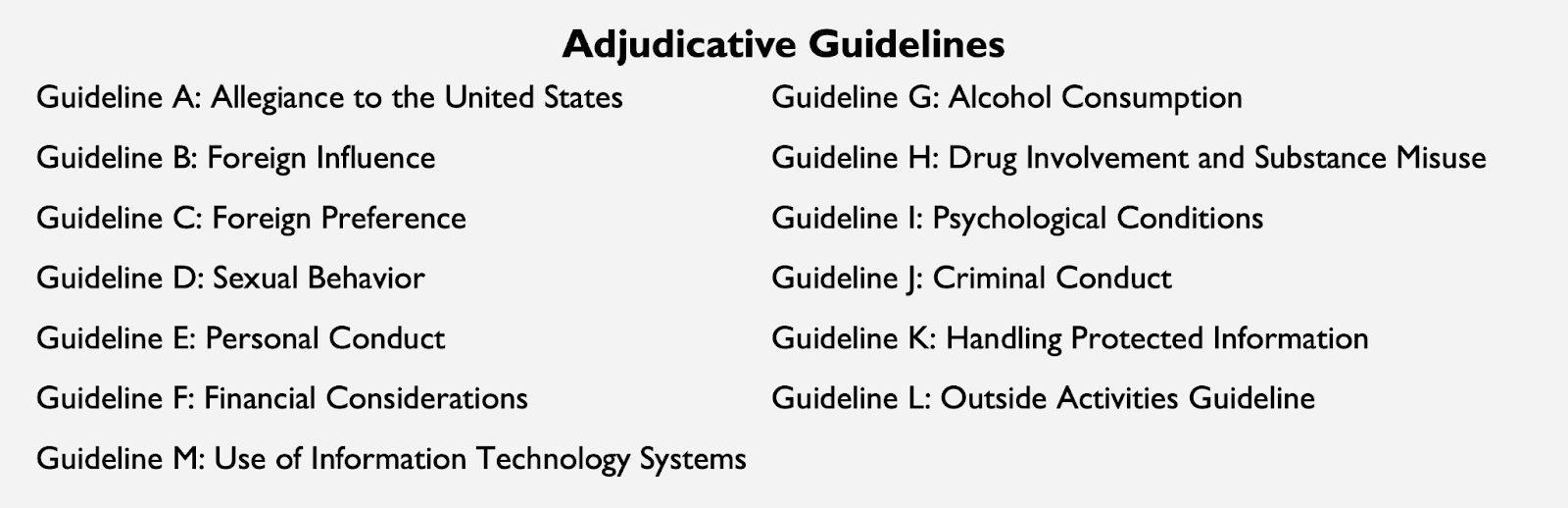
The following list highlights several areas of concern that most commonly cause clearance delays or denials.
Foreign ties—such as family, friends, property, or business interests overseas—can raise security concerns if they create the possibility of divided loyalty or make you vulnerable to pressure from a foreign government or group. Concern level depends partly on the country involved (e.g. whether that country actively targets US citizens for intelligence purposes or has a history of supporting terrorism).
Typical risk factors
- “Close and/or continuing contact” with foreign nationals, especially in countries of concern (China, Russia, Iran, Cuba)
- Financial or property interests abroad (foreign bank accounts, investments, or real estate)
- Receiving benefits, payments, or employment from a foreign government
- Immediate family members who are foreign citizens or residents
- Living with or being married to someone (regardless of citizenship status) who could create risk of foreign inducement, manipulation, or coercion
What can mitigate risk
- Relationships with foreign persons are low-risk, casual, and infrequent (i.e. “arms-length” business relationships), and unlikely to create divided loyalties
- Any sense of loyalty to foreign persons is minimal compared to strong US ties
- The individual promptly reports required foreign contacts or requests to their agency
- Foreign business, financial, or property interests are routine, low-value, and unlikely to be used for leverage
The clearance process asks for your “close and/or continuing foreign contacts”; seek advice on who counts and does not count as a foreign contact. As one of the linked articles notes, “many well-meaning security clearance applicants over-report their foreign contacts,” which can lead to substantial delays and can sometimes “rise to the level of an initial security clearance denial that takes time and expense to challenge.” If you’re uncertain who among your foreign contacts passes the threshold, consider talking to a security clearance lawyer, which could save you significant time (and even money, if you can thereby avoid an initial clearance denial). Anecdotally, people can interpret the foreign contact reporting requirements very differently, leading many to over-report.
A related but less common issue is foreign preference, which arises when someone takes actions suggesting they place another country’s interests above those of the US. Examples include applying for foreign citizenship, voting in a foreign election, or holding office in a foreign government. Simply having dual citizenship is not disqualifying on its own, but attempts to conceal it or to actively exercise foreign citizenship rights can raise concerns. Some agencies, particularly in the intelligence community, may require applicants to renounce foreign citizenship or surrender a foreign passport as a condition of employment.
Dishonesty, unwillingness to follow rules, or questionable judgment can “raise questions about an individual’s reliability, trustworthiness, and ability to protect classified or sensitive information.” Refusal or failure to comply with security processing (e.g. subject interview, medical or psychological evaluation, poly) or refusal to provide “full, frank, and truthful answers to lawful questions of investigators” will normally result in clearance denial.
Typical risk factors
- Lying or omitting relevant facts on the SF-86
- Refusal or failure to comply with security processing, such as completing a subject interview, medical or psychological evaluation, and/or a polygraph exam
- Providing false or misleading information to investigators, employers, or medical professionals involved in the process
- Patterns of dishonesty, disruptive or violent behavior, or repeated rule violations
- Misuse of government or employer time and resources
- Behavior that creates vulnerability to coercion or blackmail (e.g. concealing activities that could harm one’s reputation)
- Violating written agreements made with an employer as a condition of employment
- Association with people involved in criminal activity
What can mitigate risk
- Promptly correcting mistakes or omissions in good faith, before being confronted
- Refusal or omission was due to legal advice or misunderstanding, followed by full cooperation once clarified
- Behavior was minor, rare, or happened long ago and is unlikely to recur
- Acknowledging past behavior and showing evidence of counseling or corrective steps
- Taking steps to reduce vulnerability to coercion or blackmail
- Evidence is unsubstantiated or comes from unreliable sources
- Associations with people involved in crime were unknowing, have ended, or occur in circumstances that do not undermine trustworthiness
Financial problems can raise doubts about a person’s judgment, reliability, and trustworthiness: being financially overextended can increase the risk of obtaining money illegally, and serious financial distress may heighten risk for other issues, such as gambling, substance misuse, or alcohol abuse.
Typical risk factors
- Inability or unwillingness to pay debts (e.g. a history of late or missed payments, accounts in collections, or defaulted loans).
- Deceptive or illegal financial practices
- Consistent spending beyond one’s means, excessive indebtedness, or chronic late payments
- Failure to file or pay taxes as required, or filing fraudulent returns
- Unexplained wealth inconsistent with known income
- Gambling debts, borrowing to fund gambling, or concealing gambling-related losses
What can mitigate risk
- Financial problems happened a long time ago, were isolated, or are unlikely to recur
- Problems were caused by circumstances beyond your control (job loss, medical emergency, divorce, predatory lending, identity theft), and you acted responsibly in response
- Seeking help through legitimate financial counseling and showing clear progress in resolving issues
- Making a good-faith effort to repay debts or resolve them
- Providing documentation to dispute debts that aren’t legitimate
- Demonstrating that apparent “affluence” comes from legal income sources
- Resolving unpaid taxes
In a nutshell, file and pay your taxes on time, even if the federal or state governments owe you, and keep your short-term, revolving debt low. Strive for a clean credit report, as it’s one of the first items a Security Office will review.
Illegal drug use, the misuse of prescription or non-prescription drugs, or use of any substance in a way that impairs judgment or violates the law raises doubts about an individual’s reliability and trustworthiness. Ongoing misuse may signal deeper issues (e.g. addiction, disregard for regulations) and creates risk when combined with access to sensitive information.
Typical risk factors
- Any federally illegal drug use, including marijuana
- Misuse of prescription or non-prescription drugs
- Positive drug test for an illegal substance
- Illegal possession, cultivation, sale, or distribution of controlled substances
- Diagnosis of a substance use disorder by a qualified medical or mental health professional
- Failing to complete a prescribed drug treatment program
- Using drugs while holding a clearance or sensitive position
- Stating an intent to continue drug use or failing to commit to stopping
What can mitigate risk
- Drug use was isolated, happened a long time ago, or under circumstances unlikely to recur
- The individual acknowledges past misuse, shows evidence of recovery, and establishes a clear pattern of abstinence
- Steps have been taken to avoid relapse, such as disassociating from drug-using peers or avoiding prior environments
- Written commitment to abstain from future use
- Prescription drug misuse occurred during legitimate medical treatment and has since ended
- Successful completion of a recognized treatment or rehabilitation program, with evidence of ongoing recovery or aftercare
In short, avoid using illegal drugs, including drugs that are legal locally but illegal federally, such as marijuana in many US states. Whether drug use affects clearance eligibility depends on factors like the types of drugs, the frequency, recency, and circumstances of use. While experimentation during college with marijuana generally does not prevent you from getting a security clearance in the future, we recommend avoiding any illegal drugs if you are interested in working for the government later. The SF-86 reporting window for illegal drug use is seven years. But some questions ask whether you have ever engaged in certain activities, including voluntarily seeking counseling or treatment for drug use, or being advised or ordered to do so. These “ever” questions don’t automatically disqualify you but give investigators a fuller picture of your history and how you’ve addressed past issues.
Emotional, mental, or personality conditions can raise concerns if they impair judgment, reliability, or trustworthiness. A formal diagnosis is not required for adjudicators to consider this area, but they typically rely on evaluations from qualified mental health professionals. Importantly, counseling or treatment is not itself disqualifying; in fact, “seeking or receiving mental health care for personal wellness and recovery may contribute favorably to decisions about your eligibility.”
Typical risk factors
- Behavior that suggests poor judgment or instability (e.g. violence, self-harm, impulsivity, paranoia, or chronic dishonesty) not covered under other guidelines
- A professional opinion that a condition may impair judgment, stability, or reliability
- Voluntary or involuntary inpatient hospitalization for a psychological condition
- Failure to follow a prescribed treatment plan (e.g. not taking prescribed medication, skipping required counseling)
- Pathological gambling, especially if it leads to debt, concealment, or family conflict
What can mitigate risk
- The condition is well-controlled through treatment, with demonstrated compliance over time
- The individual voluntarily sought treatment, and the prognosis from a qualified professional was favorable
- A recent professional opinion finds the condition under control or in remission, with low likelihood of recurrence
- The condition was temporary, tied to a past situation that has been resolved
- There are no indications of a current problem
If you experience mental health challenges, do not delay treatment. Some people fear that if they seek support or treatment for a suspected or confirmed mental health problem, this will harm their chances of passing background checks down the road or threaten their current federal employment.
In addition to the commonly cited concern areas above, the other SEAD-4 risk areas are:
- Allegiance to the United States: Any activity suggesting support for the overthrow of the US government or association with extremist, violent, or terrorist groups
- Foreign Preference: Actions that demonstrate preference for a foreign country over the US
- Sexual Behavior: Patterns of criminal, coercive, or high-risk sexual behavior
- Criminal Conduct: A history or pattern of criminal behavior
- Handling Protected Information: Mishandling or unauthorized disclosure of classified material
- Outside Activities: Involvement in foreign or outside organizations that conflict with US interests or create divided loyalties
- Use of Information Technology: Misuse of government IT systems, unauthorized access, or improper handling of digital data
Security clearance tips
In addition to understanding the SEAD-4 risk factors and how to mitigate them, here are some tips for navigating the clearance process:
- Start early to gather relevant information (e.g. where you lived and traveled to, employers, your schools, foreign contacts) by reviewing the questions you’ll face. The 135+ page SF-86 can feel overwhelming, but this spreadsheet template can help you collect the right information early and save you headaches later. It’s often beneficial to begin recording this information now—while it’s relatively fresh—than delaying your clearance process later when it might be harder to access the relevant information.
- Be meticulous with the SF-86;don’t guess or leave gaps. To investigators, sloppiness, inconsistencies, or omissions could indicate carelessness or efforts to hide information.
- Look for “cheap” ways to get cleared: Student internships at national security agencies and even part-time work on a cleared project with a government contractor can be enough to secure sponsorship. Once you hold a clearance, it’s much easier to move into other cleared roles later.
- Register for the Selective Service by age 25 if you’re male (it’s required by law and employers check for this).
- Prepare for your interview: Know the kinds of questions you’ll get and practice providing honest and consistent answers. It often helps to review your SF-86 line-by-line before the interview, and to practice explaining any “red flag” areas beforehand out loud, as you would for a job interview. Your investigator may circle back to sensitive topics multiple times to test consistency, and they will directly confront you with any discrepancies between your form, records, and what others have reported.
- If in doubt, consult a security clearance lawyer: The bureaucracies that manage clearances and related processes across the federal government are complex, opaque, and heterogeneous, making them hard to navigate using only public/online information sources. As such, talking to people with first-hand knowledge can be very helpful; if you can afford to do so, we recommend talking to a lawyer specializing in federal background checks early in the process of pursuing a career in government service.
If you’re looking for further resources to better understand the clearance process and how to prepare, people we’ve advised have found this and this security clearance FAQ particularly helpful.
Specific paths to a security clearance
As discussed above, a security clearance can be a valuable professional asset. If you want to eventually work in the White House, Department of Defense, intelligence community, or other national security-related parts of government, you’ll often need one, and employers in these areas value applicants who already hold a clearance, since it saves them the time and money of sponsoring an investigation themselves.
However, you cannot apply for a security clearance on your own. A government agency or contractor must select you for work requiring access to classified information, then sponsor the investigation on your behalf.
In some cases, it may be worth taking an internship or job that is less aligned with your specific policy interests but enables you to get cleared, and then transitioning into another role later. If you’re a student or recent graduate, internships or fellowships in national security-relevant government agencies can be a great way to do this.
Some jobs and internships are much better clearance routes than others. The strongest options:
- explicitly accept applicants who do not already hold clearances,
- place all or most participants in work requiring classified access, and
- keep participants employed long enough for the clearance investigation to reach a final decision.
The opportunities below are ordered roughly by how direct and dependable they are as clearance sponsorship routes for people interested in AI and emerging technology policy (see more program details below). Their relevance for AI policy often depends on the specific projects you’d work on.
Please note that this list is not exhaustive; while we think it covers most of the best options out there, there may be some we missed. If you know of a program we should consider adding here, let us know.
Opportunity | Brief description | |
|---|---|---|
ARLIS Research for Intelligence & Security Challenges internship | Undergraduate and graduate students from technical or policy fields | Very high – i.e., clearance processing is a routine or explicit part of the program |
Technical and quantitatively oriented students | Very high | |
Graduate students | Very high | |
RAND Center on AI, Security, and Technology Fellowship and cleared RAND research roles | Researchers at several career stages | High; depends on the project and position |
Students and recent graduates interested in national security | Very high | |
Cleared positions at national laboratories, UARCs, FFRDCs, and government contractors | Technical candidates | High when sponsorship is explicit in the posting |
Government-placement fellowships such as the AAAS Science & Technology Policy Fellowships and the Horizon Fellowship | Candidates primarily seeking policy experience | Low to medium in general, but specific placements include sponsorship |
The Research for Intelligence & Security Challenges internship (RISC) is one of the best paths to a security clearance for current students.
RISC is a paid, ten-week, mostly virtual program run by the University of Maryland’s Applied Research Laboratory for Intelligence and Security. Multidisciplinary student teams work on problems submitted by the Department of War and intelligence community. Relevant projects may involve AI and machine learning, human-machine teaming, policy analysis, or program evaluation.
The program recruits undergraduate and graduate students from technical and nontechnical fields. All participants have the opportunity to be considered for a security clearance and future government employment. See detailed FAQs here.
MITRE operates federally funded research and development centers (FFRDCs) supporting the Department of War, the intelligence community, and other federal agencies. Not all MITRE internships confer a clearance; the most relevant option is the MITRE National Security Internship Program.
This multiyear program explicitly includes clearance sponsorship and serves as a pipeline into MITRE’s national security workforce. Participants work for government sponsors, receive mentoring, and can pursue learning tracks in AI, data science, and embedded security.
The program is likely to be most accessible to candidates with backgrounds in computer science, engineering, data science, cybersecurity, operations research, economics, or other quantitative fields. The work often focuses on implementation, acquisition, testing, systems engineering, and operational strategy.
The National Nuclear Security Administration Graduate Fellowship Program offers yearlong placements at NNSA headquarters, program offices, field offices, and national-security sites. It accepts graduate and PhD candidates from technical, policy, business, and project-management backgrounds.
Clearance processing is a standard part of the program: selected fellows begin the SF-86 process immediately after accepting an offer.
NNSA’s central mission is nuclear security, but relevant assignments may involve advanced computing, cybersecurity, technology assessment, research and development, acquisition, intelligence, or the application of AI to national-security missions. Prospective applicants can review the program’s eligibility and clearance requirements.
Internships and entry-level development programs at intelligence agencies offer some of the most direct routes to high-level clearances. The Intelligence Community’s student-program portal collects opportunities across participating agencies.
These programs can be especially relevant to people interested in:
- foreign AI capabilities and investment;
- military adoption of AI and autonomous systems;
- AI-enabled cyber operations;
- advanced semiconductor and computing supply chains; or
- foreign acquisition of sensitive US technology.
Potential routes include:
- CIA student programs
- NSA internships and student programs
- DIA internships
- NGA internships and student programs
- DHS Office of Intelligence and Analysis internships
Selected applicants must complete the security process required by the agency before receiving a final offer. The Intelligence Community says its clearance process takes an average of nine to twelve months, although timelines vary by agency and applicant. The CIA recommends applying six to twelve months before the desired start date.
For recent graduates, NSA’s permanent development programs may offer a particularly strong combination of technical work, classified access, and structured professional development. Relevant options include the Data Science Development Program, Intelligence Analysis Development Program, Computer Science Development Program, and several cybersecurity programs.
National labs, university-affiliated research centers, federally funded research and development centers, and defense contractors conduct substantial classified work on AI and national security.
Simply obtaining a job or internship at one of these institutions does not necessarily mean that you will receive a clearance. Many projects are entirely unclassified. Candidates should examine individual postings for language such as:
- “ability to obtain and maintain a security clearance”;
- “clearance will be required”;
- “anticipated Secret, Top Secret, L, or Q clearance”;
- “must obtain an interim clearance before starting”; or
- “the successful candidate will be submitted for a clearance.”
Relevant organizations include:
- MIT Lincoln Laboratory
- Johns Hopkins Applied Physics Laboratory
- Georgia Tech Research Institute
- The Aerospace Corporation
- Los Alamos National Laboratory
- Lawrence Livermore National Laboratory
- Sandia National Laboratories
- Pacific Northwest National Laboratory
- RAND
- Booz Allen Hamilton
Some of these organizations explicitly accept uncleared applicants and initiate clearance investigations on their behalf. For example, MIT Lincoln Laboratory requires employees to be eligible for a clearance, while current student and early-career postings at organizations such as Johns Hopkins APL and GTRI frequently state that selected candidates will undergo an investigation or must be able to obtain a clearance.
Longer appointments are generally preferable for obtaining a final clearance. A year-round internship, co-op, post-bachelor’s appointment, or full-time position gives the sponsor more reason and opportunity to see the process through than a short summer internship.
The RAND Center on AI, Security, and Technology Fellowship offers work on AI security, technology policy, and related national security questions.
US applicants must be able to obtain and maintain a government security clearance. RAND CAST also periodically advertises staff and other collaboration opportunities.
If clearance sponsorship is important for you, consider asking whether your anticipated research portfolio will require classified access and whether RAND expects to initiate an investigation.
Some fellowships place participants directly in federal agencies, and fellows may be sponsored for a clearance if their particular host office and position require classified access.
These fellowships are best understood as AI-policy opportunities that can sometimes produce a clearance, rather than efficient ways to seek one.
Horizon Fellowship
The Horizon Fellowship places emerging-technology specialists in executive branch agencies, congressional offices, national laboratories, and think tanks. Note that Emerging Tech Policy Careers is a project of the Horizon Institute for Public Service, which also runs the Horizon Fellowship.
Most placements don’t require classified access. Congressional and think tank placements will generally not require clearances, and only some executive branch positions do. Applicants do not need to be eligible for a clearance to participate in the fellowship.
When an executive branch host office requires classified access, the host office is responsible for sponsoring the fellow. Horizon provides fellows in clearance-requiring placements with access to a specialist attorney and can work with host offices on interim arrangements while the process is pending.
If you’re primarily interested in obtaining a clearance, you’ll likely have better odds through one of the programs above, though you can nevertheless express a preference for national-security executive branch placements in your Horizon Fellowship application and (if accepted) ask prospective host offices whether the position requires sponsorship. More information is available in the Horizon Fellowship applicant FAQ.
AAAS Science & Technology Policy Fellowships
The AAAS Science & Technology Policy Fellowships place scientists and engineers in federal offices for yearlong assignments (see eligibility details here). Some placements at agencies such as the Departments of Defense, Energy, Homeland Security, and State may require Secret or Top Secret access.
AAAS itself does not process or approve clearances; the requirement and process depend on the host office. Many placements require only a basic background check, and clearance processing can delay the start of an assignment or stipend.
As with the Horizon Fellowship, AAAS is a strong policy fellowship but not an especially efficient pathway to clearance. Finalists who are independently interested in cleared work can prioritize relevant agencies and ask during placement interviews what level of access each position requires. AAAS explains these arrangements in its program FAQ.
The same principle generally applies to other fellowships that place participants in government: clearance sponsorship depends on the particular office and position, and is handled by the host office.
Questions to ask before accepting a position
Don’t assume that any job or internship, even those listed above, provides a surefire route to a clearance. Before accepting an opportunity partly because of its clearance potential, clarify with the office or organization:
- Does this particular opportunity require a security clearance? If only sometimes or for certain projects, when would I learn whether I’d need one for the work?
- Will you initiate a new investigation for someone who does not already hold one?
- What clearance level will you request?
- When will I submit the SF-86?
- Can I begin unclassified work while the investigation proceeds?
- What happens if the investigation is not complete when the internship or fellowship ends?
- Can I continue part-time, renew the appointment, or convert to a full-time role?
- Will you maintain my sponsorship through final adjudication?
The final question is particularly important. An interim clearance may allow someone to begin classified work while the investigation continues, but it is not the same as a final eligibility determination. Remember that even if an organization sponsors a clearance investigation for you, this doesn’t guarantee you’ll pass. Sponsorship is necessary but not sufficient—you’ll have the best chance of securing a clearance if you also follow the best practices discussed here.
FAQ
Can I independently apply for a clearance?
No. Clearances are only granted when a relevant institution (e.g. federal agency, government contractor, or national security-related congressional committee) sponsors you for a specific position that requires access to classified information. Once you’re hired or selected, your employer will initiate the clearance process by submitting the necessary background investigation forms.
Are non-US citizens eligible for security clearances?
Only US citizens qualify for security clearances.Green card holders and other foreign nationals may still qualify for certain Public Trust or suitability positions that don’t involve access to classified information.
In rare cases, DOW may grant a Limited Access Authorization (LAA) to a non-citizen if their skills are uniquely required for a government contract and no cleared US citizen is available. LAAs allow access to information at the Secret level or below, are tied to a specific contract, and require a detailed justification and senior-level approvals. They do not make the holder eligible for broader classified access, and they are temporary by design.
Should I pursue roles just to get a clearance?
A security clearance can be a valuable professional asset, but how much you should weigh it depends on your career goals. If you want to eventually work in the White House, DOW, intelligence community, or other national security-related parts of government, you’ll usually need a clearance, and employers in these areas value applicants who already hold a clearance, since it saves them time and money on sponsorship.
Depending on your career interests, you might consider an internship or job that is less aligned with your policy interests but enables you to obtain a security clearance (and later transition more easily into more preferred roles). If you’re a student or recent graduate, internships in national security-relevant government agencies can be a great way to get a security clearance.
How long do clearances last?
Confidential clearances historically required reinvestigation every 15 years, Secret every 10 years, and Top Secret every 5 years. Today, most clearance holders are enrolled in Continuous Evaluation (CE), which conducts automated record checks year-round and requires SF-86 resubmission every 5 years regardless of level. Your clearance remains valid as long as you stay in a qualifying role and complete these periodic updates.
If you stop working in a cleared job, your clearance terminates but remains eligible for reinstatement for 24 months, provided your last investigation or CE enrollment date was within 5 years. After that window, you’ll likely need a new investigation when applying for clearance.
Does “strictness” vary by agency?
Yes. While eligibility criteria for all clearance levels are consistent across government, agencies often interpret them differently, and SAP positions may have additional requirements. Some Intelligence Community agencies (e.g. CIA, NSA, FBI) apply stricter interpretations of the National Security Adjudicative Guidelines, particularly for foreign contacts, substance misuse, and personal conduct, and require polygraph exams. These agencies often have little tolerance for issues that other departments might not regard as disqualifying. If you’re targeting these roles down the road, be especially mindful of potential clearance hurdles.
In contrast, civilian agencies like the Department of Health and Human Services or the Department of Agriculture typically apply more relaxed interpretations for collateral clearances—DCSA conducts equally thorough investigations, but these agencies generally give greater weight to mitigating factors when evaluating potentially disqualifying issues.
Will my security clearance transfer to another agency?
With certain exceptions, agencies must accept security clearances granted by other agencies (“security clearance reciprocity”). Reciprocity applies to the same clearance level, and your eligibility covers lower levels automatically. If your new role requires a higher level (e.g. moving from Secret to TS/SCI), you’ll need new vetting for that higher level.
Most reciprocity determinations now take about a day, down from ~65 days in 2020. Still, some transfers can be complex with significant barriers. Agencies often rely on different systems, which can slow verification. The gaining agency may also add steps (e.g. a polygraph, or updating an out-of-scope investigation). They should not deny reciprocity solely because of those additional steps, but they can delay final access until you complete them.
Some notes and exceptions:
- Reciprocity only applies to clearances that are final and unconditional. Interim clearances or those granted with a waiver, deviation, or condition usually won’t transfer between agencies.
- Reciprocity covers only your national-security eligibility. Agencies can and often do conduct separate suitability or fitness reviews, which are distinct processes and may extend timelines even if your clearance eligibility itself is accepted. These reviews assess general character and conduct for federal employment and apply to all federal jobs, not just those requiring clearance. That means you can hold a valid clearance but still face delays—or even be denied—if you don’t meet an agency’s employment suitability standards.
- For especially sensitive programs like Sensitive Compartmented Information (SCI) or Special Access Programs (SAPs), reciprocity means your underlying eligibility can transfer, but program-specific read-ins are separate decisions that require additional checks.
A security clearance lawyer can help navigate transfers between different federal agencies or contractors. Here are some relevant resources.
Should I report all drug use? What degree of drug use prohibits me from getting a clearance?
Yes, you should report all federally illegal drug use. Lying on the SF-86 is a federal crime and is usually treated worse than the omitted information if discovered (and often results in denial or loss of clearance). Beyond just the people you list as references, investigators can and do interview others who have known you (even as loose acquaintances) going back 7 or more years, and any inconsistencies in these interviews can provoke more intensive investigation and could result in clearance denial. Drug use reported on the SF-86 can’t be used as evidence against you in court.
Any current user of illegal drugs cannot be granted a clearance, and “current” can include use within a few months immediately before you apply. That doesn’t mean past drug use automatically disqualifies you. Adjudicators look at the type, frequency, recency, and circumstances of use, and whether it had negative effects (like legal, medical, or financial problems).
The security concern related to past drug use usually focuses more on applicants’ demonstrated willingness and ability to abstain from future drug involvement than on their past conduct. Prior experimentation with drugs (e.g. marijuana during college) is fairly common behavior, and clearances are often granted to applicants with past drug use if they can credibly show they no longer have nor intend to have any illegal involvement with drugs.
Here are some older rough benchmarks for how long applicants should typically be drug-free before concerns can be mitigated:
- At least 6 months: Occasional or experimental marijuana use with no aggravating circumstances.
- At least 1 year: Frequent marijuana use, or experimental use of another drug.
- At least 2 years: Regular marijuana use, or occasional use of another drug, with no dependence and a stable lifestyle since.
- At least 3 years: Frequent or regular use of any drug besides marijuana, or marijuana use showing psychological dependence, with stability in all other areas of life.
- At least 5 years: Minor involvement in trafficking or failure to complete treatment, with a stable and clean record since.
The forthcoming Personnel Vetting Questionnaire (expected to replace the SF-86 beginning around 2026) reflects an evolving approach toward past cannabis use by separating it from other illegal drugs in the questioning and modifying the reporting requirements.
Further resources
- Security Clearance Process: Answers to Frequently Asked Questions, Congressional Research Service (2023)
- Templates for Preparing for your Security Clearance Application
- Before You Apply: Understanding Government Background Checks, Yale Law School










Notes
-
Public Trust positions require different background investigation forms depending on the risk level. Low-risk roles use the SF-85, while moderate- and high-risk Public Trust roles use the SF-85P. Both forms are significantly less intensive than the SF-86, which is required for security clearances.
↩︎ -
Agencies distinguish between a counterintelligence (CI) polygraph and a full-scope polygraph. A CI polygraph is narrower, focusing on risks such as espionage, sabotage, terrorism, unauthorized disclosure of classified information, and improper foreign contacts. A full-scope (or “lifestyle”) polygraph includes all CI topics but also probes into personal conduct such as drug or alcohol use, criminal activity, sexual behavior, and financial integrity.
↩︎ -
The PDF version of the SF-86 is a 136-page questionnaire, but all federal agencies now require applicants to use the web-based version (eApp), which dynamically tailors the form to the applicant’s circumstances (typically resulting in a much shorter completed version). A new form, the Personnel Vetting Questionnaire (PVQ), has been approved and is expected to be implemented in 2026. The PVQ will replace the current eApp versions of the SF85, SF85P, SF85P-S, and SF86.
↩︎ -
Most agencies issue a Statement of Reasons (SOR) together with a Letter of Intent to Deny Clearance, while intelligence agencies typically issue the SOR along with the formal Denial Letter itself. In either case, the follow-up process for appealing or submitting additional mitigating information is essentially the same.
↩︎ -
The Department of Energy (DOE) uses different security clearance levels, known as L (roughly equivalent to Secret) and Q (roughly equivalent to Top Secret). DOE information and materials may be classified as Confidential, Secret, or Top Secret, and can also include categories such as Restricted Data (RD), Formerly Restricted Data (FRD), and Sensitive Nuclear Material (SNM).
↩︎ -
IC agencies generally extend conditional offers of employment that depend on the applicant completing a full TS/SCI clearance process. Even candidates who already hold an active Secret or Top Secret clearance must undergo new investigation and adjudication before starting work. Unlike many other federal agencies, the IC rarely grants interim clearances or accepts reciprocity from previous investigations, which often leads to longer hiring timelines.
↩︎ -
UARCs are nonprofit, university-affiliated research centers that provide engineering and technology capabilities to DOW. As of FY 2021, 14 universities had a UARC.
↩︎ -
As of 2019, roughly 1.35 million federal contractor personnel held a security clearance (pg. 7).
↩︎ -
The approximately 72 federal Security Offices and their adjudicators know their agencies need talent, and understand that newcomers might not have been familiar ahead of time with the rules governing access to sensitive information.
↩︎ -
Historically, some agencies required applicants to renounce foreign citizenship or physically surrender foreign passports as a condition of employment. The Director of National Intelligence ended this practice for intelligence agencies in 2008, and most other agencies followed suit by 2017. Today, investigators may ask applicants whether they would be willing to renounce a foreign citizenship, but they rarely request or advise doing so in practice. In fact, renunciation can be counterproductive—it may attract attention from foreign intelligence services and is generally considered poor security practice.
↩︎ -
“As required” means doing so by the legally mandated deadlines—for example, paying federal income taxes by April 15 and filing by April 15 or October 15 if you’ve received an extension. Filing and/or paying prior-year taxes just days before completing an SF-86 is likely to be viewed as a problem during the clearance process.
↩︎ -
As of August 2025, President Trump has indicated interest in reclassifying marijuana from a Schedule I to a Schedule III drug. Such a change would likely not legalize recreational use at the federal level, though it could expand pathways for certain medical uses. For more, see this article.
↩︎ -
See the SEAD-4 for more in-depth information on both the risk and mitigating factors for each of these concern areas.
↩︎ -
We have not created the linked spreadsheet template and don’t take responsibility for its accuracy.
↩︎ -
Anecdotally, clearance-related problems can cause severe distress for some people, especially when they lack good information about their situation, get stuck in a months- or years-long bureaucratic limbo, or lack a clear sense of their options going forward. Speaking with a lawyer can help you avoid these issues upfront, but it can also help you resolve these issues after they arise.
↩︎ -
Keep in mind that clearances are tied to the role you’re in, not to you. Clearances terminate when you leave the role it was tied to, though your eligibility can usually be reinstated without a new investigation if 1) fewer than 24 months have passed, 2) your underlying investigation is less than five years old, and 3) no new disqualifying information has surfaced. Job postings often ask for an “active” clearance, meaning you are currently in a cleared role, but many employers will accept candidates whose eligibility is merely “current”, meaning within that 24-month window.
↩︎ -
Programs vary in how they handle clearance timing. Some start your paperwork months before your start date so the investigation is well underway when you arrive. Others rely on an interim clearance (a temporary determination that lets you access classified information) while the full investigation continues. Interims are enough to do the work, but they are not final clearances: they do not cover SCI, they can be withdrawn, and if you leave before adjudication finishes you may leave with nothing on record. When evaluating a program, it’s worth figuring out whether participants typically leave with a final clearance or only an interim.
↩︎ -
“Very high” means clearance processing is a routine or explicit part of the program. “Depends on the project” means the organization conducts cleared work but not every participant will need or receive a clearance. “Depends on the placement” means only fellows placed into particular clearance-requiring government positions are likely to be sponsored.
↩︎ -
Technically there is no clearance status of “inactive,” but it is a commonly used term to describe a state where a terminated clearance can be reactivated without a new investigation.
↩︎ -
Federal employment suitability and fitness is governed by Title 5 Code of Federal Regulations, Part 731, specifically 731.202. However, agencies can create job-specific eligibility criteria. The Department of Homeland Security is known for especially strict suitability checks, with applicants reporting that foreign family ties or financial issues can cause delays during the suitability check process.
↩︎ -
Note that these resources may contain outdated information; we recommend checking official government sources and consulting with a current security clearance attorney for more comprehensive and up-to-date information.
↩︎ -
If investigators uncover something you denied, they will confront you during your subject interview. At that point, admitting it doesn’t erase the fact that you only told the truth after being caught, which is documented as intentional dishonesty rather than oversight. This damages your credibility, often triggering deeper scrutiny and creating a spiral of mistrust.
↩︎ -
The SF-86 states (on Illegal Use of Drugs): “We note, with reference to this section, that neither your truthful responses nor information derived from your responses to this section will be used as evidence against you in a subsequent criminal proceeding….. As to this particular section, this applies whether or not you are currently employed by the Federal government.”
↩︎ -
The Adjudicative Desk Reference uses the following definitions for levels of drug use:
↩︎
• Experimental Use: Initial use for a maximum of six times, or more intensive use for a maximum of one month.
• Occasional Use: Once a month or less.
• Frequent Use: Once a week or less, but more than once a month.
• Regular or Habitual Use: More than once a week. -
These modifications create a mixed impact that is potentially more lenient for some applicants while introducing new disclosure requirements for others. See this article for a more in-depth analysis.
↩︎