Department of State (DOS)
State oversees US foreign policy, negotiating treaties, managing diplomatic missions, and representing the US in international bodies. In this capacity, State contributes to technology policy, which is becoming increasingly important in diplomacy.
Overview
The Department of State (“State” or DOS) conducts US foreign policy to promote US security, prosperity, and democratic values. It negotiates treaties, manages diplomatic missions, issues passports and visas, and represents the US in international organizations like the UN and NATO.
State underwent a major reorganization in 2025 that consolidated, eliminated, or realigned numerous bureaus and offices. Several entities that had led technology and biosecurity work were merged into successor bureaus, and many remaining USAID programs and functions were realigned to State. The structure described below reflects the current department; see State’s June 2026 organizational chart.
State contributes to technology policy, which is becoming increasingly important in diplomacy. Its Bureau of Cyberspace and Digital Policy (CDP) leads diplomacy on critical and emerging technologies including AI, quantum, biotechnology, and telecommunications. Its Bureau of Emerging Threats, established in March 2026, comprises offices covering cybersecurity, critical infrastructure security, space security, threat assessment, and disruptive technologies including AI and quantum.
On AI, State runs Pax Silica, an initiative launched in December 2025 that convenes partner economies around supply chains spanning critical minerals, energy inputs, semiconductors, advanced manufacturing, and AI infrastructure; a second summit was held in June 2026. Under the American AI Exports Program, established by the administration’s AI Action Plan, the Secretary of State chairs the Economic Diplomacy Action Group, which coordinates federal financing tools in support of selected AI export packages.
State’s biosecurity and biodefense work includes leading US participation in the Biological Weapons Convention (BWC) and administering US global health foreign assistance through the Bureau of Global Health Security and Diplomacy. In September 2025, the US announced an effort to develop an AI-enabled verification system for the BWC, which State has since raised at BWC meetings in Geneva. US global health assistance is guided by the September 2025 America First Global Health Strategy, which sets out multi-year bilateral agreements with recipient countries.
Background on State
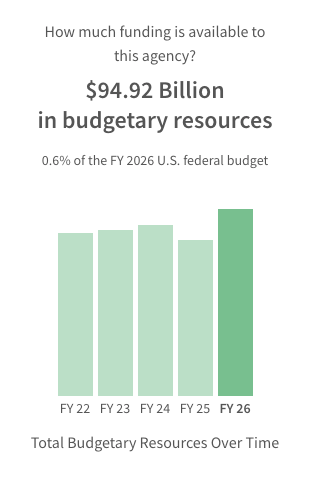
Source: USASpending
- Government context: the Department of State is the oldest of 15 executive departments in the US government; the Secretary is a member of the US president’s cabinet and the National Security Council
- Main activities: oversees foreign policy and relations with other nations; negotiates treaties and international agreements; runs US missions (embassies and consulates) abroad; represents the US in international fora (UN, NATO, etc.); issues passports and visas; administers US foreign assistance.
- Budget: small compared to other executive departments ($94 billion in FY 2026)
- Staff: ~78,000 employees; middling for executive departments (by comparison: DOW has ~748,000 civilian staff; DOJ has ~115,000; Commerce has ~47,000)
- Brief history: founded in 1789 as the first of three departments (alongside War and Treasury); initially named the “Department of Foreign Affairs” in July 1789 but Congress decided there was not enough work to set up a Department of Home Affairs, so it renamed it the “Department of State” and gave it many domestic responsibilities (such as running the census, approving patents, and minting currency—responsibilities largely passed on to other departments over the next two centuries); underwent some significant reorganizations in the 20th century, including the absorption but not full integration of the US Agency for International Development (USAID)
Organizational structure

Source: State Department.
The State Department is headed by the Secretary of State, who is appointed by the President and confirmed by the Senate. The Secretary is supported by two deputy-secretary positions: the Deputy Secretary of State and the Deputy Secretary of State for Management and Resources. Both serve as principal advisers to the Secretary; the Deputy Secretary for Management and Resources has a particular focus on management, planning, evaluation, and resource allocation. Several staff offices and bureaus also report directly to the Secretary or deputy secretaries rather than through an under secretary, as shown in the Department’s organizational chart.
Most of State’s headquarters bureaus and offices are grouped under six under secretaries:
- Political Affairs (P): coordinates regional and bilateral foreign policy. P oversees six regional bureaus—African Affairs (AF), East Asian and Pacific Affairs (EAP), European and Eurasian Affairs (EUR), Near Eastern Affairs (NEA), South and Central Asian Affairs (SCA), and Western Hemisphere Affairs (WHA)—as well as the Bureau of International Organization Affairs (IO), which coordinates policy toward the UN and other multilateral organizations.
- Economic Affairs (E): leads economic and commercial diplomacy and work involving energy, critical supply chains, environmental and scientific affairs, and digital and emerging technologies.
- Arms Control and International Security (T): oversees arms control, nonproliferation, emerging security threats, counterterrorism, security assistance, and political-military affairs.
- Public Diplomacy and Public Affairs (R): oversees State’s public-diplomacy strategy, communications, and international educational and cultural exchanges.
- Management (M): oversees many of the systems and services that support State’s domestic and overseas operations.
- Foreign Assistance, Humanitarian Affairs, and Religious Freedom (F): oversees foreign-assistance policy and programs and several related humanitarian, global-health, migration, human-rights, and religious-freedom portfolios.
Offices of the Under Secretaries are referred to by a letter (e.g. “P”, “E”, etc.), which does not always correspond to the name of the office. The letter is used to refer to both the office and the Under Secretary themselves; thus, Public Diplomacy and Public Affairs, including all the bureaus beneath it, and the individual who is Under Secretary are all are referred to as “R”. They are also often referred to as “families” (e.g. the “T family”). See the footnote for other State lingo.
Political Affairs (P) is often considered the most powerful and prestigious. The Under Secretary of Political Affairs is the 4th most senior officer at State (after the Secretary “S”, the Deputy Secretary “D”, and the Deputy Secretary for Management and Resources “D-MR”). P leads on bilateral and multilateral relations, including oversight of all embassies and consulates abroad. Each of its bureaus contains country-level offices, often referred to as “desks” or “houses” (e.g. the “China house”).
Most bureaus under Political Affairs are regional bureaus, responsible for policy toward particular countries and geographic regions and for supporting US embassies and other overseas missions. Most bureaus under the other under secretaries are functional bureaus, responsible for subjects that cut across geographic boundaries. Cross-cutting issues therefore generally require coordination among functional bureaus, relevant regional bureaus, and US missions abroad. For example, AI and biotechnology issues may involve CDP and other E-family offices, ET and ACN in the T family, GHSD in the F family, DT in the M family, and the regional bureaus responsible for relations with the countries concerned.
The power balance between regional and functional bureaus within State has shifted over time; when it comes to technology-related questions with a regional component (which most of them have), it’s often unclear whether the relevant functional or regional bureau(s) will be more influential—but regional bureaus are typically more influential and have final say in matters affecting their country domains.
Until 2025, the US Agency for International Development (USAID) operated as a separate agency whose work was closely coordinated with the Department of State. As part of the 2025 foreign-assistance reorganization, USAID was eliminated and State assumed responsibility for remaining foreign-assistance programs, functions, and active awards previously administered by USAID.
Workforce
State employs four major categories of full-time staff:
- Foreign Service Officers (FSOs): There are about 14,000 FSOs; if you’re interested in a diplomatic career, see this career guide. The Foreign Service is divided into two categories: “generalists” and “specialists.” Generalists are people you typically think of as diplomats, rising through the ranks to potentially become ambassadors over 30-year careers (though many ambassador positions are filled through political appointments). FSOs are hired through a competitive examination process. Once selected, they tend to serve 3-year terms in different countries, often—though not always—returning for a DC-based term after every two terms abroad. There are five different tracks for generalist FSOs, with the political and public diplomacy tracks tending to be the most competitive. Because they move around so much between both geographies and issue areas, FSOs are often seen as strong generalists, rather than experts in any one area.
- Civil service employees: Different from FSOs, civil servants are hired through hiring notices on USAJOBS and have a fixed fob description tied to a single office. They don’t tend to serve abroad and they often serve longer in their positions than the 3 years of an FSO’s rotation. Civil servants are often recruited for their specific subject-matter expertise, while many have generalist backgrounds. There are about 12,000 civil servants, most of whom serve in Washington DC.
- Political appointees: Like all federal departments, State’s senior leadership tends to comprise officials appointed by the presidential administration. The number of political appointees has increased over time.
- Locally employed staff (formerly, Foreign Service National): Embassies and consulates employ in-country staff to support programming and logistics (e.g. translators, event staff, drivers). Locally employed staff make up the bulk of the State Department’s workforce at almost 50,000 people. They are often of the same nationality as the country in which they serve.
In addition, there are also many contractors, consultants, and fellows working at or with State.
Department of State and AI policy
Parts of State have worked on technology policy for decades, including the Office of the Science & Technology Advisor to the Secretary (STAS). In recent years, State has been restructured with the creation of two offices focusing on emerging technology and digital policy: the Bureau of Cyberspace and Digital Policy (CDP) and the Office of the Special Envoy for Critical and Emerging Technology (S/TECH). See also State’s (partly outdated) website laying out its approach and actions on AI policy.
State’s work on AI policy includes international negotiations and coordination on AI, including preparing for and participating in international summits. This has included work with OECD on the Global Partnership on AI (GPAI) and the Responsible AI in the Military Domain Summit (REAM). AI has become an increasingly significant area of diplomatic engagement, including in domains of human rights, scientific research, and global security.
Major recent AI-related developments at State
- July 2026: State hosts the inaugural meeting of the Economic Diplomacy Action Group. Chaired by the Secretary of State, the group coordinates federal financing and economic-diplomacy tools, including support for AI exports and supply-chain initiatives such as Pax Silica.
- June 2026: State hosts the second Pax Silica Summit in Washington, D.C. Ten additional partners signed the Pax Silica Declaration, increasing the initiative to 24 signatories. Participants also issued a Joint Statement on AI Opportunity, setting out shared positions on AI innovation and the supply chains supporting AI development and deployment.
- March 2026: State establishes the Bureau of Emerging Threats to counter the weaponization of AI, cyber, and space technologies by foreign adversaries.
- February 2026: The US and India announce the US-India AI Opportunity Partnership, a bilateral initiative focused on AI adoption, infrastructure, investment, and related technology cooperation.
- December 2025: State launches Pax Silica, an 11-country international coalition aimed at securing the global AI supply chain and reducing reliance on strategic competitors.
- July 2025: The White House releases America’s AI Action Plan and an executive order establishing the American AI Exports Program. The order assigns State responsibility for coordinating a federal strategy to promote US AI exports and align diplomatic and federal financing support for selected full-stack AI export packages.
- January 2025: President Trump revokes President Biden’s 2023 executive order on AI. The earlier order had assigned State responsibilities related to AI-relevant immigration pathways, international development, research coordination, and diplomatic engagement.
- November 2024: State and the Department of Commerce launch the International Network of AI Safety Institutes at the inaugural convening in San Francisco. The convening aimed to address three high-priority topics that would benefit from international coordination: (1) managing risks from synthetic content, (2) testing foundation models, and (3) conducting risk assessments for advanced AI systems.
- September 2024: State released the Compliance Plan for OMB Memorandum M-24-10, outlining the Department’s actions to strengthen AI governance, advance responsible AI innovation, and manage the risks associated with AI use.
- September 2024: State, alongside several other federal agencies, announced the new Global AI Research Agenda and AI in Global Development Playbook. See the research agenda webpage to learn more.
- September 2024: Secretary of State Blinken launched the Partnership for Global Inclusivity on AI (PGIAI), aiming to “to unlock AI’s potential as a powerful tool for sustainable development and improved quality of life in developing countries.”
- July 2024: State published a Risk Management Profile for AI and Human Rights “as a practical guide…to design, develop, deploy, use, and govern AI in a manner consistent with respect for international human rights.”
- May 2024: State published the US International Cyberspace and Digital Policy Strategy, which includes several AI-related activities.
- November 2023: State released its AI Enterprise Strategy, laying out how the Department would incorporate generative AI into its daily operations; State has also published its internal use of AI systems.
- October 2023: The Biden Administration’s October 2023 Executive Order on AI (EO) requires State to act on several AI-related questions. For example, the EO tasks State to streamline visa processing of applicants with AI-relevant skills, create a program to identify and recruit talent from overseas, create an AI in Global Development Playbook to adapt NIST’s standards to international contexts, and to develop a research agenda on AI.
- February 2023: State announced the Political Declaration on Responsible Military Use of AI and Autonomy, a normative framework addressing the use of these capabilities in the military domain. The declaration was subsequently endorsed by over 55 states.
State offices working on AI policy
There are several State offices and components relevant to AI policy and the Department’s use of AI, including the following. This list is not necessarily comprehensive. State’s external AI diplomacy is concentrated primarily within the economic-affairs and international-security organizations, while the Department’s internal adoption and governance of AI sit largely within its management organization.
- Office of the Secretary of State (S): leads the Department and determines strategic direction for its bureaus
- Policy Planning Staff (S/P): State’s in-house think tank, providing policy analysis for the Secretary; in recent years, S/P has become a central director of strategy within State
- Office of the Deputy Secretary of State (D): principal advisor to the Secretary and oversees Department operations and implementation
- Under Secretary for Economic Affairs (E): leads State’s economic and commercial diplomacy. Its AI-related work includes diplomacy on critical and emerging technologies, promoting US AI exports, developing international technology partnerships, and strengthening the supply chains and infrastructure that support AI development and deployment. The organization houses two bureaus particularly relevant to AI policy.
- Bureau of Cyberspace and Digital Policy (CDP): State’s principal bureau for international policy involving AI and other digital and emerging technologies. CDP leads diplomatic engagement with foreign governments, international organizations, industry, and other stakeholders on issues including AI, telecommunications, quantum technology, biotechnology, digital infrastructure, and cybersecurity. CDP components relevant to AI include:
- Office of Emerging and Critical Technology Policy (ECTP): develops and coordinates foreign policy involving technologies such as AI, biotechnology, robotics, and quantum technology.
- Office of Bilateral and Multilateral Affairs (BMA): leads bilateral and multilateral diplomacy on digital and telecommunications issues, including engagement with international organizations. Its work can include AI policy coordination, international standards, and technology partnerships, although its portfolio extends beyond AI.
- Science and Technology Advisor to the Secretary (STAS): provides science and technology expertise within the Department. STAS is now housed within CDP rather than operating as a standalone office reporting directly to the Secretary.
- Bureau of Economic, Energy, and Business Affairs (EEB): contributes to the economic and commercial components of State’s AI work, including AI exports, critical-mineral and semiconductor supply chains, energy and infrastructure, investment, and commercial engagement with foreign governments. EEB contributes to initiatives such as Pax Silica and State’s work under the American AI Exports Program.
- Bureau of Cyberspace and Digital Policy (CDP): State’s principal bureau for international policy involving AI and other digital and emerging technologies. CDP leads diplomatic engagement with foreign governments, international organizations, industry, and other stakeholders on issues including AI, telecommunications, quantum technology, biotechnology, digital infrastructure, and cybersecurity. CDP components relevant to AI include:
- Under Secretary for Arms Control and International Security (T): handles nonproliferation and arms control as well as defense relations, arms transfers, and security assistance.
- Bureau of Emerging Threats (ET): addresses national-security challenges involving emerging and disruptive technologies. Its portfolio includes risks associated with AI and quantum technology, as well as cybersecurity, critical infrastructure, space security, and the assessment of new and evolving threats. The bureau also participates in bilateral security cooperation involving the use of AI for cybersecurity.
- Bureau of Arms Control and Nonproliferation (ACN): leads diplomatic and policy work on arms control, weapons of mass destruction, nonproliferation, and related advanced technologies. Its stated portfolio includes assessing the effects of AI and other emerging technologies on weapons of mass destruction, counterproliferation, arms control, and international security. ACN also manages the Political Declaration on Responsible Military Use of Artificial Intelligence and Autonomy, a nonbinding framework for responsible state behavior involving military AI.
- Office of Conventional Dual-Use Technology Controls (CDT): leads efforts to prevent the proliferation of destabilizing conventional weapons and advanced technologies, including through interdiction and by leading US participation in the Wassenaar Arrangement. CDT also leads on export controls to protect the use of dual-use goods, including semiconductors and quantum technologies, and prevent their use in ways that harm US national security or abuse human rights.
- Office of Countering Technological Competition (CTC): develops foreign policy to protect US critical technologies and to counter competitive powers.
- Export Controls and Border Security (EXBS): works to strengthen the operational capabilities of partner countries to protect US critical technologies and dual-use components from diversion and misuse.
- International Security Advisory Board (ISAB): provides independent, expert insight on all aspects of arms control, disarmament, nonproliferation, outer space, critical infrastructure, cybersecurity, the national security aspects of emerging technologies, international security, and related aspects of public diplomacy; e.g. ISAB wrote reports on new and emerging security challenges and the impact of AI on arms control, nonproliferation, and verification.
- Under Secretary for Management (M): State’s management organization, which oversees the Department’s internal technology systems and enterprise use of AI.
- Bureau of Diplomatic Technology (DT): manages much of State’s information technology, data infrastructure, cybersecurity, and digital modernization. Its AI responsibilities relate primarily to the Department’s own development, procurement, governance, and use of AI rather than international AI diplomacy.
- Center for Analytics (CfA): develops and implements data, analytics, and AI capabilities across the Department. Its director also serves as State’s Chief Data and AI Officer, who coordinates enterprise AI strategy, governance, and implementation. The Center maintains State’s public AI use-case inventory and supports implementation of the Department’s Enterprise Data and Artificial Intelligence Strategy.
- Bureau of Diplomatic Technology (DT): manages much of State’s information technology, data infrastructure, cybersecurity, and digital modernization. Its AI responsibilities relate primarily to the Department’s own development, procurement, governance, and use of AI rather than international AI diplomacy.
- Under Secretary for Foreign Assistance, Humanitarian Affairs, and Religious Freedom (F): oversees State’s foreign-assistance policy and programs, managing more than $50 billion in annual appropriated funding and the grant-making machinery that absorbed most former USAID functions in 2025. F is less a technology-policy shop than the channel through which technology-related assistance is designed, funded, and evaluated. F has also worked with the Under Secretary for Economic Affairs on the intersection of foreign assistance, innovative financing, and commercial diplomacy, including where AI investment and supply-chain initiatives touch recipient countries.
- Bureau of Democracy, Human Rights, and Labor (DRL): contributes where AI intersects with digital threats, online civic activity, and the security of civil-society organizations and independent media. For example, DRL’s 2026 Global Digital Threat Lab initiative identifies AI as enabling more efficient cyberattacks and lowering barriers for malicious actors.
- Regional bureaus and overseas missions: State’s regional bureaus and US embassies and consulates work with functional bureaus to conduct bilateral and regional AI diplomacy. Their roles can include negotiating technology partnerships, identifying local infrastructure and investment needs, administering assistance, and coordinating with foreign governments and businesses. Recent examples include regional work on the US-India AI Opportunity Partnership, an Edge AI package for the Indo-Pacific and the US-ASEAN AI Ministerial. Which regional bureau is most relevant depends on the country or region involved.
Department of State and biosecurity policy
State contributes to biosecurity and biodefense primarily through international diplomacy, arms control and nonproliferation, foreign assistance, and coordination of the international aspects of biological-incident preparedness and response. Its role is principally international; other departments, particularly the Departments of Health and Human Services and Homeland Security, lead most domestic public-health preparedness and emergency-response functions.
Its key activities in these area include:
- International coordination, nonproliferation, and arms control: State leads US diplomatic engagement on biological weapons and other international-security issues involving biological threats. Within the Bureau of Arms Control and Nonproliferation, the Office of Chemical and Biological Convention Affairs manages US interagency work on the Biological Weapons Convention (BWC) and Chemical Weapons Convention (CWC). State works with foreign governments and international organizations to strengthen implementation of these agreements, address suspected violations, and reinforce international norms against biological weapons.
- Bio-related international agreements: International Health Regulations (IHR), the Biological Weapons Convention (BWC), and the Chemical Weapons Convention (CWC), among others.
- Bio-related multilateral institutions: The World Organization for Animal Health (WOAH), the UN Office for Disaster Risk Reduction (UNDRR), and the UN’s Food and Agriculture Organization (FAO), among others.
- Global-health diplomacy and foreign assistance: The Bureau of Global Health Security and Diplomacy leads and coordinates State’s work on global health security and administers the President’s Emergency Plan for AIDS Relief (PEPFAR). State’s regional bureaus and overseas missions also work with partner governments on infectious-disease surveillance, health-system capacity, medical supply chains, and preparedness and response capabilities. The United States completed its withdrawal from the World Health Organization (WHO) in January 2026; State’s current global-health framework emphasizes bilateral agreements and other partnerships.
- Interagency coordination, domestic preparedness, and technology policy: State represents the international and diplomatic dimensions of government-wide biodefense planning. Its roles include working with partner countries on surveillance and reporting; strengthening laboratory biosafety and biosecurity; supporting responsible biological research; addressing biological-weapons threats; improving international preparedness; and coordinating the international response to major biological incidents. State also supports domestic interagency work where foreign policy, international travel, supply chains, or overseas response capabilities are relevant.
In 2022, the White House published the government-wide National Biodefense Strategy and Implementation Plan. The strategy assigns State lead or supporting roles across international surveillance, global-health capacity building, laboratory biosafety and biosecurity, biological-weapons deterrence, medical supply chains, preparedness, response, and recovery.
-
- GOAL 1: Enable risk awareness and detection to inform decision-making across the biodefense enterprise
- 1.1.1. Detection and Reporting of Biological Threats (Lead)
- 1.1.2. Biological Threat Sequencing and Analytical Data Sharing (Support)
- 1.1.3. Data Integration for Early Warning (Support)
- 1.1.4. Biological Threat Assessment and Characterization Capabilities (Support)
- 1.2. Additional Actions (Lead)
- GOAL 2: Ensure biodefense enterprise capabilities to prevent bio incidents.
- 2.1.1. Strengthen Country Capacities (Lead)
- 2.1.2. Establish and Maintain Sustainable Global Financing for Health Security and Pandemic Preparedness (Lead)
- 2.2.1. Promote Safe and Secure Biological Laboratories and Practices (Lead)
- 2.2.2. Strengthen Responsible Conduct for Biological Research (Lead)
- 2.2.3. Accelerate biosafety and biosecurity innovation (Support)
- 2.2.4. Deter Biological Weapons (Lead)
- 2.2.5 Reduce Zoonotic Pathogen Spillover (Lead)
- GOAL 3: Ensure biodefense enterprise preparedness to reduce the impacts of bioincidents.
- 3.2.3. Rapid, Low Cost, Point-of-Need Tests (Support)
- 3.3.1. PPE Capacity (Support)
- 3.3.2. PPE Innovation (Support)
- 3.4.4. Vaccine Administration and Allocation (Support)
- 3.5.3. Controlling Counterproductive Responses to Infection (Support)
- 3.6. Additional Actions (Support)
- GOAL 4: Rapidly respond to limit the impacts of bioincidents.
- 4.1.1. Effective Response to Mitigate Biological Incidents (Support)
- GOAL 1: Enable risk awareness and detection to inform decision-making across the biodefense enterprise
Major recent biosecurity-related developments at State
State’s role in biosecurity evolved over the years, beginning with its involvement in the Cooperative Threat Reduction (CTR) programs initiated after the dissolution of the Soviet Union. Initially, these efforts focused on dismantling nuclear, chemical, and biological weapons and preventing the proliferation of related expertise. The Department’s responsibilities expanded in 2006 with the launch of the Biosecurity Engagement Program (BEP), which aimed to enhance global biosecurity by improving the physical security of pathogens, upgrading laboratory biosafety, and strengthening disease surveillance in key regions such as South Asia and the Middle East. State also plays a coordinating role in international pandemic preparedness, such as during the Ebola epidemic in West Africa.
During the COVID-19 pandemic, State focused on protecting US citizens abroad and supporting global health initiatives. The Department coordinated a large-scale effort to repatriate over 100,000 Americans in 137 countries. It also provided updated Travel Advisories and alerts to keep US travelers informed of the situation overseas. Additionally, State played a role in the global vaccination effort, collaborating with COVAX, the African Vaccine Acquisition Trust, and other organizations to donate over 687 million vaccine doses to countries around the world.
- July 2026: State and HHS release a joint statement supporting the new US Government Policy for Stopping High-Risk Life Sciences Research. The policy prohibits federal support for dangerous gain-of-function research, establishes additional review for other high-risk life-sciences research, and restricts funding for research conducted in countries or institutions without adequate safety, security, and oversight standards. It implements President Trump’s earlier executive order on improving the safety and security of biological research.
- April 2026: State reports that it has signed 30 bilateral global-health memoranda of understanding (MOUs) under the America First Global Health Strategy. These multiyear agreements set out US and partner-country commitments for health programs, financing, commodities, workforce support, data systems, and longer-term transitions toward greater partner-country financing.
- December 2025: State hosts a side event at the Biological Weapons Convention Meeting of States Parties examining how AI and other technologies could support BWC implementation, verification, and assurance.
- September 2025: State releases the America First Global Health Strategy, which becomes the Department’s principal current framework for global-health foreign assistance. The strategy shifts toward multiyear bilateral agreements that establish US and partner-country financing commitments, protect frontline health programs and commodity procurement, and provide for the gradual transition of some program costs to recipient governments.
- July 2025: State and HHS announce that the United States rejects the amendments to the International Health Regulations adopted by the World Health Assembly in 2024.
- July 2025: State assumes responsibility for many foreign-assistance programs and functions previously administered by USAID, including global-health programming. Some former USAID functions are discontinued, while others are transferred to State’s regional bureaus, the Bureau of Global Health Security and Diplomacy, and administrative offices.
- October 2024: State’s Bureau of Global Health Security and Diplomacy released its five-year strategic plan, which aims to end HIV/AIDS as a public health threat by 2030, improve global preparedness and response to health security threats, and empower the diplomatic workforce to integrate health security as a central element of US foreign policy, among other goals.
- April 2024: The White House published the Global Health Security Strategy (GHSS), which outlined State’s role in countering international health threats.
- August 2023: State launched the new Bureau of Global Health Security and Diplomacy, consolidating several other units (see related interview).
- January 2023: State established the Office of the Special Envoy for Critical & Emerging Technology (S/TECH), which helps coordinate policy to account for new global tech developments, including biotechnology.
- October 2022: The White House published the National Biodefense Strategy and Implementation Plan, which tasks State with (co-)leading or supporting various important biosecurity efforts (see our list above for details).
- January 2021: The White House published the National Security Memorandum on US Global Leadership to Strengthen the International COVID-19 Response and to Advance Global Health Security and Biological Preparedness, which outlined State’s role in coordinating the US’s global response to COVID-19, working with international partners to support health security and resource distribution, while managing the deployment of health and diplomatic personnel overseas.
State offices and bureaus working on biosecurity and pandemic-related policy
There are several State offices and bureaus relevant to those interested in biosecurity policy, including (not comprehensive):
- Office of the Secretary of State (S): leads the Department and determines the strategic directions for its bureaus.
- Deputy Secretary of State for Management and Resources (D-MR): advises the Secretary on department-wide management, planning, resource allocation, and operational programs. The office may shape high-level decisions involving foreign-assistance resources and the implementation of global-health and biosecurity programs.
- Under Secretary for Arms Control and International Security (T): leads State’s work on arms control, nonproliferation, emerging security threats, counterterrorism, security assistance, defense relations, and defense trade. The T organization houses most State offices focused on biological weapons and the deliberate misuse of biological materials and technologies.
- Bureau of Arms Control and Nonproliferation (ACN): leads State’s diplomatic and policy work on arms control, weapons of mass destruction, nonproliferation, export controls, verification, and related foreign-assistance programs. ACN offices particularly relevant to biosecurity include:
- Office of Chemical and Biological Convention Affairs (CBC): oversees US implementation of the Biological Weapons Convention and Chemical Weapons Convention. Its work includes treaty policy, implementation, verification and compliance questions, and diplomatic engagement concerning chemical and biological weapons.
- Office of WMD and Missile Controls (WMC): develops policy addressing the proliferation of chemical and biological weapons, missile systems, and related equipment, materials, and technologies. Its portfolio includes export-control and nonproliferation tools relevant to biological materials and technologies.
- Office of Cooperative Threat Reduction (CTR): administers foreign-assistance programs intended to prevent states and nonstate actors from acquiring or misusing weapons of mass destruction, related materials, expertise, and advanced technologies. Its work has historically included laboratory biosafety and biosecurity, disease surveillance, responsible biological research, and biological-threat reduction.
- Biosecurity Engagement Program (BEP): mitigates global biological threats by denying proliferator states and non-state actors the biological expertise, materials, and equipment that could be misused to conduct biological weapons (BW) attacks; works to strengthen biosecurity tools and practices; promotes the adoption of and compliance with comprehensive international frameworks that advance US biological nonproliferation objectives.
- Office of Export Controls and Border Security (EXBS): provides assistance to partner countries seeking to strengthen strategic trade controls, border security, licensing systems, and enforcement capabilities. This work can help prevent illicit transfers of biological materials, equipment, technology, and other items relevant to weapons proliferation.
- Office of the Nonproliferation and Disarmament Fund (NDF): provides flexible funding for urgent or emerging nonproliferation and disarmament projects. NDF can support biological-threat-reduction initiatives, but current public sources do not identify which specific biosafety, biosecurity, or biotechnology projects remain active following the reorganization.
- Bureau of Emerging Threats (ET): addresses national-security challenges involving emerging and disruptive technologies. It is relevant where biotechnology, AI-enabled biological tools, and other technological developments affect biological-weapons risks, threat assessment, or international security.
- Bureau of Counterterrorism (CT): leads State’s international counterterrorism policy and programs. It contributes to biosecurity where biological agents or other weapons of mass destruction intersect with terrorist threats, crisis response, partner capacity building, and the protection of US interests abroad. The bureau maintains capabilities for responding to overseas terrorist incidents involving chemical, biological, radiological, or nuclear materials.
- Bureau of Political-Military Affairs (PM): serves as State’s principal link to the Department of War. PM coordinates defense relations, security assistance, military operations, arms transfers, and defense trade. It may contribute to biosecurity policy where State’s diplomatic responsibilities intersect with DOW biodefense activities, international security cooperation, or the transfer of controlled defense articles, such as personal protective equipment (PPE) and toxicological agents.
- Bureau of Arms Control and Nonproliferation (ACN): leads State’s diplomatic and policy work on arms control, weapons of mass destruction, nonproliferation, export controls, verification, and related foreign-assistance programs. ACN offices particularly relevant to biosecurity include:
- Under Secretary for Foreign Assistance, Humanitarian Affairs, and Religious Freedom (F): oversees State’s foreign-assistance, global-health, humanitarian, migration, human-rights, and religious-freedom portfolios. Its components most directly relevant to biosecurity are:
- Bureau of Global Health Security and Diplomacy (GHSD): leads State’s diplomatic engagement and coordinates US foreign assistance on health security. GHSD is State’s coordination point for international infectious-disease outbreaks, negotiates bilateral health agreements under the America First Global Health Strategy, and handles health-system transition planning, including the financing, procurement, and supply of health commodities.
- Office of Foreign Assistance Oversight (FAO): coordinates US foreign assistance across State, including policy, budgeting, program design, performance management, grants and assistance management, and evaluation. It helps align global-health and biosecurity assistance with broader foreign-policy priorities, while GHSD and regional bureaus manage the relevant substantive programs and country relationships.
- Under Secretary for Economic Affairs (E): houses State’s principal organization for diplomacy on critical and emerging technologies.
- Bureau of Cyberspace and Digital Policy (CDP): leads diplomatic engagement on critical and emerging technologies, including AI and biotechnology. Biosecurity-relevant work can include international coordination on biotechnology governance, the convergence of AI and biology, research security, technology partnerships, and risks associated with advanced biological tools.
- Office of Emerging and Critical Technology Policy (ECTP): develops and coordinates foreign policy involving biotechnology, AI, quantum technology, robotics, and other emerging technologies. It is the most directly relevant CDP office for biotechnology and AI-bio policy.
- Bureau of Cyberspace and Digital Policy (CDP): leads diplomatic engagement on critical and emerging technologies, including AI and biotechnology. Biosecurity-relevant work can include international coordination on biotechnology governance, the convergence of AI and biology, research security, technology partnerships, and risks associated with advanced biological tools.
- Under Secretary for Political Affairs (P):
- State’s regional bureaus and US embassies and consulates help implement bilateral and regional biosecurity policy. They work with functional bureaus to negotiate agreements, administer foreign assistance, coordinate outbreak responses, engage foreign ministries and technical agencies, and assess country-specific risks and capacity needs.
- Bureau of International Organization Affairs (IO): coordinates US policy toward the United Nations system and other international organizations. On biosecurity, IO supports multilateral diplomacy involving global health, food security, biological incidents, and UN response mechanisms, in coordination with the relevant functional bureaus and US missions to international organizations.
Working at State
Hiring processes at State differ among the Foreign Service, Civil Service, and temporary or fellowship-based positions.
To become US diplomats, foreign service applicants go through a competitive examination process that includes a written examination and interview. Foreign Service Officers tend to have graduate degrees and prior language proficiency—though some join the foreign service with no foreign languages straight out of their undergraduate degrees. As generalists, they are not required to have degrees in any particular fields. Those interested in graduate degrees should consider applying for the Pickering Fellowship or the Rangel Fellowship, which pay for up to two years of a graduate degree in relevant fields with the requirement of five years in the Foreign Service upon graduation.
Civil servants tend to be recruited based on their subject-matter expertise, often stemming from experience in a relevant field that intersects with diplomacy. Roles can include foreign-affairs officers, program and policy analysts, scientists, economists, data specialists, attorneys, budget analysts, and information-technology professionals. Such positions can be found on USAJOBS.
State offers internships, both in Washington DC and in its embassies worldwide. Similarly, the Rangel Fellowship offers a summer scholars program for undergraduates. Recent graduates should look into the Pathways Program for entry-level opportunities. In addition, for an overview of State Department internships, fellowships, and other early-career opportunities, check out the Federal Internship Finder and the USAJOBS Federal Internship Portal, and filter for “Department of State”. For example, consider the Colin Powell Leadership program, which offers a paid fellowship for recent college graduates and internships for bachelor’s degree students— both paths can lead to full-time employment at the Department.
To find open full-time positions at State, visit USAJOBS filtering for “Department of State”, and check out its Careers page, which may include postings not listed on USAJOBS. You can also follow State on LinkedIn to stay updated about their activities and new job postings.
Further reading
General DOS resources
On AI policy
- Enterprise Data & AI Strategy, State Department (September 2025)
- Promoting the Export of the American AI Technology Stack, White House (July 2025)
- Pax Silica, State
- Political Declaration on Responsible Military Use of AI and Autonomy, State (November 2025)
On biosecurity policy
- America First Global Health Strategy (September 2025)
- Report to Congress on the global health compacts and bilateral agreements being developed in support of the September 2025 America First Global Health Strategy
- Modern Tools for Modern Threats: Towards Strengthening BWC Implementation, Verification, and Assurance, State (December 2025)
- Bureau of Global Health Security and Diplomacy October 2024 Strategic Plan, GHSD (October 2024)

Notes
-
- The Secretary of State is called “S” and often referred to as such in conversation.
- Offices located in the Office of the Secretary are often referred to as “S/xx”. The Office of the Special Envoy for Critical and Emerging Technology is called S/TECH (pronounced “ESS-tek”).
- The Department of State is sometimes referred to as “Foggy Bottom” after the neighborhood of DC where the Department’s headquarters are located.
- State Department leadership are known as the “Seventh Floor” after the floor these offices are located on in headquarters.
-
By contrast, the “specialists” are people whose career track has them specialize in important support functions for embassies. There are 17 tracks for specialists, and they often serve in one for much of their career. These tracks include areas like diplomatic security, facilities maintenance, medicine, and human resources.
↩︎ -
These assignments predate State’s 2025 reorganization, the transfer of many former USAID functions to State, the withdrawal from the WHO, and the current global-health strategy. They therefore illustrate the scope of State’s government-wide biodefense role but do not necessarily identify the State office currently responsible for each activity.
↩︎ -
Another pathway into the State Department is the Consular Fellows Program (CFP), which recruits individuals with proficiency in Arabic, Mandarin Chinese, Portuguese, or Spanish for a 5-year appointment in a country with a visa backlog. While ongoing employment with State is not guaranteed after completion of the fellowship, it can serve as a first step to a permanent post. Interested applicants should note that consular tours may not involve much direct policymaking work.
↩︎