
US Department of the Treasury
Treasury manages federal finances and uses sanctions, financial intelligence, and investment screening to protect national security. It plays a growing role in AI security and in managing AI risks in the financial sector.
US Department of the Treasury
This profile focuses on the US Department of the Treasury (commonly known as “Treasury”). It provides a department-wide overview of Treasury and its relevance to AI and biosecurity, including the work of its principal offices and bureaus.
Overview
The US Department of the Treasury manages the federal government’s finances and public debt, administers the federal tax system through the Internal Revenue Service (IRS), and uses sanctions, financial intelligence, and investment screening to protect national security. It is also taking on a growing role in AI security. In June 2026, the White House directed Treasury to lead the establishment of an AI cybersecurity clearinghouse and to help develop a classified process for assessing advanced AI systems’ cyber capabilities. These new responsibilities, on top of its existing work on AI risks in the financial system, make Treasury an increasingly important place for work on AI policy.
Treasury’s AI-relevant work primarily involves managing AI risks in the financial sector, using financial tools to protect national security, and adopting AI in its own operations. On the financial side, it studies how AI affects financial institutions and coordinates the sector’s cybersecurity and resilience. On national security, it reviews foreign investments, restricts certain US investments abroad involving AI and other sensitive technologies, and uses sanctions, financial intelligence, and anti-money-laundering rules to counter technology-enabled threats.
Internally, AI is used across Treasury, including at the IRS, Bureau of the Fiscal Service, and Financial Crimes Enforcement Network (FinCEN). Since 2025, the department appointed a new Chief AI Officer, launched an AI Transformation Office, and published an enterprise AI strategy, compliance plan, and department-wide inventory of AI use cases.
Treasury has a narrower role in biosecurity, focused on cases where biotechnology intersects with foreign investment, sensitive health or genetic data, sanctions, and the funding networks that support weapons programs. It does not run a broad biosecurity program, and its current outbound-investment regulations do not cover biotechnology as a distinct sector, but certain AI systems trained primarily on biological-sequence data can fall within those rules.
Background on Treasury
- Government context: Treasury is one of 15 executive departments in the US government; the Secretary is a member of the US president’s cabinet. Scott Bessent has served as Secretary of the Treasury since January 28, 2025; the Secretary sits in the President’s Cabinet and chairs both the Financial Stability Oversight Council (FSOC) and the Committee on Foreign Investment in the United States (CFIUS).
- Mission: to maintain a strong economy and create economic and job opportunities by promoting the conditions that enable economic growth and stability at home and abroad, strengthen national security by combating threats and protecting the integrity of the financial system, and manage the US government’s finances and resources effectively.
- Main activities:
- Administering the federal tax system through the IRS.
- Managing federal payments, collections, cash, and public debt through the Bureau of the Fiscal Service and other Treasury offices.
- Developing domestic and international economic, financial, and tax policy and coordinating financial-stability policy.
- Administering economic sanctions, anti-money-laundering rules, and financial-intelligence programs.
- Reviewing certain foreign investments through the Committee on Foreign Investment in the United States (CFIUS) and administering the Outbound Investment Security Program.
- Coordinating cybersecurity and resilience for the financial-services sector, for which Treasury serves as the federal Sector Risk Management Agency.
- Budget: ~$16 billion in FY2025, including ~ $12.3 billion for the IRS.
- Staff: ~125,000 staff in 2025, including nearly 70,000 at the IRS.
- Brief history: Congress established the Department of the Treasury in 1789, with Alexander Hamilton as its first Secretary. Treasury initially collected revenue, managed the public debt, disbursed federal funds, and advised the government on financial policy. During the Civil War, its role expanded with the creation of the IRS, issuance of national paper currency, and establishment of a national banking system. In 2004, it created the Office of Terrorism and Financial Intelligence, bringing sanctions, financial intelligence, anti-money-laundering policy, and efforts to disrupt terrorist and proliferation financing under one office. The 2010 Dodd-Frank Act established the Financial Stability Oversight Council (FSOC) and the Office of Financial Research. In 2018, the Foreign Investment Risk Review Modernization Act expanded and modernized CFIUS. Since 2023, Treasury has also developed the Outbound Investment Security Program, which regulates specified US investments in sensitive technologies in countries of concern.
Organizational structure
Treasury is led by a Secretary, who is presidentially appointed and Senate-confirmed, and a Deputy Secretary (see all Treasury officials here). It’s organized into two main components: Departmental Offices, which primarily develop policy and manage department-wide functions, and seven operating bureaus, which carry out most of the department’s operational and regulatory work.
- Departmental Offices develop policy, advise senior leadership, coordinate interagency and international work, and manage Treasury-wide functions. They include Domestic Finance, International Affairs, Economic Policy, Tax Policy, and Terrorism and Financial Intelligence, among others.
- Operating bureaus make up 98% of the Treasury workforce and are responsible for carrying out specific operations assigned to the Department. They include the IRS, the Bureau of the Fiscal Service, the Financial Crimes Enforcement Network (FinCEN), and the Office of the Comptroller of the Currency (OCC), among others.
The line between policy and operational work isn’t clear-cut; some bureaus, like FinCEN, also play a big role in setting policy, and some Departmental Offices run major programs.
But the distinction is useful if you’re considering emerging technology work at Treasury: Departmental Offices are generally more relevant to policy development, interagency coordination, investment security, and department-wide AI governance, while bureaus offer more opportunities to work on AI deployment in tax administration, federal payments, bank supervision, fraud detection, and other large operational systems.
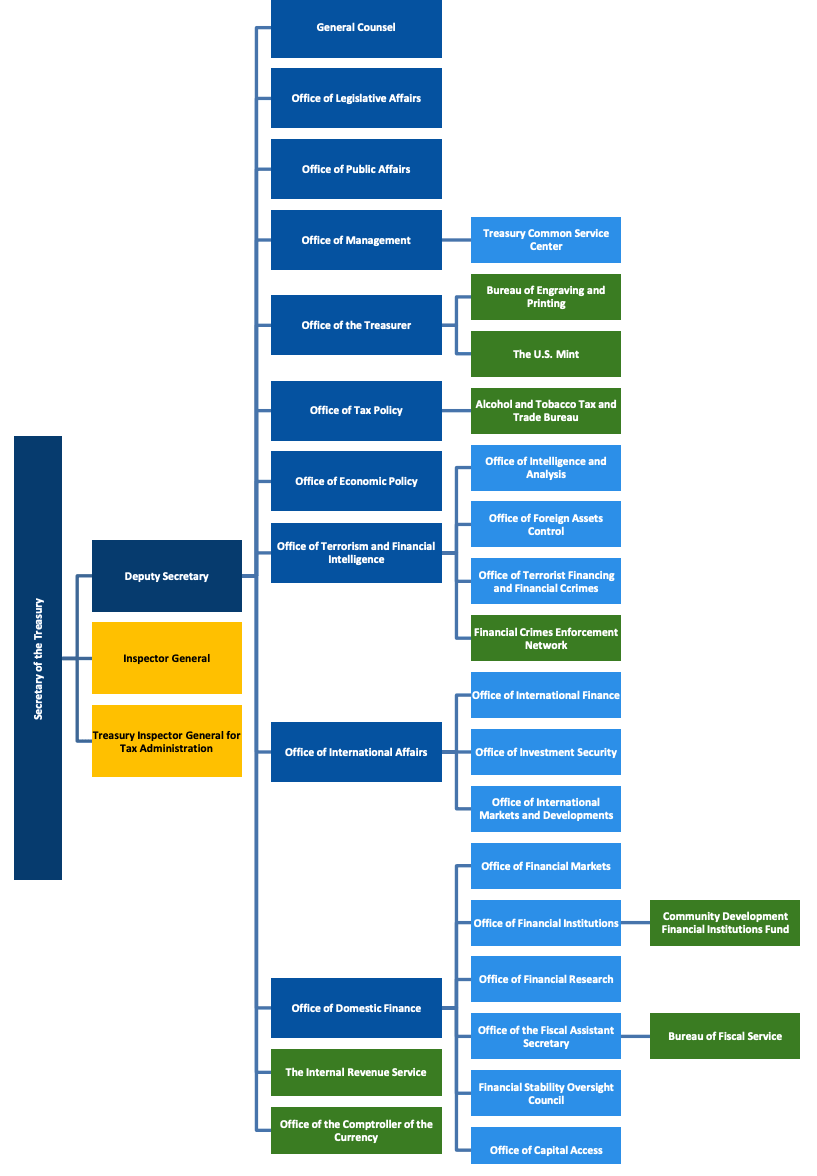
Source: US Department of the Treasury, Strategic Plan 2026–2030. Note that the chart does not show every office or department-wide function, including the Chief AI Officer and AI Transformation Office.
Key:
- Dark navy: Secretary and Deputy Secretary
- Dark blue: major Departmental Offices
- Light blue: offices within those Departmental Offices
- Green: operating bureaus
- Yellow: inspectors general
Treasury and AI policy
Treasury influences how financial institutions use and manage the risks of AI, restricts certain investments involving sensitive AI technologies, addresses AI-enabled financial crime, and sets rules for AI use within its own operations.
These authorities vary substantially in legal force. Some Treasury work relies mainly on research, convening, and voluntary guidance, particularly around financial-sector AI adoption. Other areas (e.g. outbound-investment controls, sanctions and anti-money-laundering requirements, OCC bank supervision, and governance of Treasury’s own systems) involve more direct regulatory or administrative authority.
Treasury’s AI work spans seven main areas:
- Governing AI in financial services: Treasury’s Domestic Finance offices and the Financial Stability Oversight Council (FSOC) examine how AI affects financial institutions, markets, cybersecurity, and financial stability. Treasury has increasingly convened banks, technology companies, and regulators around AI adoption, including through its 2026 AI Innovation Series and voluntary Financial Services AI Risk Management Framework. FSOC and Treasury primarily coordinate across regulators rather than directly supervise the entire financial sector; individual regulators retain their own authorities. The Office of the Comptroller of the Currency (OCC), an independent bureau within Treasury, directly supervises national banks and federal savings associations, including examining how AI affects bank supervision and risk management.
- Protecting financial infrastructure: As the federal agency responsible for coordinating financial-sector risk management, Treasury works on cybersecurity and resilience through the Office of Cybersecurity and Critical Infrastructure Protection. Its 2024 report on AI-specific cybersecurity risks addresses threats including fraud, reliance on third-party providers, data vulnerabilities, and differences in AI capabilities across financial institutions.
- Controlling sensitive investment: Treasury chairs the Committee on Foreign Investment in the United States (CFIUS), which can review certain foreign investments involving AI companies, semiconductors, computing infrastructure, critical technologies, and sensitive data. Treasury also administers the Outbound Investment Security Program, which prohibits or requires notification of specified US investments involving AI, semiconductors, and quantum technologies connected to China, Hong Kong, or Macau.
- Countering AI-enabled financial threats: The Office of Terrorism and Financial Intelligence, Office of Foreign Assets Control, Financial Crimes Enforcement Network (FinCEN), and related offices address AI-enabled fraud, cybercrime, sanctions evasion, and illicit finance. For example, FinCEN has issued guidance on deepfake-enabled fraud. These offices may also use machine learning and related analytical tools to identify suspicious activity, connect records, prioritize leads, and support intelligence or enforcement work.
- Deploying AI in federal financial systems: Treasury uses AI in tax administration, federal payments, fraud detection, financial research, internal knowledge management, and enterprise productivity. Its Treasury and Artificial Intelligence repository includes the January 2026 department-wide AI inventory, which listed 129 use cases across the IRS, Office of the Comptroller of the Currency, Bureau of the Fiscal Service, Office of Financial Research, and other components.
- Building internal AI governance: Since 2025, Treasury has appointed a Chief AI Officer, established the AI Transformation Office (AITO), and issued an AI Strategy and AI Compliance Plan. These arrangements support department-wide governance, training, procurement, shared tools, inventory management, and controlled testing.
- Supporting government-wide AI security efforts: In June 2026, President Trump’s Executive Order on AI Innovation and Security directed Treasury to lead the establishment of an AI cybersecurity clearinghouse and participate in a classified process for evaluating advanced AI systems’ cyber capabilities. In July, the White House launched GOLD EAGLE to coordinate this effort.
Treasury addresses AI internationally via its involvement in international forums that govern financial stability, cybersecurity, illicit finance, and economic security. These primarily include:
- Financial stability and cyber resilience: Treasury works through the G7 and G20 and the Financial Stability Board to coordinate with foreign finance ministries, central banks, and regulators on risks that can cross borders or affect the global financial system. Treasury also co-chairs the G7 Cyber Expert Group, which coordinates financial-sector cybersecurity policy, information sharing, exercises, and incident response.
- Illicit finance: Through the Financial Action Task Force and bilateral partnerships, Treasury coordinates approaches to money laundering, terrorist financing, sanctions evasion, fraud, and the use of new technologies in financial crime and compliance.
- International finance: Treasury leads US engagement with the International Monetary Fund and multilateral development banks, including the World Bank. These institutions increasingly examine how AI affects economic growth, financial markets, cybersecurity, and institutional resilience.
- Sanctions and investment security: Treasury also works with allies and partner governments on sanctions and investment-security measures, including coordination around outbound-investment restrictions and efforts to strengthen foreign investment-screening regimes.
Recent AI developments
Since 2024, Treasury’s AI work has expanded across financial-sector policy, internal governance, investment security, and national-security coordination.
- July 2026: The White House launches GOLD EAGLE, an AI cybersecurity clearinghouse for cyber vulnerability coordination developed by Treasury, the Department of War, and industry partners. The announcement doesn’t specify Treasury’s lead office, staffing, budget, or specific operational responsibilities.
- June 2026: President Trump’s Executive Order on AI Innovation and Security directs Treasury to lead the establishment of a voluntary AI cybersecurity clearinghouse and work with the National Security Agency and Cybersecurity and Infrastructure Security Agency on a classified process for evaluating advanced AI systems’ cyber capabilities. (See our full breakdown of who’s doing what in the US government on AI security.)
- April–June 2026: Following the announcement of Anthropic’s Claude Mythos Preview model, Secretary Bessent and Federal Reserve Chair Jerome Powell convene heads of major US banks to discuss the model’s cybersecurity implications and risks to the financial system. Subsequent reporting indicates that concerns from financial institutions—including about potential threats to critical infrastructure such as Federal Reserve payment systems—contributed to Bessent taking a more active role in AI policy. In June, Bessent publicly described AI as an issue he thinks about “every day at Treasury” and characterized the administration’s challenge as balancing innovation and safety while maintaining the US technological lead over China.
- March–June 2026: Treasury hosts the AI Innovation Series, four roundtables convening financial institutions, tech companies, regulators, and experts to explore high-value AI use cases and find ways to “scale innovation while preserving safety and soundness.” Treasury’s Office of the Financial Stability Oversight Council (FSOC) and AI Transformation Office lead the series.
- January–February 2026: Treasury leads a public-private initiative to strengthen AI cybersecurity and risk management in financial services, bringing together financial institutions, federal and state regulators, and other stakeholders. The initiative produced resources on governance, data practices, transparency, fraud, digital identity, and cybersecurity, along with a Financial Services AI Risk Management Framework adapted from the National Institute of Standards and Technology’s framework. Treasury also publishes its department-wide AI resources and use-case inventory.
- December 2025: Congress passes the Comprehensive Outbound Investment National Security (COINS) Act as part of the annual defense bill (the FY2026 National Defense Authorization Act). The law turns Treasury’s limits on US investments in sensitive foreign technology, which were previously based on an executive order, into permanent law. It also widens their scope to cover high-performance computing and hypersonic weapons, and to cover investments in Cuba, Iran, North Korea, Russia, and Venezuela as well as China. Treasury has 450 days (until roughly March 2027) to write the detailed rules putting the law into effect.
- December 2025: The Financial Stability Oversight Council (FSOC) approves its 2025 annual report, which recommends using its AI Working Group to examine AI-related opportunities and financial-stability risks. Secretary Bessent also announces the AI Innovation Series, a collaboration between FSOC and Treasury’s AI Transformation Office.
- June 2025: Treasury appoints Paras Malik as Counselor to the Secretary and Chief AI Officer. Treasury subsequently publishes an enterprise AI Strategy and AI Compliance Plan through its AI policy repository.
- January 2025: Treasury’s Outbound Investment Security Program takes effect, imposing prohibitions and requirements on certain US investments involving AI, semiconductors, and quantum technologies in China, Hong Kong, and Macau. Congress later expanded the program and made it law through the COINS Act (see December 2025).
- December 2024: Treasury publishes its report on AI in financial services, addressing data privacy, bias, reliance on third-party providers, regulatory coordination, consumer harm, and other opportunities and risks associated with AI adoption.
- March 2024: Treasury releases a report led by the Office of Cybersecurity and Critical Infrastructure Protection on AI-specific cybersecurity risks in financial services. The report examined fraud, explainability, reliance on third-party providers, data gaps, regulatory coordination, and differences in AI capabilities between large and small financial institutions.
Treasury offices working on AI policy
Several offices are especially relevant for AI policy work at Treasury, ranging from department-wide AI governance and financial-sector policy to investment security, illicit finance, and the infrastructure needed to deploy AI across Treasury. This list is not comprehensive.
- Chief AI Officer and AI Transformation Office (AITO) lead Treasury’s department-wide AI strategy and governance. Their work includes coordinating AI adoption, reviewing use cases, maintaining the department’s AI inventory, developing training and shared resources, and implementing government-wide AI requirements.
- Domestic Finance leads much of Treasury’s work on AI in the financial system. Relevant components include:
- Office of Financial Institutions examines how AI affects financial institutions, consumers, competition, risk management, and the provision of financial services. It has helped lead Treasury consultations and public-private initiatives on financial-sector AI.
- Financial Stability Oversight Council (FSOC) coordinates work among Treasury and independent financial regulators on risks that AI may pose across the financial system. This includes supporting FSOC’s AI Working Group and AI Innovation Series.
- Office of Financial Research (OFR) conducts research and data analysis on financial-system risks, including market concentration, operational dependencies, and other potential systemic effects of AI.
- Office of Cybersecurity and Critical Infrastructure Protection (OCCIP) leads Treasury’s work on cybersecurity and resilience in the financial-services sector. Its AI-related work addresses fraud, deepfakes, third-party providers, data vulnerabilities, incident coordination, and the use of AI for both cyberattack and defense. Treasury’s 2024 AI cybersecurity report describes this work in more detail.
- Office of Investment Security leads Treasury’s work on the national-security implications of investments involving AI and other sensitive technologies.
- Committee on Foreign Investment in the US (CFIUS) coordinates reviews of certain foreign investments involving AI companies, semiconductors, computing infrastructure, sensitive data, and other critical technologies.
- Office of Research & Analysis (R&A), created in 2025, brings scientists, engineers, and data experts into the CFIUS review process. They assess the technology behind foreign investments CFIUS reviews, including what it can do, how easily it could be transferred, and what a foreign buyer would gain from access to it.
- Office of Global Transactions administers the Outbound Investment Security Program, including prohibitions and notification requirements for specified investments involving AI, semiconductors, and quantum technologies.
- Office of Terrorism and Financial Intelligence (TFI) addresses AI-related threats involving sanctions evasion, financial crime, cybercrime, fraud, and national security. Relevant components include:
- Office of Intelligence and Analysis (OIA) produces financial intelligence concerning foreign actors, illicit networks, cyber threats, and other national-security risks. For more on intelligence work and career paths across the federal government, see our Intelligence community profile.
- Office of Foreign Assets Control (OFAC) administers sanctions that may apply to technology companies, cyber actors, proliferators, and entities using AI-enabled methods to evade restrictions.
- Office of Terrorist Financing and Financial Crimes (TFFC) develops policy on money laundering, terrorist financing, proliferation finance, and other illicit-finance threats, including those affected by emerging technologies.
- Financial Crimes Enforcement Network (FinCEN) combats money laundering and other illicit finance by administering the Bank Secrecy Act and analyzing financial data. Its AI-related work has focused especially on AI-enabled fraud and identity abuse, including deepfakes and generative-AI-created identity documents used to evade customer-verification processes, open fraudulent accounts, or facilitate other financial crimes.
- Office of the Comptroller of the Currency (OCC) regulates and supervises national banks and federal savings associations, making it one of Treasury’s principal sources of direct authority over financial institutions’ technology use. In 2026, OCC and other banking regulators revised their model risk guidance and said they planned additional work specifically addressing banks’ use of generative, agentic, and other AI systems.
- Office of the Chief Information Officer (OCIO) and Treasury management offices provide the technology, cybersecurity, procurement, privacy, and data-governance infrastructure needed to implement Treasury’s internal AI policies. These offices are particularly relevant to AI acquisition, vendor oversight, cloud services, system security, and compliance with federal AI requirements.
While less directly involved in AI policy work, the IRS and Bureau of the Fiscal Service run some of the government’s largest technology systems: the IRS holds sensitive tax and financial data on nearly every American, and Fiscal Service runs the payment systems most federal agencies use. This makes them frequent targets of cyberattacks, and both invest heavily in cybersecurity and fraud prevention.
Treasury and biosecurity policy
Treasury’s biosecurity role is relatively narrow. It matters mainly where biotechnology, sensitive health or genetic data, and chemical or biological weapons programs intersect with foreign investment, sanctions, illicit finance, and national security. Treasury generally doesn’t regulate biological research, public health, or lab safety directly. Instead, it uses financial and investment authorities to address the money, transactions, companies, and data connected to these risks.
Its main biosecurity-related functions include:
- Reviewing sensitive foreign investments: Through CFIUS, Treasury can review certain foreign investments in US biotechnology and life-sciences companies for national security risks. This can include transactions involving sensitive health or genetic data or technologies connected to chemical or biological weapons.
- Using sanctions to disrupt weapons programs: Treasury can impose financial sanctions on people, companies, and networks involved in weapons-of-mass-destruction programs or in supplying them with money, equipment, or other support. For example, in 2024 Treasury sanctioned networks that supplied laboratory equipment and other goods to Russian institutes associated with chemical and biological weapons programs.
- Tracking and disrupting the financing of weapons programs: Treasury works to identify the financial and supply networks that support weapons proliferation and uses tools such as financial intelligence, anti-money-laundering rules, and information from financial institutions to help disrupt them. This work focuses on the money and transactions behind weapons programs (rather than on regulating biological research itself).
- Restricting some US investment abroad: Treasury’s Outbound Investment Security Program restricts certain US investments involving semiconductors, quantum technologies, and AI. Biotechnology is not currently a separate covered sector, although some AI systems trained primarily on biological-sequence data can fall under the rules. The Trump administration has also directed Treasury to consider expanding outbound-investment restrictions to biotechnology.
Recent biosecurity developments
Treasury is not a central biosecurity agency, but several developments show how its financial and investment authorities can apply to biological risks.
- March 2026: Treasury publishes its 2026 National Proliferation Financing Risk Assessment, which assesses how state and non-state actors raise and move money or acquire goods to support biological, chemical, nuclear, and radiological weapons programs. The assessment highlights illicit procurement networks, misuse of the financial system, and efforts to acquire sensitive dual-use technologies as continuing risks.
- February 2025: President Trump’s America First Investment Policy directs a review of US outbound-investment restrictions and specifically identifies biotechnology among the sectors where new or expanded restrictions should be considered. As of August 2026, biotechnology has not been added as a standalone covered sector under Treasury’s current rules.
- January 2025: Treasury’s Outbound Investment Security Program takes effect. Biotechnology is not a separately covered sector, but the rules cover certain AI systems trained primarily on biological-sequence data above specified computing thresholds.
- May 2024: The Office of Foreign Assets Control sanctions entities and individuals involved in supplying Russian institutes associated with chemical and biological weapons programs, illustrating how Treasury can use financial sanctions against networks supporting biological- and chemical-weapons activities.
- February 2020: Revised Committee on Foreign Investment in the United States regulations take effect, expanding the committee’s jurisdiction over certain investments involving sensitive personal data. The rules include specified health information and genetic-test information within the definition of sensitive personal data, with genetic-test information receiving special treatment regardless of the usual numerical thresholds.
Treasury offices working on biosecurity policy
Biosecurity-related work at Treasury is concentrated in a small number of offices focused on investment security, sanctions, financial intelligence, and disrupting the financing of weapons programs.
- Office of Investment Security (OIS) leads Treasury’s work on national-security risks from foreign and outbound investment.
- Committee on Foreign Investment in the United States (CFIUS) reviews certain foreign investments and transactions for national security risks, including risks involving sensitive personal data and critical technologies. Treasury chairs the committee.
- Office of Global Transactions administers the Outbound Investment Security Program, which restricts certain US investments involving semiconductors, quantum information technologies, and AI. Biotechnology is not separately covered, although some AI systems trained primarily on biological-sequence data fall within the rules.
- Office of Terrorism and Financial Intelligence (TFI) houses several offices that can address the financial and supply networks supporting chemical or biological weapons programs:
- Office of Foreign Assets Control (OFAC) administers and enforces sanctions that can target chemical or biological weapons programs, proliferators, procurement networks, and people or organizations providing financial or material support.
- Office of Terrorist Financing and Financial Crimes (TFFC) develops and coordinates Treasury policy on proliferation financing and efforts to disrupt the financial and procurement networks that support weapons programs.
- Office of Intelligence and Analysis (OIA) provides financial intelligence and analysis that can support sanctions, counter-proliferation activity, and other national-security actions.
- Financial Crimes Enforcement Network (FinCEN) collects, analyzes, and shares financial intelligence that can support investigations of illicit financing networks.
Working at Treasury
Treasury hires from a wide range of backgrounds, including economics, public policy, law, finance, national security, intelligence, data science, cybersecurity, and information technology. For emerging technology work, roles can include developing AI or financial sector policy, reviewing sensitive investments, analyzing illicit finance networks, coordinating cybersecurity, supervising banks, or building technology used in tax administration and federal payments.
Jobs vary substantially across Treasury. Departmental Offices tend to have more policy, economic analysis, rulemaking, legal, and interagency-coordination roles. Operating bureaus such as the IRS, Bureau of the Fiscal Service, OCC, and FinCEN run large regulatory and operational programs and generally have more roles involving technology, data, supervision, enforcement, and program implementation.
For national security work, particularly relevant offices include the Offices of Investment Security (OIS) and Terrorism and Financial Intelligence (TFI). TFI recruits people with backgrounds ranging from finance and regional expertise to intelligence, law, economics, and technology; some national-security and intelligence positions require security clearances.
How to get entry-level jobs
For students and early-career applicants, Treasury offers several routes:
- Pathways Internships and Recent Graduates: government-wide programs for qualifying students and recent graduates. Eligibility, location, conversion potential, and security requirements depend on the individual vacancy.
- International Affairs Junior Fellowship: a two-year program for new college graduates to work shaping international economic policy in Treasury’s Office of International Affairs.
- Financial Stability Oversight Council (FSOC) Junior Fellowship: a two-year program for new college graduates to work at the Office of the Financial Stability Oversight Council to monitor risks to US financial stability.
- Treasury Headquarters Student Internship Program: Offers spring, summer, and fall placements across Departmental Offices in Washington, DC. The program is currently unpaid and open to qualifying high school, undergraduate, and graduate students; opportunities are posted on USAJOBS.
- Law student internships: Treasury’s Office of General Counsel offers volunteer summer internships in offices working on areas including banking, enforcement and intelligence, international affairs, tax, OFAC, and financial research.
- AAAS Science & Technology Policy Fellowship: For scientists and engineers with advanced degrees. Treasury has hosted AAAS fellows in its Office of Investment Security, including fellows working there in 2025–26. Placements vary by year.
For full-time positions, see Treasury Careers and Treasury vacancies on USAJOBS. It’s also worth checking the career pages of individual bureaus of interest (listed on this page).
See our federal agency application advice for guidance on USAJOBS, federal resumes, interviewing for federal positions, and more.
Federal jobs are grouped into occupational series, identified by four-digit codes. Searching by series can help you find Treasury vacancies that use different job titles for similar kinds of work. Treasury’s Occupational Toolkit shows which occupations appear across its offices and bureaus and links to current openings.
For emerging-technology work, useful series include:
- Policy, economics, and analysis: 0110 Economist, 0343 Management and Program Analysis, 1160 Financial Analysis, and 1515 Operations Research.
- Data and technology: 1550 Computer Science, 1560 Data Science, and 2210 Information Technology Management.
- Law, intelligence, and enforcement: 0905 General Attorney, 0132 Intelligence, 1801 General Inspection/Investigation/Enforcement/Compliance, and 1811 Criminal Investigation.
Further reading
General Treasury resources
- Role of the Treasury, US Department of the Treasury
- Treasury Strategic Plan, FY 2026–2030, US Department of the Treasury (2026)
- Department of the Treasury, United States Government Manual (2025)
- FY 2027 Budget-in-Brief, US Department of the Treasury (2026)
Treasury and AI
- Treasury and AI, US Department of the Treasury (2026)
- Uses, Opportunities, and Risks of AI in Financial Services, US Department of the Treasury (2024)
- The Financial Stability Implications of AI, Financial Stability Board (2024)
- AI and Financial Stability: Mitigating Risks, Harnessing Benefits, Brookings Institution (2024)
- US Department of the Treasury’s AI Strategy, US Department of the Treasury (2025)
Treasury and biosecurity
- National Security Commission on Emerging Biotechnology: Final Report and Options for Congress, Congressional Research Service (2025)
- Foreign Investment in the U.S.: Efforts to Mitigate National Security Risks Can Be Strengthened, US Government Accountability Office (2024)
- Complex Proliferation Financing and Sanctions Evasion Schemes, Financial Action Task Force (2025)






Notes
-
OCC is a special case: it’s technically a Treasury bureau, but the law gives it significant independence. It pays for itself through fees charged to the banks it oversees rather than through money from Congress, and the Treasury Secretary is legally limited in how much they can weigh in on its decisions.
↩︎