
Department of Energy (DOE)
DOE oversees energy policy, scientific research, and the nuclear arsenal, being the largest US government funder of physical science research. It significantly contributes to science and technology development and policy, including AI and biosecurity, particularly via its national labs.
Department of Energy (DOE)
This profile outlines the US Department of Energy (DOE), focusing on its organizational structure and its role in AI and biosecurity policy. See our complementary profiles on the DOE’s National Nuclear Security Administration:

Overview
The Department of Energy (DOE) manages national energy policy, sponsors scientific research, and maintains the nuclear arsenal alongside the DOW. It plays a crucial role in funding and policy related to science, technology, and national security. DOE is the largest US government funder of physical science research, most of which is conducted through DOE-operated national laboratories.
DOE has actively funded research into AI and computing for decades, especially in its national labs. The labs operate some of the world’s most powerful supercomputers, which are used for AI research and large-scale training runs, among other things. Via its Office of Strategy and Roadmaps, Office of AI and Quantum, and other components, DOE also plays an important role in AI policy. The Department also carries significant taskings under America’s AI Action Plan and subsequent executive actions, including on AI data center siting and permitting, technical AI evaluations for threats involving weapons of mass destruction or critical infrastructure, and partnerships with private AI developers to secure frontier AI systems.
DOE national labs also conduct extensive life sciences research, including researching biodefense, bioengineering, and emerging infectious diseases. DOE contributed resources, infrastructure, and expertise to scientific research during the COVID-19 pandemic and continues to advance biosecurity-relevant technologies, including by conducting research into synthetic biology, gene-editing, diagnostics, infectious diseases, bioinformatics, and bioengineering.
Background on DOE
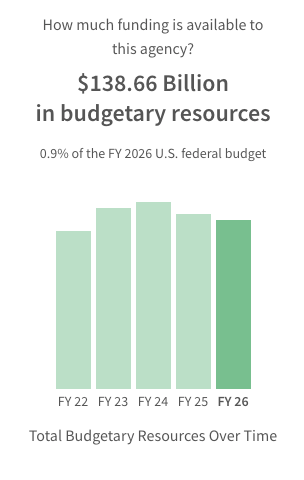
Source: USASpending
- Government context: the Department of Energy (DOE) is one of 15 executive departments in the US government; the Secretary is a member of the US president’s cabinet and National Security Council
- Main activities: oversees national energy policy and production, sponsors science research (as the largest federal sponsor of basic research in the physical sciences), and maintains the nuclear stockpile in coordination with DOW.
- Budget: ~$138 billion in total annual budgetary resources in FY2026, ~1.2% of the federal budget in 2026 (small-to-mid-sized compared to other executive departments).
- Staff: ~14,000 employees, though this number doesn’t include DOE’s ~95,000 contractors, many of whom work at DOE laboratories around the country.
- Brief history: DOE was created under the Carter Administration in response to the 1970s oil crisis, when securing energy independence from OPEC became a national priority—both through domestic fossil fuel production and by sourcing clean energy alternatives. There was also an increasing need to better regulate and promote private sector nuclear energy development. DOE combined prior agencies, including the Federal Energy Administration and the Energy Research and Development Administration. Over its history it has broadened the scientific fields it works on.
Organizational structure
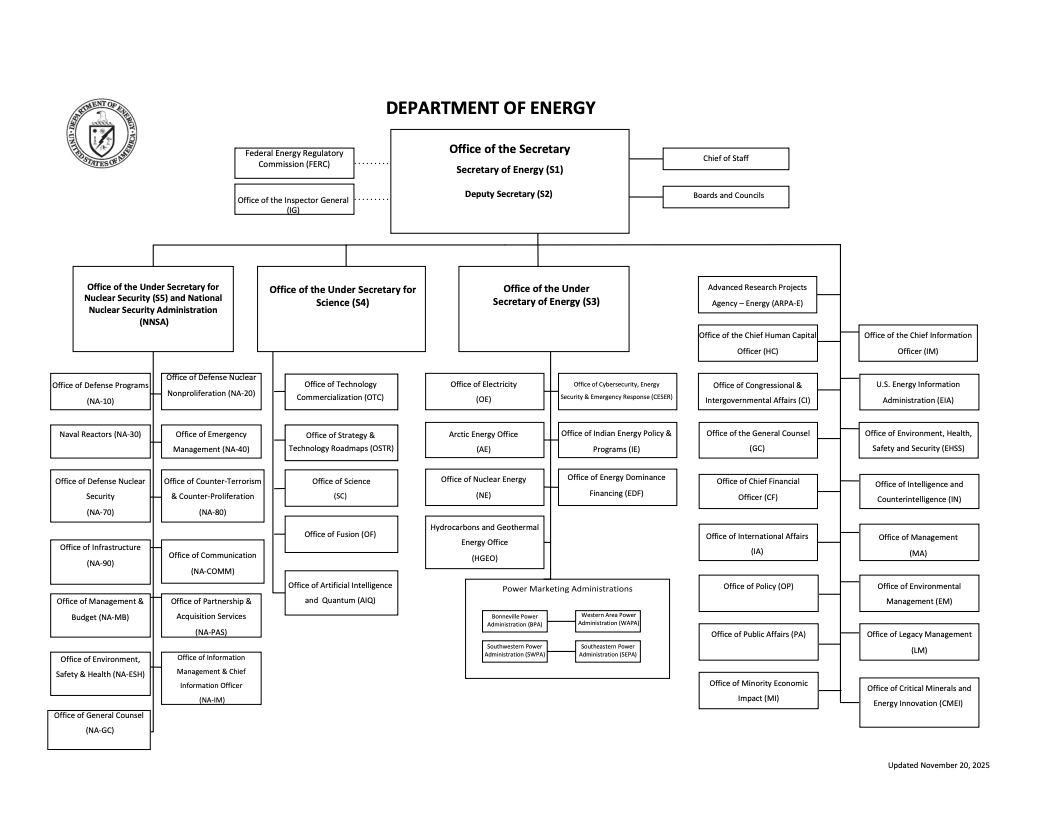
Source: DOE. Note that DOE announced a significant reorganization on November 20, 2025; the description below reflects the updated org chart. DOE also oversees 17 national laboratories, which are government-owned but contractor-operated (see our guide).
DOE is headed by a Secretary of Energy, appointed by the President and confirmed by the Senate. Other senior leadership positions are also politically appointed, such as the Deputy Secretary, Chief of Staff, Under Secretaries, Assistant Secretaries, and heads of the offices that directly report to the Secretary or Deputy Secretary.
DOE is organized into five main offices, labeled S1 to S5:
- Office of the Secretary of Energy (S1)
- Office of the Deputy Secretary of Energy (S2)
- Office of the Under Secretary of Energy (S3)
- Office of the Under Secretary for Science (S4)
- Office of the Under Secretary for Nuclear Security (S5)
The Secretary (S1) and Deputy Secretary (S2) oversee the Department, with S3, S4, and S5 reporting to them. S1 and S2 also oversee 21 smaller offices listed on the right of the org chart. Many—though not all—of these smaller offices have administrative functions, such as finance (Office of the Chief Financial Officer) or legal (Office of the General Counsel).
S3 leads DOE’s “energy dominance” mission and oversees offices including Nuclear Energy, Electricity, Cybersecurity, Energy Security, and Emergency Response (CESER), the Hydrocarbons and Geothermal Energy Office (HGEO), and the Office of Energy Dominance Financing (formerly the Loan Programs Office). S4 leads the science and innovation mission and oversees the Office of Science, the Office of Artificial Intelligence and Quantum, the Office of Fusion, the Office of Strategy and Technology Roadmaps, and the Office of Technology Commercialization. S5 comprises the National Nuclear Security Administration (NNSA), which was largely unaffected by the 2025 reorganization. The Office of Critical Minerals and Energy Innovation (CMEI), which absorbed most of the former Office of Energy Efficiency and Renewable Energy, is unusual in reporting directly to the Secretary rather than through an under secretary.
DOE also oversees 17 national laboratories that produce federally-funded research (see map). Management of these labs is headed by different parts of DOE org chart. The Office of Science (located in S4) oversees 10 of the labs, while the National Nuclear Security Administration (NNSA) (S5) oversees 3 labs, including Los Alamos. The Hydrocarbons and Geothermal Energy Office supports the National Energy Technology Laboratory, DOE’s only government-owned and government-operated national laboratory.
Much of DOE’s work and budget is dedicated to the funding and production of scientific research. Similar to the National Institutes of Health (NIH), DOE funds both in-house research, taking place within DOE and its labs, and external research conducted by outside organizations, such as universities.
DOE and AI policy
DOE has been involved in AI research for decades, notably by funding machine learning and other AI research in its national labs. It also has a long history of regulating dual-use technology through its oversight over nuclear research and weapons stockpiles. DOE has since become a central player in federal AI policy, reflecting both its research investments and its unique position at the intersection of domestic science and technology policy and national security. It now leads the government’s flagship AI-for-science initiative, carries significant taskings on AI security and infrastructure, and requested $1.2 billion for its new Office of Artificial Intelligence and Quantum in FY2027
In 2019, DOE established the Office for AI and Technology to coordinate AI efforts across the labs and the Department. In 2023, DOE replaced this office with the Office for Critical and Emerging Technology (CET), following President Biden’s October 2023 Executive Order on AI (EO).
In the November 2025 reorganization, CET was renamed the Office of Strategy and Technology Roadmaps (OSTR), which retains a coordination and roadmapping role across critical and emerging technologies, while DOE established a separate Office of Artificial Intelligence and Quantum (AIQ) to lead its AI and advanced computing work. Both sit under the Under Secretary for Science (S4).
The 2023 EO had assigned DOE responsibilities including AI talent development, applying AI foundation models to science, and building evaluations and testbeds to assess risks from AI outputs relating to nuclear, chemical, biological, critical infrastructure, and energy-security threats. Since 2025, a series of presidential directives has further shaped and expanded DOE’s AI role, spanning data center permitting on federal land, security partnerships with frontier AI developers, and AI applications for national security (see recent developments below). Significant among these is the Genesis Mission, which was launched by executive order in November 2025 as a national effort to apply AI to scientific discovery. DOE leads implementation, with the Under Secretary for Science serving as DOE’s lead and AIQ responsible for delivery. The Mission has since grown into a whole-of-government initiative, with more than 15 federal agencies contributing datasets, research facilities, and funding opportunities.
Advances in the national labs
DOE has a long history of driving advances in earlier AI technologies (before machine learning) and in computing, including supercomputers. Many national labs have been involved in AI-related research, including (but not limited to) Oak Ridge National Laboratory (ORNL), Argonne National Laboratory (ANL), Lawrence Berkeley National Laboratory (LBL), Pacific Northwest National Laboratory (PNNL), and the National Energy Technology Laboratory (NETL).
One of DOE’s most notable AI-related efforts involves investment in supercomputing. One of DOE’s most notable AI-related efforts involves investment in supercomputing. As of June 2026, DOE operates three of the world’s four most powerful supercomputers: El Capitan at Lawrence Livermore National Laboratory, Frontier at ORNL, and Aurora at ANL.
DOE is now building a new generation of systems designed specifically for AI, many through public-private partnerships in which industry partners co-invest and share computing capacity. In October 2025, DOE announced nine new supercomputers across its labs, including Solstice at ANL, which will feature 100,000 NVIDIA Blackwell GPUs and become the largest AI supercomputer in the DOE complex. Under the Genesis Mission, the labs are also expanding into autonomous experimentation, with DOE funding 14 projects in robotic automated laboratories and the autonomous control of large-scale experiments.
Other research on neural network architectures, learning methodologies, AI applications, and AI’s societal impacts are underway at various other labs. More information about how the national labs are involved in research on emerging technologies can be found in our national labs and FFRDC guide.
Major recent AI-related developments at DOE
Recent highlights are listed below (not comprehensive):
- July 2026: At the Genesis Mission 2026 Summit, the White House announces more than $5 billion in federal commitments and a slate of National Science and Technology Challenges, as the Mission expands to more than 15 agencies. DOE selects 278 projects, 87 of them led by national labs.
- June 2026: President Trump’s National Security Presidential Memorandum on AI directs DOE, with DOW and the intelligence community, to develop partnerships with private-sector AI companies to secure frontier AI systems against threats including distillation attacks, and to apply AI to national security missions through the Genesis Mission.
- December 2025: DOE announces over $320 million across four Genesis Mission initiatives, including the American Science Cloud, the Transformational AI Models Consortium, 14 projects in robotic automated laboratories, and 37 foundational AI awards. Later that month, DOE announces research collaboration agreements with 24 industry participants.
- November 2025: President Trump launches the Genesis Mission via executive order, a DOE-led national effort to “unleash a new age of AI‑accelerated innovation and discovery that can solve the most challenging problems of this century.” DOE is tasked with building an integrated AI platform to harness federal scientific datasets to train scientific foundation models and create AI agents to test new hypotheses, automate research workflows, and accelerate scientific breakthroughs.
- November 2025: DOE announces an organizational realignment creating a standalone Office of Artificial Intelligence and Quantum, renaming the Office of Critical and Emerging Technologies to the Office of Strategy and Technology Roadmaps, and creating nine new offices while eliminating others.
- October 2025: DOE and Argonne National Laboratory announce a public-private partnership with NVIDIA and Oracle to build two AI supercomputers, ‘Solstice’ and ‘Equinox,’ to accelerate AI-driven scientific research.
- September 2025: The DOE’s Grid Deployment Office launches the Speed to Power Initiative, issuing a Request for Information (RFI) to identify ways to accelerate grid infrastructure projects to meet growing energy demands from AI data centers.
- August 2025: DOE awards $35 million via the Technology Commercialization Fund to 42 projects moving new energy technologies to market.
- July 2025: President Trump’s Executive Order on AI data center infrastructure directs DOE to identify suitable federal sites for data center development and offer appropriate authorizations to project sponsors, in consultation with industry and the Department of Commerce. The order also revokes President Biden’s January 2025 Executive Order on AI infrastructure.
- January 2025: Biden’s Executive Order on AI Infrastructure directs DOE and the Department of Defense to each identify at least three federal sites suitable for frontier AI data centers and to select winning proposals from private entities to build AI infrastructure on federal sites. The EO also requires DOE to analyze possible AI data center effects on electricity prices and to expand R&D efforts on AI data center efficiency.
- October 2024: The White House publishes the Memorandum on Advancing the US’ leadership in AI, followed by a DOE press release on its efforts through the NNSA, including advancing AI safety and risk assessment for nuclear, radiological, and other threats; supporting AI testing and evaluation; developing AI infrastructure; coordinating on AI supply chain risks; streamlining AI infrastructure approvals; and enhancing AI-focused workforce strategies.
- September 2024: The White House convenes a roundtable on US Leadership in AI Infrastructure, announcing that DOE would create an AI datacenter engagement team and sharing resources on repurposing closed coal sites with datacenter developers.
- July 2024: DOE proposes its Frontiers in AI for Science, Security and Technology (FASST) initiative to advance national security; attract and build a talented workforce; harness AI for scientific discovery; develop technical expertise necessary for AI governance; and address energy challenges.
- April 2024: DOE delivers an initial risk assessment on AI for critical energy infrastructure, through its Office of Cybersecurity, Energy Security, and Emergency Response (CESER), supported by Lawrence Livermore National Laboratory.
- January 2024: DOE shares its role in the National AI Research Resource (NAIRR), which “aims to develop a shared national research infrastructure to provide researchers and students with significantly expanded access to computational resources, high-quality data, educational tools, and user support to advance AI research and discovery.”
- December 2023: DOE launches the Office of Critical and Emerging Technology (CET) to accelerate US advancements in AI, biotechnology, quantum computing, and semiconductors.
- October 2020: NNSA establishes a partnership to accelerate AI computing initiatives through the acquisition and integration of SambaNova DataScale systems at Lawrence Livermore and Los Alamos National Laboratories, enhancing capabilities for high-performance cognitive simulations and machine learning applications.
- September 2020: DOE announces $16 million for machine learning and AI research.
DOE offices working on AI policy and research
There are several DOE offices and components relevant to AI development and policy (non-exhaustive):
- Office of the Undersecretary for Science (S4): S4 oversees 13 of DOE’s national labs and is the epicenter of R&D in the Department.
- Office of Artificial Intelligence and Quantum (AIQ): created in the November 2025 reorganization to lead DOE’s AI and advanced computing work, and responsible for Genesis Mission delivery, including aligning investments, developing workforce, and optimizing shared infrastructure.
- Office of Strategy and Technology Roadmaps (OSTR): renamed from the Office of Critical and Emerging Technologies (CET) in the November 2025 reorganization, OSTR coordinates DOE work across critical and emerging technologies (from AI and biotech to quantum computing) and develops technology roadmaps.
- Office of Science (SC): largest US government funder of fundamental physical science research and stewards of 10 of the 17 national labs, with a budget of ~$8 billion.
- Advanced Scientific Computing Research (ASCR): funds much of the supercomputing work specifically at the Office of Science labs, predominantly Oak Ridge, Argonne, and Berkeley.
- Advanced Research Projects Agency-Energy (ARPA-E): advances high-potential, high-impact energy technologies that are too early for private-sector investment (similar to other ARPAs in DOD and the Intelligence Community). Reports directly to the Secretary and Deputy Secretary.
- Office of the Undersecretary of Nuclear Security (NNSA – S5): NNSA is a semi-autonomous nuclear security vertical of DOE; well set-up to liaise between industry and the national security establishment (org chart on p. 174).
- Advanced Simulation and Computing Program (ASC): super-computing program run by the NNSA to simulate, test, and maintain the US nuclear stockpile; parallel to ASCR (see above)
- Office of Defense Nuclear Nonproliferation (DNN): works to prevent nuclear proliferation; investing in a venture called “STEEL THREAD” to develop foundation models and assess trustworthiness to assist with nonproliferation efforts.
DOE and biosecurity policy and research
DOE’s resources, infrastructure, and expertise in scientific research and national security allow the Department to support federal biosecurity efforts. DOE’s network of national laboratories in particular play an important role in advancing technical solutions to biological threats.
DOE national labs involved in biosecurity research include (non-exhaustive list):
- Sandia National Laboratories: has a significant biological research mission including a specific focus area on biodefense & emerging infectious disease. Their work includes biomanufacturing and biodefense research, synthetic biology and gene-editing, infectious disease technology, computational biology and bioinformatics, and developing biosensors and diagnostic devices.
- Los Alamos National Laboratory: includes biosecurity and emerging threats preparedness in its strategic lab agenda, aimed at reducing natural and deliberate biological threats through drug discovery and development, creation of biological research tools, DNA sequencing and bioinformatics, and artificial human organ systems for research. Los Alamos has a National Security Life Sciences program, which houses a Biodefense Research Center and a Global Disease Modeling and Forecasting Center.
- Lawrence Livermore National Laboratory: includes a research focus area on bioscience and bioengineering, studying underlying mechanisms of disease, engineering microbial communities, and addressing biosecurity, health and ecological threats. Home to the Center for Bioengineering, Forensic Science Center, and the Select Agent Center.
- Lawrence Berkeley National Laboratory: conducts research in biomanufacturing and is home to the Joint Genome Institute, which focuses on genomic innovation.
- Pacific Northwest National Laboratory: has a program on Chemical and Biothreat Signatures, including projects on Pathogen Science and Detection and Threat-Agnostic Biodefense.
- Argonne National Laboratory: has a Biosecurity program among its National Security Programs, which “uses new computational and experimental tools to detect engineered biological systems and monitor their potential to spread disease.”
- Brookhaven National Laboratory: leads a research effort focused on biosecurity for bioenergy crops.
2022 National Biodefense Strategy and Implementation Plan
As of July 2026, the 2022 National Biodefense Strategy remains the most recent publicly available government-wide biodefense framework. DOE has supporting responsibilities across all five goals, including biological-threat detection, data sharing, biosafety and biosecurity innovation, preparedness, response, and recovery.
- GOAL 1 (p. 18): Enable risk awareness and detection to inform decision-making across the biodefense enterprise
- 1.1.1. Detection and Reporting of Biological Threats (Support)
- 1.1.2. Biological Threat Sequencing and Analytical Data Sharing (Support)
- 1.1.3. Data Integration for Early Warning (Support)
- 1.1.4. Biological Threat Assessment and Characterization Capabilities (Support)
- 1.2. Additional Actions (Support)
- GOAL 2 (p. 22): Ensure biodefense enterprise capabilities to prevent bio incidents.
- 2.2.1. Promote Safe and Secure Biological Laboratories and Practices (Support)
- 2.2.2. Strengthen Responsible Conduct for Biological Research (Support)
- 2.2.3. Accelerate biosafety and biosecurity innovation (Support)
- 2.2.4. Deter Biological Weapons (Support)
- GOAL 3 (p. 26): Ensure biodefense enterprise preparedness to reduce the impacts of bioincidents
- 3.1.2. Strengthen Capacities to Combat Emerging and Zoonotic Disease (Support)
- 3.2.3. Rapid, Low Cost, Point-of-Need Tests (Support)
- 3.3.2. PPE Innovation (Support)
- 3.5.3. Controlling Counterproductive Responses to Infection (Support)
- 3.6. Additional Actions (Support)
- GOAL 4 (p. 33): Rapidly respond to limit the impacts of bioincidents
- 4.1.1. Effective Response to Mitigate Biological Incidents (Support)
- GOAL 5 (p. 35): Facilitate recovery to restore the community, the economy, and the environment after a bioincident
- 5.1.1. Recovery Planning and Implementation (Support)
Major recent biosecurity-related developments at DOE
Following the 2001 anthrax attacks, Lawrence Livermore National Laboratory and Los Alamos National Laboratory collaborated and contributed to the development of the Biological Aerosol Sentry and Information System (BASIS), a field-ready detection system for pathogens and a precursor to the Homeland Security (DHS) BioWatch program. DOE’s labs continue to collaborate with agencies like DHS to advance biosecurity efforts.
During the COVID-19 pandemic, DOE established the National Virtual Biotechnology Laboratory (NVBL), through the 2020 CARES Act, leveraging its access to some of the world’s fastest supercomputers to develop complex epidemiological models and additive manufacturing capabilities to alleviate shortages of personal protective equipment (PPE) and other supplies. DOE also established the COVID-19 Technical Assistance Program (CTAP) to provide funding to assist non-DOE entities in their efforts to combat the pandemic. See the DOE Office of Science video on the Department’s response to the pandemic.
More recently, DOE’s biosecurity work has converged with its AI and computing mission. The Genesis Mission names biotechnology among the national science and technology challenges it targets, and DOE’s supercomputers, scientific datasets, and automated laboratories are increasingly central to federal AIxBio efforts.
Additional recent highlights are listed below (not comprehensive):
- June 2026: Senators introduce the Web of Biological Data Act of 2026, which would direct the Secretary of Energy to establish a single secure point of access for AI-ready biological datasets, executed by a selected DOE national laboratory through a one-year pilot expanding over five years. The bill reflects a recommendation from the National Security Commission on Emerging Biotechnology’s April 2025 report.
- December 2025: The FY2026 National Defense Authorization Act (NDAA) enacts the BIOSECURE Act, restricting federal contracting with certain foreign biotechnology companies, which applies to DOE and national lab procurement.
- November 2025: President Trump’s Genesis Mission executive order names biotechnology among the national science and technology challenges DOE is directed to address using AI.
- May 2024: DOE publishes the Workplace Safety Framework for Public Health, covering workplace preparedness measures such as ventilation and air filtration.
- September 2023: DOE announces $112.4 million in funding for 10 research projects for the Biopreparedness Research Virtual Environment (BRaVE) initiative.
- December 2023: DOE launches the Office of Critical and Emerging Technology (CET) to accelerate US advancements in AI, biotechnology, quantum computing, and semiconductors.
- October 2022: DOE’s Office of Science funds a pilot study focused on biosecurity for bioenergy crops
- September 2022: The White House issues an executive order on Advancing the American Bioeconomy, calling on the Secretary of Energy to report on how biotechnology, biomanufacturing, bioenergy, and biobased products can address climate change.
- June 2022: DOE announces $5 million for Research on Computer Modeling and Epidemiology for Bio-preparedness and Response.
- March 2022: DOE requests (and ultimately receives) funding for the Bioassurance Program in its FY2023 budget under NNSA, with goals to expand DOE’s role in biodefense, but DOE did not request additional funding in FY2025.
- March 2020: DOE establishes the National Virtual Biotechnology Laboratory (NVBL), a consortium of DOE national laboratories with core capabilities relevant to the threats posed by COVID-19.
DOE offices working on biosecurity policy and research
Beyond DOE’s national labs, the Department has several offices relevant to biosecurity (non-exhaustive):
- Office of the Undersecretary for Science (S4): S4 oversees 13 of DOE’s national labs and is the epicenter of R&D in the Department.
- Office of Strategy and Technology Roadmaps (OSTR): renamed from the Office of Critical and Emerging Technologies (CET) in the November 2025 reorganization, OSTR coordinates DOE work across critical and emerging technologies (from AI and biotech to quantum computing) and develops technology roadmaps.
- Office of Science (SC): largest US government funder of fundamental physical science research with a budget of ~$8 billion. Oversees the BRaVE initiative established in 2023 to develop scientific capabilities aiding in the prevention of and response to potential biological threats.
- Office of Science National Laboratories: oversees laboratories in the DOE Laboratory System, including several mentioned above–Argonne, Brookhaven, Lawrence Berkeley, and Pacific Northwest.
- Biological and Environmental Research (BER): supports scientific research aimed at understanding complex biological and environmental systems, focusing on energy security and infrastructure resilience. Its work has included genomic science, bioengineering, and ecosystem modeling. BER supports most DOE biological research and faces the largest proposed reduction within the Office of Science: the FY2027 request would cut it from $854 million to $396 million (-54%).
- Office of Technology Commercialization (OTC): renamed from the Office of Technology Transitions (OTT) in the November 2025 reorganization; facilitates the commercialization of technologies, including biosecurity innovations, developed by DOE and its laboratories.
- National Nuclear Security Administration (NNSA – S5): NNSA is a semi-autonomous nuclear security vertical of DOE. It oversees three national labs, all of which have been involved in biosecurity-related research: Los Alamos, Sandia, and Lawrence Livermore. In 2023, it received $20 million for its Bioassurance Program to expand DOE’s role in biodefense, but the program appears to have been discontinued.
- Office of Intelligence and Counterintelligence: responsible for intelligence and counterintelligence activities across DOE, leveraging the Department’s scientific expertise to support defense, homeland security, cybersecurity, and energy security missions. As part of its responsibilities, the office also contributed to investigations into the origins of COVID-19.
- Office of Environment, Health, Safety, & Security (EHSS): manages policies and programs related to the safety of DOE employees and facilities, including biosecurity measures.
- Office of Worker Safety and Health Policy: provides administrative support for EHSS and identifies biological safety-related issues of concern to DOE and pursues solutions to issues identified.
Working at DOE
DOE hires applicants from a wide range of backgrounds, ranging from law and consulting to science, technology, and academia. One common path to working at DOE is its ORISE STEM Internships and Fellowships. Interns and fellows are placed in offices around the Department, and many are able to transition into full-time jobs afterward. Another great early-career opportunity are the NNSA Post-Bachelor’s and Graduate Fellowship Programs, run by Pacific Northwest National Lab and sponsored by DOE’s National Nuclear Security Administration (NNSA). Additional fellowships that facilitate placements at DOE and other agencies to consider are the AAAS Science and Technology Policy Fellowship, and the Horizon Fellowship (see full policy fellowship database here).
The national labs employ many of scientists (often with STEM degrees) as contractors (not federal employees) and they also offer many policy-oriented “analyst” roles. Advantages of working for the national labs include being able to work on some of the most cutting-edge scientific research, with access to advanced DOE technologies and the opportunity to collaborate with scientists across the DOE laboratory network. The labs are also where much of DOE’s new AI work is happening. Also, after working at a national lab for several years, there are often opportunities to transition into government.
To find open positions at DOE, visit USAJOBS filtering for “Department of Energy”, and check out its Careers page, which may include postings not listed on USAJOBS. Lab positions are posted separately on each laboratory’s own careers site rather than on USAJOBS, so those need to be searched individually (see also our guide to the national labs). You can also follow DOE on LinkedIn to stay updated about their activities and new job postings. If you’re looking for DOE internships, fellowships, and other early-career opportunities, check out the Federal Internship Finder and the USAJOBS Federal Internship Portal, and filter for “Department of Energy”.
If you want to apply, check out our federal agency application advice section for guides to USAJOBS, federal resumes, interviewing for federal positions, and more.
Further reading
General DOE resources
- DOE 2027 Budget in Brief
AI
- Launching the Genesis Mission, White House (2025)
- Artificial Intelligence, DOE
- 2025 AI use case inventory, Department of Energy
- Testimony of Helena Fu Director, Office of Critical and Emerging Technologies, U.S. Department of Energy, Senate Committee on Energy & Natural Resources (September 2024)
- AI for Science, Energy, and Security Report, Argonne National Lab (May 2023)
Biosecurity
- Biosecurity 2026: New Challenges, New Opportunities?, Lawrence Livermore National Laboratory (2026)
- Video highlighting the National Labs’ role in the COVID-19 response, Department of Energy


Notes
-
A note about the organizational chart: DOE has gone through significant organizational changes in 2022 and 2023, mostly involving the creation of a new under secretary—Office of the Under Secretary for Infrastructure (S3)—as a result of the 2021 Infrastructure Investment and Jobs Act (IIJA) and the 2022 Inflation Reduction Act (IRA). Second, in December 2023, the Department announced that the Artificial Intelligence and Technology Office (AI) would be shuttered and, in parallel, announced the creation of the Office of Critical and Emerging Technology (CET) in S4 (not yet reflected in the linked organizational chart).
↩︎