
Executive Office of the President (EOP)

EOP is a group of offices and councils that support the president in executing their agenda domestically and internationally. EOP advises the president, coordinates policy development among federal agencies, and guides policy implementation.
This profile outlines the Executive Office of the President (EOP), focusing on its functions and relevance to AI and biosecurity policy. See also our complimentary profiles on the EOP components most relevant to AI and biosecurity:



Overview
The Executive Office of the President (EOP), often colloquially referred to as “the White House,” is a group of offices and councils that support the president in directing the executive branch. The president relies on the EOP to help manage the vast federal bureaucracy and implement their policy agenda. Most EOP staff work in or around the White House, and many senior EOP advisors work in the West Wing. Key EOP components include policy councils facilitating and advising policymaking; specialized offices providing expert analysis on policy issues; the Office of Management and Budget (OMB), which develops the ~$6 trillion presidential budget request and oversees agencies’ programs; and the White House Office, which assists with daily operations, communications, and political strategy.
EOP has the highest concentration of presidentially appointed positions without Senate confirmation of the entire executive branch, allowing its leadership to closely reflect the president’s preferences and serve as a powerful instrument for extending presidential influence throughout the executive branch and Congress. Many EOP heads work in close proximity to the president and provide major inputs into presidential decision-making.
EOP touches nearly all federal policy through its central coordinating role in the executive branch, and EOP has increasingly supported major cross-agency initiatives on emerging technologies:
- On AI, EOP has coordinated key policies, including President Trump’s 2019 Executive Order on American Leadership in AI, oversight over the implementation of the 2022 CHIPS and Science Act, issuance of export controls on semiconductors to China, and Biden’s 2023 Executive Order on AI and subsequent National Security Memorandum on AI. EOP offices have guided federal AI R&D, risk management, and acquisition across the executive branch and have led US international engagement on AI, in bilateral talks with China, and at the G7 on responsible military use of AI.
- On biosecurity, EOP supported the government’s COVID-19 response and subsequent pandemic preparedness initiatives. Under the Trump administration, EOP supported Operation Warp Speed, provided agency guidance on COVID-19 response, and developed the president’s COVID-19 funding requests. EOP also coordinated the development of the 2021 American Pandemic Preparedness Plan and the 2022 National Biodefense Strategy and Implementation Plan under the Biden administration. President Biden’s Executive Order on AI included a focus on biosecurity. In 2022, the PREVENT Pandemics Act established EOP’s Office of Pandemic Preparedness and Response Policy (OPPR) as a centralized coordinating body for continued pandemic preparedness efforts. On biotechnology and biomanufacturing, President Biden’s 2022 Executive Order on the Bioeconomy and subsequent National Security Memorandum assigned roles across the EOP to coordinate biotechnology solutions across health, energy, agriculture, and other sectors; a 2024 White House report detailed progress on these efforts.
Background
- Government context: EOP is a collection of ~20 offices that serve the president; some EOP heads receive Cabinet-level status (e.g. White House Chief of Staff, OMB Director, US Trade Representative).
- Mission: “To provide the President with the support that he or she needs to govern effectively.”
- Main activities: advising the president, supporting executive actions, coordinating executive branch efforts, and promoting US interests globally
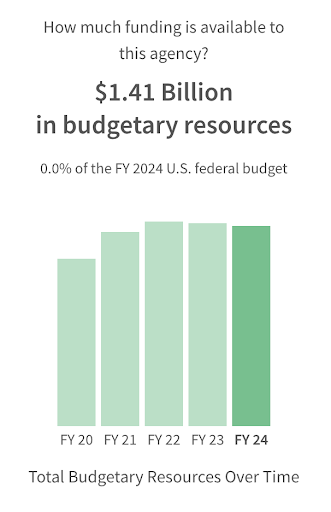
- Budget: ~$1.5 billion
- Staff: over 2,000 employees (not including many detailees in certain offices)
- Brief history: created by Franklin D. Roosevelt in 1939, EOP originally included the White House office; the OMB predecessor, the Bureau of Budget; and small national security and economic policy councils. EOP expanded over time through executive orders, presidential reorganization plans, and legislation, and it now includes ~20 main offices and thousands of staff members.
- Headquarters: many senior EOP advisors work in the West Wing, which houses the president’s Oval Office, Cabinet Room, Situation Room, and other central offices; most staff are housed in office buildings close to the White House, such as the Eisenhower Executive Office Building.
Main activities
EOP offices support the president in carrying out the functions of the executive branch and implementing their vision. Some of the key activities of EOP offices include:
- Developing the president’s budget proposal: review and compile agency budget requests to create the president’s ~$6 trillion budget proposal to Congress, including for defense spending, which makes up ~half of discretionary spending.
- Advising the president: convene agency heads, senior officials, and experts to deliberate on foreign and domestic policy issues, generate policy or response options, and advise the president.
- Developing policy: provide technical and legal expertise to draft executive orders and other presidential directives.
- Directing and coordinating agencies: convene agencies to coordinate multi-agency initiatives, translate policy into specific implementation instructions, and provide guidance for agency operations like procurement, financial services, and technology use.
- Developing national strategies and guidance: create nonbinding guidance to direct agencies in alignment with the president’s agenda and communicate it to the public and internationally.
- Overseeing policy implementation: monitor policy implementation and programs across agencies; review rules and regulations created by agencies.
- Developing and communicating the president’s agenda: craft messaging strategies, coordinate public statements across agencies, manage media relations, and articulate administration positions to Congress, the public, and international audiences.
- Managing legislative affairs: work with Congress on legislation, advance the president’s legislative agenda, and build congressional support for initiatives.
- Promoting US trade interests abroad: negotiate trade agreements, resolve international trade disputes, enforce trade policies, and represent US interests in global trade organizations like the WTO to advance American economic and strategic objectives.
Organizational structure
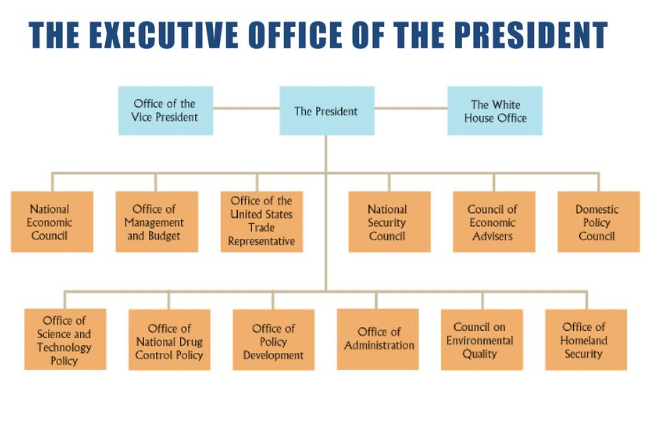
Since EOP is a collection of distinct offices and agencies all serving the president, there is no single “head” of all EOP entities. But the White House Chief of Staff functionally leads EOP, with all senior advisors and office heads either reporting to the Chief of Staff or directly to the president. While Senate confirmation is required for some advisors, such as the OMB Director, most are appointed with full presidential discretion.
While EOP is the technical term for the White House Office plus the collection of other offices directly supporting the president, the term “White House” is commonly used to describe the entire EOP. For example, the OMB Director and the US Trade Representative are technically “EOP staff,” not “White House staff,” but you can think of them as White House advisors to the president.
Main EOP offices
Most EOP offices advise the president and coordinate policy development and implementation among other executive agencies. With some exceptions, EOP offices themselves rarely serve an operational role in implementing policy. As EOP is designed to support the work of the president, EOP’s structure has varied over time, with offices created, reorganized, or dissolved via legislation or executive order. The table below overviews some of the main EOP components.
Office | Purpose | Head of Office | Staff | Budget |
|---|---|---|---|---|
prepare the federal budget and monitor agency performance; coordinate policy and regulations | Director of OMB (cabinet-level, Senate confirmed) | ~500 | ~$140M | |
advise the president on national security and foreign policies; coordinate security-related government actions | National Security Advisor (not cabinet, not Senate confirmed) | ~250-400 | ~$17M | |
advise the president on science and technology issues; guide R&D priorities | Director of OSTP (sometimes cabinet-level, Senate confirmed) | ~40-150 | ~$8M | |
coordinate international and domestic economic policy across federal agencies; advise on key economic policy issues | Director of NEC (not cabinet, not Senate confirmed) | ~30-35 | N/A | |
coordinate domestic policy across federal agencies; advise on key domestic policy issues | Director of DPC (not cabinet, not Senate confirmed) | ~60-70 | N/A | |
develop and coordinate US international trade policy; conduct trade negotiations | U.S. Trade Representative (cabinet, Senate confirmed) | 200+ | ~$76M | |
advise the president on pandemic preparedness and response policy; coordinate on biological threats | Director of Pandemic Preparedness (cabinet-level, Senate confirmed) | ~15 | ~$6M | |
advise the president on environmental policies; oversee federal environmental efforts | Chair of CEQ (not cabinet, Senate confirmed) | ~22 | ~$4.5M | |
National Space Council | advise on space policy and coordinate efforts; manage national space activities | Executive Secretary of the National Space Council (not cabinet, not Senate confirmed) | ~7 | ~$2M |
lead and coordinate cybersecurity efforts; advise on national cybersecurity policy | National Cyber Director (not cabinet, Senate confirmed) | ~77 | ~$19M | |
advise the president on economic policy; prepare economic reports and analyses | Chair of CEA (not cabinet, Senate confirmed) | ~28 | ~$5M | |
oversee thousands of executive branch appointments; manage personnel recruitment and vetting for the president. | Director of PPO, (not cabinet, not Senate confirmed) | ~80 | N/A | |
Office of the Intellectual Property Enforcement Coordinator | advise the president on intellectual property policy and strategy; coordinate implementation | Intellectual Property Enforcement Coordinator (not cabinet, Senate confirmed) | ~7 | ~$2M |
advise the president on national and international drug control policy; coordinate drug control programs | Director of ONDCP (not cabinet, Senate confirmed) | ~72 | ~$30M | |
assist and support the vice president in carrying out their executive duties | Vice President (cabinet) | ~26 | ~$6M |
Policy councils
While many EOP offices serve advisory policy roles, EOP has four formal policy councils—the National Security Council (NSC), the National Economic Council (NEC), the Domestic Policy Council (DPC), and the Office of Science and Technology Policy (OSTP). Each council is chaired by the president and brings together Cabinet members and senior officials to coordinate policy across the federal government. Council staff facilitate policy deliberations, manage interagency processes, and synthesize technical expertise from across agencies into actionable policy recommendations.
Council staff serve many roles: as “honest brokers” convening and mediating high-level policy deliberations among senior officials, as strategic advisors analyzing options and presenting recommendations to the president, as policy managers coordinating implementation across federal agencies, and as official representatives articulating and advocating for the president’s positions in government and to external stakeholders. NEC and DPC are smaller councils supported by ~20 staff; NSC is ~15 times larger with over 350 staff (though NSC staff size has varied greatly by administration).
Leadership and political appointments
EOP office heads generally hold the title “Assistant to the President” (or senior advisor) and are appointed at the full discretion of the president (PA positions). Senior executive branch officials who oversee a particular policy field are sometimes informally referred to as “czars” of their policy area. For example, the ONDCP director may be called “drug czar,” or the Chief Information Officer, the “information czar.”
There are about 225 presidential appointees in the EOP. Of these, ~22 require Senate confirmation due to their significant policy and budgetary responsibilities (e.g. OMB Director, US Trade Representative). In total, EOP houses about a third of presidential appointments not requiring Senate confirmation, making it a key tool for projecting presidential influence across the executive branch and Congress.
Why (not) work at EOP?
This section outlines key advantages and disadvantages of working in EOP. Given significant variation across EOP offices, these points are general observations that may not apply equally to every position. For example, unlike the rest of EOP, OMB, and USTR are staffed primarily by career civil servants, making some political considerations less relevant for staff there.
Advantages
- Public service and policy change: EOP staffers substantially contribute to executive agenda-setting by fleshing out, substantiating, and supporting presidential priorities. Few federal roles provide as many opportunities to contribute to policy change and positively impact the lives of all Americans.
- Career development: EOP staff positions are highly competitive and prestigious, providing strong credentials for senior positions in and out of government. They offer deep networking and learning opportunities, especially given the heavy collaboration among EOP offices. EOP staff or appointees will commonly rotate in and out of EOP, often starting in a more junior position and returning later to an appointed, more senior position.
- Supporting big-picture, cross-cutting policy work: Given EOP’s coordinating function in the executive branch, working there provides experience with policy and programs across the federal goverment (which is why EOP offices value prior government experience and process knowledge when hiring). As an EOP staffer, you could help create government-wide directives or national strategies that could affect how hundreds of agencies and sub-agencies implement policy. Some EOP offices—including USTR, NSC, and NEC—also work heavily on international issues, allowing staffers to contribute to multilateral coordination and governance.
- Helping shape the federal budget: OMB develops the president’s budget proposal, and many EOP components help coordinate the implementation of the final budget once it’s passed by Congress. Most policies are linked to the federal budget in some way, like R&D funding, federal procurement, operational costs of implementing new regulations, and funding for specific programs, making budget influence a powerful lever for shaping policy outcomes across the government.
- Intellectual stimulation: At EOP, you can work with talented and idealistic colleagues on complex, challenging issues of national importance in a fast-paced, rapidly-changing environment.
- Access to expertise from across federal government: Many EOP offices collate analysis and input from government agencies to help guide their coordination processes. By working at EOP, you can work with and learn from experts from across the executive branch.
Disadvantages
- Political dynamics: EOP work is heavily shaped by political considerations, especially during election years, when politically salient policies may dominate workflows. Most staff must maintain strict confidentiality about their work, carefully manage their public presence, and may need to support administration positions regardless of personal views. Political appointee positions in particular can create lasting partisan affiliations that may limit future career options with the opposite party, though this is less of a concern for career civil servants who often serve across administrations. Additionally, administrative transitions can lead to significant office restructuring, and career civil servants, particularly in offices like OMB, must adapt to potentially dramatic shifts in policy priorities when new presidents take office. But some EOP components are relatively more insulated from political dynamics, including parts of OMB and USTR.
- Less direct policy implementation: While EOP plays a crucial coordinating role and translates high-level policy into agency guidelines, it remains mostly removed from actual policy implementation, which happens through departments and agencies. Many EOP offices have limited budgets and formal authorities, requiring them to rely on softer influence methods like coordination, agenda-setting, and advisory roles. This distance from operational realities can cause agencies to criticize the White House for crafting impractical policies without understanding ground-level implementation challenges. For this reason, it can be beneficial to start your career at an agency to gain practical implementation experience before transitioning to a White House role.
- Much work is reactive: In some EOP components, like NSC, much of the work involves responding to current events (“putting out fires”) rather than proactively and strategically choosing projects based on their importance.
- Barriers to entry: Securing an EOP position often requires significant prior government experience, with many offices staffed heavily by detailees from other agencies, though fellowships can provide an alternative pathway into these roles. Most positions also require security clearances. Even at the entry-level, including internships, many positions will be filled by people whose applications have been internally flagged, making it challenging for outsiders to break in without existing connections.
- Location constraints: Almost all EOP positions are in person in DC, in or near the White House compound.
- Work/life balance: Many EOP offices demand intense work schedules, with long days common and work frequently extending into weekends and holidays. EOP staffers often work in fast-paced, high-stakes environments given the scope of their policy coverage, and must remain perpetually available. Security concerns can also restrict where staffers can travel in some cases. These conditions can lead to high burnout and turnover rates, with many staff members departing after just 12-18 months of service. For career civil servant positions, workloads can still be intense but are often more sustainable long term.
- Career instability: Administration changes can lead to substantial office restructuring and replacement of political appointees, and the prevalence of temporary detailees creates constant staff turnover. Advancement to senior positions often depends heavily on political connections rather than merit alone.
- Pay: Generally, EOP staff receive lower pay than private sector equivalents (though often more than staff in academia or at nonprofits). More information about recent pay ranges can be found on Ballotpedia and on EOP official salary reports (some White House data might exclude certain EOP components).
EOP and AI policy
EOP components help the president develop AI policy, guide and oversee federal spending on AI R&D and acquisition, coordinate AI use within agencies, and monitor and oversee policy implementation by agencies. EOP also supports US international engagement on AI, including through bilateral talks, international forums, and tariff and export control strategies.
Trump administration (2025):
- December 2025: The White House launches the US Tech Force, a cross-government corps aimed at recruiting ~1,000 technology specialists to to serve across federal agencies, with training and post-program employment pathways provided by private-sector partners.
- December 2025: President Trump signs an Executive Order on “Ensuring a National Policy Framework for Artificial Intelligence,” which formalizes an administration policy favoring “minimally burdensome” AI regulation. The order directs federal agencies to identify and challenge state laws deemed inconsistent with this policy.
- August 2025: Under the Trump administration’s new OneGov initiative, the General Services Administration (GSA) secures procurement agreements allowing federal agencies to access commercial AI tools from OpenAI, Anthropic, Google, and xAI for $1 or less per agency per year.
- July 2025: The White House unveils its AI Action Plan, which outlines a strategy to ensure US dominance in AI. The plan includes over 90 policy recommendations structured around three pillars: “Accelerating Innovation,” “Building American AI Infrastructure,” and “Leading in International Diplomacy and Security.”
- July 2025: President Trump signs an Executive Order to accelerate AI data center buildout through expedited federal permitting, streamlined environmental reviews under the National Environmental Policy Act (NEPA), and access to federal lands for projects over 100 megawatts or $500+ million in investment.
- July 2025: President Trump signs an Executive Order establishing the “American AI Exports Program” to promote the global deployment of full-stack American AI technology. The Department of Commerce will solicit proposals from industry consortia for comprehensive AI packages that include hardware, software, models, and applications targeting specific countries or regions. Selected proposals will receive coordinated federal financing and diplomatic support through the Economic Diplomacy Action Group to compete with adversary AI technologies globally.
Biden administration (2021-2024):
- January 2025: President Biden signs an Executive Order on AI infrastructure to accelerate AI infrastructure development, including by making federal sites available for AI data centers, fulfilling permitting obligations expeditiously, and facilitating interconnection of AI infrastructure to the electric grid. The EO tasks CEA with helping analyze electricity cost implications and CEQ with helping establish a “grand challenge” for energy efficient data center practices.
- October 2024: The White House releases the first National Security Memorandum on AI, focused on US leadership, national security, and international AI governance. The memorandum assigns coordination roles across EOP, tasking NEC with assessing the competitiveness of the US private sector AI ecosystem, OMB with exploring AI defense procurement options, and OSTP with developing standards for publishing computational biological models using AI, among many directives.
- May 2024: The Biden administration issues tariff increases on semiconductors following a USTR review of China’s trade practices.
- March 2024: The US and over 50 other countries endorse the Political Declaration on Responsible Military Use of AI and Autonomy, advancing international consensus on AI military applications. NSC led the development of the declaration, which launched in February 2023.
- December 2023: USTR co-chairs US-EU Trade and Technology Council meeting to deepen cooperation on AI, quantum technology, and semiconductor supply chains.
- November 2023: EOP coordinates US participation in the UK AI Safety Summit, an international forum to foster collaboration on the safe development of AI.
- November 2023: NSC coordinates Biden’s meeting with President Xi Jinping on global challenges, including addressing the risks of advanced AI systems and improving AI safety through US-China government talks.
- October 2023: President Biden signs an Executive Order on AI, establishing a comprehensive framework for federal AI policy. Many EOP offices drove the EO’s development: OSTP advised on the order’s technical goals; NSC analyzed domestic and international security implications; OMB translated the order into concrete government-wide directives through memorandums on AI acquisition and risk-management.
- July 2023: The White House receives voluntary commitments from Amazon, Anthropic, Google, Inflection, Meta, Microsoft, and OpenAI to help move toward the “safe, secure, and transparent development of AI technology.”
- May 2023: The White House releases the National AI R&D Strategy under OSTP leadership, prioritizing investments in responsible AI research, safety systems, and evaluation standards.
- October 2022: The US issues export controls on advanced semiconductors and manufacturing equipment to China, coordinated through NSC and other EOP policy councils.
- September 2022: OSTP publishes a Blueprint for an AI Bill of Rights providing non-binding principles for responsible AI system development and deployment.
- August 2022: The CHIPS and Science Act becomes law, providing $52.7 billion for semiconductor R&D and manufacturing. Implementation begins under EOP coordination, including through a steering council co-chaired by NSC, NEC, and OSTP.
Trump administration (2017-2021):
- December 2020: President Trump’s Executive Order on AI Use in Government tasks OMB with creating guidance for the use of AI in agency processes and programs.
- November 2020: OMB releases a memorandum to agency heads with guidance for the regulation of AI applications. OSTP, DPC, and NEC contributed to the memorandum’s development.
- February 2020: OSTP releases the American AI Initiative Annual Report detailing progress toward President Trump’s Executive Order on American Leadership in AI. Updates included US adoption of OECD AI principles and the president’s budget recommendation to double AI R&D over the following two years.
- September 2019: The White House hosts a Summit on AI in Government, focused on how the federal government can partner with the private sector to improve public services.
- June 2019: OSTP’s National Science and Technology Council releases an update to the National AI R&D Strategic Plan in support of the American AI initiative.
- February 2019: President Trump’s Executive Order on American Leadership in AI assigns coordinating roles to EOP offices for key objectives, including promoting sustained investment in AI R&D, training the next generation of American AI researchers and users, and developing a plan to protect US advantage in AI against strategic competitors.
- May 2018: The White House hosts an AI for American Industry Summit, bringing together over 100 senior government officials, technical experts, heads of research labs, and American business leaders to discuss policies to ensure American leadership in AI.
- May 2018: The White House announces the creation of the Select Committee on Artificial Intelligence under the National Science and Technology Council (NSTC) to advise the White House on interagency AI R&D priorities and improve the coordination of federal AI efforts. Its charter designated OSTP, the Defense Advanced Research Projects Agency (DARPA), and the National Science Foundation (NSF) as committee chairs. Designated members included representatives from the Department of Commerce, the Department of Energy, OMB, and NSC.

EOP and bio policy
EOP components help the president develop biotech and biosecurity-related policy, guide and oversee federal spending on R&D and bio-related programs, coordinate approaches among health and science agencies, and monitor and review policy implementation by agencies. EOP also supports US international engagement, including multi-lateral pandemic preparedness efforts.
Biden administration (2021-2024):
- October 2024: Biden’s National Security Memorandum on AI tasks OSTP, NSC, and OPPR with developing guidance promoting the benefits of and mitigating the risks associated with in silico biological and chemical research.
- April 2024: OSTP releases a framework on nucleic acid synthesis screening outlining how providers can implement scalable and verifiable screening mechanisms to prevent misuse of AI-enabled biotechnologies.
- December 2022: Congress passes the PREVENT Pandemics Act, establishing the Office of Pandemic Preparedness and Response Policy (OPPR) within EOP to lead efforts on biological threats and pandemics.
- October 2022: The Biden administration releases the National Biodefense Strategy and Implementation Plan, prioritizing pandemic preparedness and biosecurity innovations.
- October 2022: NSC develops the National Security Memorandum on Countering Biological Threats, Enhancing Pandemic Preparedness, and Achieving Global Health Security, formalizing multi-agency objectives to address biological national security risks.
- September 2022: President Biden signs the Executive Order on Advancing the American Bioeconomy, directing agencies to advance biotechnology solutions across sectors including health, agriculture, energy, and supply chain resilience. Among many directives, OMB was tasked with developing an implementation plan and recommending cybersecurity practices for biological data, OSTP with advancing data analysis on the bioeconomy, and USTR with helping review the regulatory process for biotechnology products.
- September 2022: OSTP, in coordination with relevant federal departments and agencies, releases the First Annual Report on Progress Towards Implementation of the American Pandemic Preparedness Plan, which details advancements toward pandemic preparedness, including priority areas for investment and additional efforts needed.
- July 2022: OMB and OSTP release multi-agency R&D priorities, including genomic sequencing for early warning in human, animal, and plant communities; innovations to improve indoor air quality and reduce disease transmission in buildings; next-generation personal protective equipment; and applied biosafety and biosecurity innovations.
- September 2021: OSTP and NSC release the American Pandemic Preparedness Plan outlining the transformational capabilities needed to directly address future biological threats.
- June 2021: The US and G7 countries commit to support the 100 Days Mission, aimed at shortening the cycle for developing safe and effective vaccines, treatments, and tests from 300 to 100 days after a pandemic outbreak.
Trump administration (2017-2021):
- December 2020: President Trump’s Executive Order on Ensuring Access to US government COVID-19 vaccines provides a mandate for the US to facilitate access to safe and effective COVID-19 vaccines. The order tasks NSC with coordinating the interagency strategy for ensuring a “sufficient supply of COVID-19 vaccine doses for all Americans who choose to be vaccinated.” More information on the first Trump administration’s COVID-19 response can be found here.
- May 2020: The Trump administration launched Operation Warp Speed (OWS), a public-private partnership to accelerate the development, manufacturing, and distribution of COVID-19 vaccines, therapeutics, and diagnostics. This joint DOW-HHS initiative coordinated vaccine development, manufacturing, and distribution across agencies with strategic direction from the White House.
- March 2020: OMB releases a memorandum with guidance on federal agency operational alignment to slow the spread of COVID-19.
- February 2020: OMB sends a letter to Congress requesting $2.5 billion for COVID-19 response efforts.
- January 2020: President Trump announces the formation of the President’s Coronavirus Task Force, charged with leading the US government response to COVID-19. EOP task force members included the national security advisor, the DPC Director, and the OMB director.
EOP components working on emerging technology policy
The following sections briefly highlight EOP offices that may play an especially important role in emerging technology:
–> See also our full NSC profile.
NSC is the oldest and largest White House policy council, coordinating the government’s national security enterprise and advising the president on national security matters. NSC is responsible for aggregating inputs from the government’s vast array of defense and intelligence bodies; convening agency heads and senior officials for international and domestic national security decisions; coordinating national security policy implementation among agencies; and designing short- and long-term national security strategies.
NSC’s policy focuses span homeland security, global public health, international economics, science and technology, cybersecurity, climate, irregular migration, and others. NSC’s staff mostly consists of temporarily assigned detailees from other federal agencies and political appointees.
On AI policy, NSC substantially contributed to the October 2023 Executive Order on AI, the February 2023 Political Declaration on Responsible Military Use of AI and Autonomy, and bilateral initiatives such as the EU-US Trade and Technology Council working groups on AI and AI safety dialogues with China, among many others. In October 2024, NSC released the first-ever National Security Memorandum on AI, directing government-wide actions to
“(1) ensure that the US leads the world’s development of safe, secure, and trustworthy AI; (2) harness cutting-edge AI technologies to advance the US Government’s national security mission; and (3) advance international consensus and governance around AI.”
On biosecurity policy, NSC’s Directorate for Global Health Security and Biodefense has coordinated policy to address threats ranging from pandemics to the misuse of biotechnology. As directed by Biden’s Executive Order on the Bioeconomy, NSC developed a national security memorandum to coordinate a whole-of-government approach to advance biotechnology and biomanufacturing in health, climate change, energy, food security, agriculture, supply chain resilience, and national and economic security.
–> See also our full OSTP profile.
OSTP is EOP’s primary science and technology (S&T) policy advisory body and helps coordinate federal S&T efforts across the executive branch. OSTP helps develop the federal research and development (R&D) budget in collaboration with OMB, convenes and facilitates deliberation among agency heads and senior officials, evaluates the effectiveness of science and technology programs, and ensures that policies are informed by the best available practices. It also plays a key role in shaping S&T-related national strategies, including microelectronics and research security, and collaborates with other federal agencies on both AI and biosecurity policies.
On AI policy, OSTP houses the National AI Initiative Office, which was established in 2021 to coordinate federal AI research and implement US national AI strategy. OSTP’s Science, Society, and Policy team has worked to ensure AI development, deployment, and use aligns with civil rights principles, including through OSTP’s 2022 Blueprint for an AI Bill of Rights. OSTP has also been heavily involved with implementing the 2022 CHIPS and Science Act, developing guidance on US semiconductor manufacturing, and developing the 2023 National AI Research and Development Strategic Plan.
On bio policy, OSTP has helped develop policy on bio-preparedness, biosecurity, and biotechnology. Under the Biden administration, OSTP’s Health Outcomes team focused on pandemic preparedness, biomedical innovation, antimicrobial resistance, and biosecurity, and OSTP’s National Security team focused on reducing pandemic risks.
–> See also our full OMB profile.
OMB is the largest EOP component, with roughly 500 staff. While its most visible function is developing the president’s annual budget proposal, OMB performs numerous other government-wide functions, including clearing legislative materials, executive orders, and memoranda; reviewing major regulations from agencies (through its Office of Information and Regulatory Affairs); and developing a management plan to efficiently implement the president’s agenda across the federal government.
OMB impacts AI policy through its many cross-cutting functions—it shapes AI-related R&D investment, reviews major regulations created by agencies, including those impacting the regulatory landscape for emerging technologies, guides government-wide technology procurement and implementation strategies, and issues memorandum to agency heads to implement executive orders, among other management roles.
OMB similarly impacts biosecurity policy through its wide-ranging oversight functions—it shapes funding for agencies like the National Institute of Health (NIH) and the Administration for Strategic Preparedness and Response (ASPR), reviews major regulations implementing biosecurity policy, and supports development and implementation of executive orders and other executive actions.
OPPR, established by Congress in 2023, leads and coordinates plans to prepare for and respond to potential pandemic threats or significant public health disruptions in the US. The office advises the president on pandemic preparedness, drives interagency coordination for domestic and global biological threats, and supports the development of expertise for detecting, identifying, and responding to these threats. OPPR generally maintains a more domestic focus, while NSC deals with more international biosecurity issues, though with significant collaboration across these areas. Having absorbed the COVID-19 and Mpox response teams, OPPR operates with approximately 15 staff members as of late 2024, though this number may change as the new office and public health needs develop.
Biden’s 2024 National Security Memorandum on AI tasked OPPR with helping develop guidance promoting the benefits of and mitigating the risks associated with in silico biological and chemical research.
–> See also our full NEC & DPC profiles.
NEC analyzes economic policy, advises the president, convenes senior officials for deliberation on international and domestic economic issues, and monitors policy implementation.
NEC has played multiple roles in AI policy: it helped coordinate the implementation of the CHIPS and Science Act and is responsible for identifying priority areas for increased federal government AI talent and co-leading a new task force on AI data center infrastructure to coordinate policy across government.
–> See also our full NEC & DPC profiles.
DPC has similar responsibilities to NEC but focuses on domestic policy issues, including education, health, immigration, welfare, labor, and many other cross-cutting issues.
While DPC plays a much broader convening and coordination role than more specialized offices (e.g. OSTP), it can still play specific roles in AI and biosecurity policy. For example, on AI, DPC is responsible for helping identify priority areas for increased federal government AI talent, and on biosecurity, DPC is responsible for supporting federal messaging for biothreats and bio incidents and for coordinating agency reports on biotechnology and biomanufacturing.
ONCD, established by Congress in 2021, coordinates cybersecurity strategy and policy, including efforts relevant to AI and biosecurity. As a new and growing office, ONCD’s permanent staff increased from 46 to 77 between FY 2023 and 2024, with an estimated 85 positions for FY 2025.
ONCD leads the implementation of the 2023 National Cybersecurity Strategy and subsequent cyber strategies, focusing on critical infrastructure protection, digital ecosystem resilience, and emerging technologies like AI. The office coordinates government-wide defense against cyber threats to healthcare, digital infrastructure, and biotechnology, and contributed to the 2024 National Security Memorandum on AI.
USTR is tasked with advising the president on trade issues, leading international trade negotiations, and overseeing the resolution of disputes, enforcement actions, and other trade matters before the World Trade Organization (WTO) and other global trade organizations. USTR meets with international governments, business groups, legislators, and the public to gather input on trade issues and to discuss the president’s trade policy positions. USTR has offices in Washington DC, Geneva, and Brussels. USTR has around 200 staff, making it one of the largest EOP offices (after the OMB and NSC).
On AI policy, US Trade Representative Katherine Tai co-chaired a US-EU Trade and Technology Council meeting focused on deepening cooperation in areas like AI, quantum technology, semiconductor supply chains, and digital infrastructure. Tai also worked on digital trade policy, including digital competition, privacy, and AI. In response to USTR’s review of 2024 China trade practices, the Biden administration issued tariff increases on semiconductors and other strategic sectors.
On bio policy, Biden’s Executive Order on Advancing the American Bioeconomy tasked USTR with helping review the regulatory process for biotechnology products and with coordinating international engagement on biosafety and biosecurity best practices.
Working at EOP
Staff positions and political appointments
Staffing composition in EOP varies widely by office. OMB and USTR are primarily staffed by career civil servants, which helps maintain continuity across presidential administrations. These offices experience less turnover and are typically more stable, offering long-term institutional knowledge for new presidents. For competitive service openings in EOP offices, you can filter for the name of the office on USAJOBS.
In contrast, most other EOP components (e.g. NSC and OSTP) are primarily staffed by a mix of political appointees, temporary detailees (e.g. from other federal agencies, nonprofits, or universities), and fellows from government fellowship programs like the White House Fellows program.
Some EOP offices like OSTP hire detailees with little to no government experience from academia or the private sector, making them accessible entry points for professionals with domain expertise but without extensive federal policy experience. For example, OSTP frequently brings in detailees from academia to draw on their scientific expertise. In contrast, many EOP offices like NSC typically require prior government experience, with staffing composed almost entirely of political appointees and detailees with federal backgrounds.
Political appointees, who comprise roughly 10% of EOP, are typically brought in by each new administration and serve at the pleasure of the president. These positions require strong alignment with the administration’s political priorities and connections to the administration, and appointees are often drawn from campaign teams, Congress, think tanks, or other policy organizations.
Civil servants and detailees provide technical and operational expertise, with temporary rotations from academia, nonprofits, and research institutions being common in offices like OSTP and OMB, particularly for specialized roles like economists, lawyers, or scientists.
Internships and fellowships
Internships are available across most EOP offices, many of them paid, and all based in Washington, DC. Only US citizens are eligible, and applicants who proceed to the final stage of the application will be required to complete the Standard Form (SF) 86 to determine whether they meet security clearance eligibility requirements. Some EOP offices (e.g. NSC) don’t take interns through this program.
Several fellowship programs offer placements across EOP (certain EOP offices may not be available in certain programs):
There’s a list of fellowship programs here, which are omitted from this narration.
- White House Fellows – a 1-year full-time fellowship for individuals from diverse disciplines and career stages with placements offered across the EOP, executive departments, the intelligence community, and other agencies. The program’s 2024 cohort included fellows with backgrounds in medicine, law, real estate, military, consulting, and many other disciplines, and placement offices included ONCD, OSTP, DPC, and the Office of the White House Chief of Staff.
- Presidential Management Fellowship – a 2-year full-time fellowship for graduate degree holders in any of various executive agencies. PMF fellows are paid for by the office that hosts them, which means that many smaller EOP offices do not have the staff budget to take PMF fellows. As a much larger office, OMB does take PMF fellows.
- AAAS Science and Technology Policy Fellowships (American Association for the Advancement of Science) – a 12-month fellowship in DC for STEM PhD holders with four separate tracks, placing fellows within the executive branch, judicial branch, legislative branch. As of 2024, AAAS only offered EOP placements in OSTP.
- STPI Science Policy Fellowship – a 2-year full-time science and technology policy fellowship with US executive branch offices for recent bachelor’s graduates. Of EOP offices, STPI primarily makes placements in OSTP.
- Horizon Fellowship (Horizon Institute for Public Service) – a 6-24 month full-time US emerging technology policy fellowship facilitating job placements in the US executive branch, Congress, and think tanks for early- and mid-career individuals. (Both this website and the Horizon Fellowship are projects of the Horizon Institute).
Further reading
General EOP resources
- EOP Budget Submission, Congressional Research Service (CRS) (2024)
- EOP Historical Overview, CRS (2008)
- White House Transition Project Office Briefs
- Trump White House Archives
AI
- Biden Administration Actions on AI, White House
- National AI Advisory Committee (NAIAC) reports
Bio
- Global Health Security Strategy, White House (2024)
- National Biodefense Strategy, White House (2022)
- American Pandemic Preparedness Plan, White House (2021)
- Executive Order on Advancing the American Bioeconomy, White House (2021)




Notes
-
Detailees are federal employees or non-government personnel (typically from think tanks or universities) temporarily assigned from other agencies to support specific offices within EOP. Many EOP offices heavily rely on detailees for their workforce, including the National Security Council (NSC) and the Office of Science and Technology Policy (OSTP). They often provide specialized expertise and are paid for by their home agency or organization (and not the EOP).
↩︎ -
Inside of EOP, there is the White House Office (WHO), and inside of WHO, there are 10+ offices and divisions, including the Presidential Personnel Office (PPO), the Domestic Policy Council (DPC), the National Economic Council (NEC), the Office of the Chief of Staff, and many others. While all of these components fall under the EOP umbrella, some also fall under the WHO umbrella. But this is largely a technicality with little functional relevance.
↩︎