Office of Science and Technology Policy (OSTP)

OSTP is the president's chief advisory body on science and technology. OSTP convenes senior officials on S&T policy, develops R&D budgets, evaluates federal programs, and coordinates science policy across agencies.
This profile focuses on the Office of Science and Technology Policy (OSTP) within the Executive Office of the President (EOP). For a more general overview of EOP and its relevance to AI and biosecurity, see:

Overview
The Office of Science and Technology Policy (OSTP) is the president’s chief advisory body on science and technology (S&T), providing strategic guidance and coordinating federal science policy initiatives. As part of the Executive Office of the President (EOP), OSTP develops R&D budgets, evaluates federal programs, convenes senior officials to deliberate on S&T issues, and ensures federal policy reflects scientific best practices. While OSTP’s formal powers are limited, much of OSTP’s influence stems from its collaboration with other executive departments and agencies with greater formal authority.
On emerging technology policy, OSTP plays a leading role in setting guidance and national strategies, coordinating R&D spending levels and multi-agency projects, and monitoring policy implementation. In the Biden administration, OSTP work included drafting a Blueprint for an AI Bill of Rights, helping implement CHIPS and Science Act directives on federal research policy, helping develop the American Pandemic Preparedness Plan, and creating a framework for nucleic acid synthesis screening to reduce the risk of misuse of synthetic biological products in R&D, among other initiatives. In the first Trump administration, OSTP published the first-ever national AI strategy, published a national AI R&D strategic plan, and launched the National AI Initiative Office, among other activities.
Background on OSTP
- Government context: OSTP is an EOP office; in the Biden administration, the OSTP director was a Cabinet-level political appointee
- Mission: to “serve as a source of scientific and technological analysis and judgment for the President with respect to major policies, plans, and programs of the Federal Government.”
- Main activities: advising the president on science and technology (S&T) issues; working with federal departments, agencies, and Congress to develop S&T programs; assisting the Office of Management and Budget (OMB) with budget preparation; evaluating the effectiveness of federal S&T efforts; supporting the President’s Council of Advisors on S&T (PCAST) and the National S&T Council (NSTC); and helping facilitate national security and emergency preparedness communications during national crisis
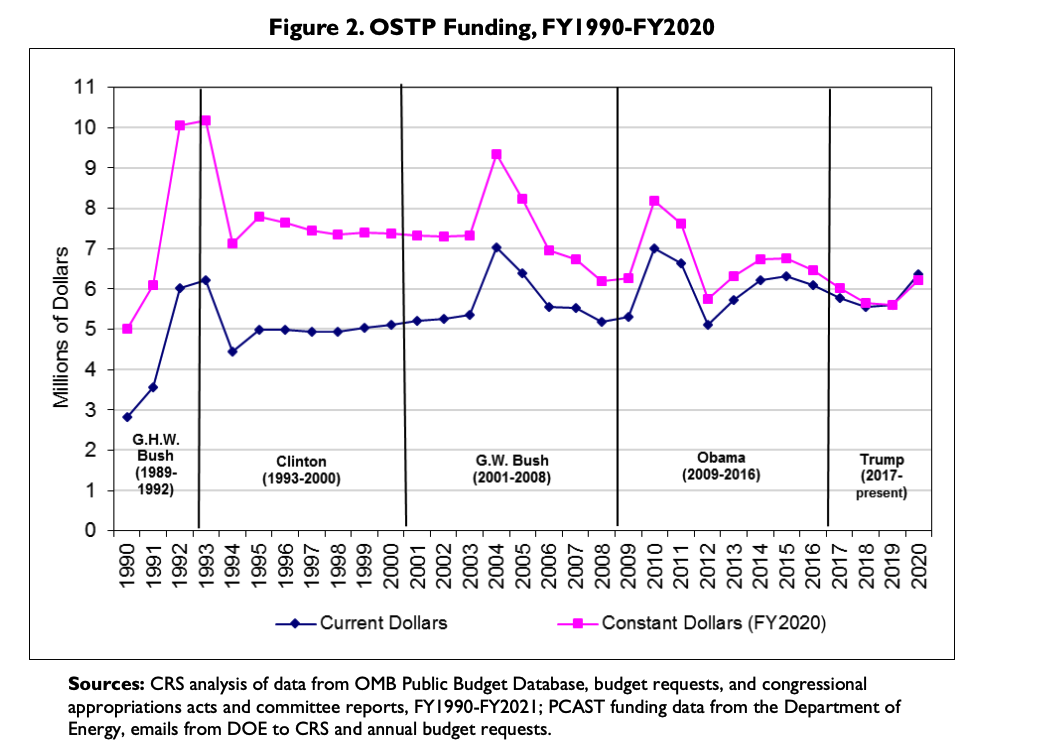
- Budget: ~$9 million (see figure below)
- Staff: 40-150 depending on the administration, with a large majority as temporary detailees from federal agencies or external organizations
- Brief history: prior to OSTP, presidents relied on various advisory mechanisms for S&T guidance, including the Office of Scientific Research and Development during WWII for wartime R&D. After several iterations of non-statutory science advisory bodies under different administrations, Congress established OSTP in 1976, creating a permanent statutory structure for presidential S&T advice.
EOP science and technology policy advisory structure
EOP’s primary components for broadly coordinating S&T advice and policy include:
- OSTP: serving as the central S&T coordinating office.
- National Science and Technology Council (NSTC): an interagency body of Cabinet members, the OSTP Director, and agency heads that coordinates federal S&T policy. OSTP staff frequently chair NSTC subcommittees and working groups.
- President’s Council of Advisors on Science and Technology (PCAST): external experts providing high-level advice to the president. OSTP provides operational support to PCAST.
Many other EOP offices also contribute to areas of S&T policy, including specialized offices like the Office of Pandemic Preparedness and Response Policy (OPPR), the National Space Council (NSpC), the Climate Policy Office (CPO), and the Office of the National Cyber Director (ONCD). Broadly-scoped coordinating bodies in EOP play higher-level roles in S&T policy, including the Office of Management and Budget (OMB), the National Security Council (NSC), and the National Economic Council (NEC). The activities section below discusses OSTP’s relationship with other EOP offices.
Organizational structure
OSTP is led by a director and up to four associate directors, all presidentially appointed and Senate-confirmed. The president can choose whether the OSTP director also serves as the Assistant to the President for S&T (APST, or “science adviser”), or appoint a separate APST without Senate confirmation. Additional leadership positions like deputy directors can be appointed without Senate confirmation, giving presidents flexibility in determining the structure of OSTP leadership and the extent of congressional oversight.
OSTP’s structure can vary significantly between administrations. For example, the Biden administration established six OSTP policy teams: climate and environment; energy, health and life sciences; national security; science and society; and the office of the US Chief Technology Officer. The first Trump administration established only three teams—science, technology, and national security—and reduced OSTP staff size from more than 100 to less than 70. Under President Obama, OSTP had ~100 staff (breakdown of staff positions by office). See OSTP org charts for Biden and Trump below.
Several presidents have also jointly appointed (“dual-hatted”) OSTP leadership to other EOP offices with overlapping policy issues. For example, President Trump appointed the OSTP director jointly to the National Space Council; and President Biden jointly appointed an OSTP deputy director to the NSC.


Activities
With limited formal authorities and a very small budget, OSTP relies on strong interagency relationships to advance its mission. So, much of OSTP’s influence arises from its extensive collaboration with federal agencies and other EOP offices. As former OSTP Deputy Director Thomas Kalil noted:
I often tell people that ‘influence without authority’ is one of the most valuable skills a White House staffer can have…OSTP couldn’t have accomplished much without having strong relationships with key decision-makers within federal agencies. Ideally, these agencies would (a) react to the ideas OSTP proposed; (b) suggest ideas to us; and (c) implement the ideas we jointly agreed to pursue.
Coordinating federal R&D spending
OSTP guides science and technology (S&T) priorities through its role in the federal budget process. In each budget cycle, OSTP collaborates with the Office of Management and Budget (OMB) to shape the president’s budget by following these steps:
- Federal agencies send R&D priority recommendations to OSTP and OMB. These form the basis for a joint memorandum on the administration’s R&D priorities, which agencies use to prepare their budget requests.
- OSTP provides guidance as agencies develop their budgets, focusing on agencies with larger R&D budgets and cross-agency priorities.
- OSTP and OMB review proposed agency budgets to ensure alignment with administration goals. OSTP gives direct feedback as agencies negotiate with OMB over funding levels.
- OSTP advises on the quality and alignment of agency budget proposals with presidential priorities, while OMB decides what goes into the president’s budget proposal (though in many cases, OMB defers to OSTP). Ultimately, Congress makes the final funding decisions.

In recent years, federal R&D spending has averaged about 9% of the discretionary budget. As shown in the graph, this amounted to ~$180 billion in fiscal year 2021, of which more than three quarters was spent by the Departments of Defense and Health and Human Services (primarily the NIH), followed by smaller (though still substantial) amounts for DOE, NASA, NSF, and other agencies.
Broadly overseen by OMB and OSTP, federal R&D funds flow from over 30 federal agencies to researchers in industry, academia, and the nonprofit sector. OSTP’s fact sheet on the Biden administration’s 2025 budget outlines $202 billion in S&T investments, highlighting programs like DARPA’s AI Forward Initiative and DOE’s integration of supercomputing, AI, and quantum technology.
Advising the president on S&T issues
OSTP is critical in drafting and coordinating national strategies and executive orders on S&T issues. This often involves close collaboration with the National Security Council (NSC), as both OSTP and NSC are statutorily responsible for advising the president on S&T and national security. During the COVID-19 pandemic, for example, OSTP and NSC issued a joint request for input on building emergency clinical research capacity. When S&T matters arise, the OSTP director attends NSC meetings, and some presidents have appointed individuals to both OSTP and NSC to strengthen collaboration.
Similarly, OSTP often collaborates with NEC where S&T issues overlap with economic policy. When the OSTP director is also appointed Assistant to the President for S&T (APST), they become a member of the NEC, enhancing the integration of S&T policy in economic discussions.
Convening the NSTC for policy coordination
The National Science and Technology Council (NSTC), a cabinet-level body advising the president on S&T, is integral to federal S&T coordination. OSTP staff chair or co-chair most NSTC committees, subcommittees, and interagency working groups. Coordination of federal S&T initiatives typically happens through these NSTC components:
- NSTC Subcommittees: Representatives from federal departments and agencies plan, coordinate budgets, and evaluate S&T initiatives.
- National Coordination Offices (NCOs): These offices support operations by hosting meetings and preparing documents like annual reports to Congress.
- Interagency Working Groups: Agency personnel with technical expertise work together on international collaborations, strategic documents, and projects.
Many OSTP outputs result from collaboration with NSTC. Federal R&D priority setting, for instance, is guided by NSTC subcommittees, supported by NCOs, and executed by interagency working groups.
Supporting S&T policy formulation and implementation
Through its role in NSTC, OSTP helps issue policy guidance and frameworks for federal research agencies on topics such as research security, advanced manufacturing, and orbital debris. While typically nonbinding, these frameworks carry significant weight by setting widely recognized norms and goals, guiding council deliberations, and signaling administration priorities.
OSTP’s guidance can also attempt to inform federal and private sector actions in the absence of existing law or policy. For example, OSTP’s nonbinding Blueprint for an AI Bill of Rights sought to guide the design, use, and deployment of automated systems in areas not yet covered by federal policy.
OSTP can also use its status as a White House office to catalyze action from private sector actors, such as philanthropic investment in priority areas. For example, in 2024 OSTP convened an event and announced $100 million in investments in the public interest ecosystem, much of which came from non-governmental foundations.
OSTP and AI policy
OSTP serves a pivotal role in federal AI policy by convening and coordinating agency heads, setting R&D priorities, shaping federal AI strategies, and ensuring progress on the implementation of national AI initiatives. OSTP often acts as a coordination hub or support mechanism for significant AI-related efforts, particularly those involving cross-cutting policy issues.
AI-related developments at OSTP
Trump administration (2025):
- November 2025: OSTP issues a Request for Information on “Accelerating the American Scientific Enterprise,” soliciting proposals to modernize federal R&D funding, strengthen regional innovation ecosystems, and prepare for AI-driven advances in scientific research.
- October 2025: OSTP and the Office of Management and Budget (OMB) release the FY27 R&D priorities memorandum, which identifies AI as a top priority for ensuring US leadership in critical technologies and accelerating scientific discovery.
- October 2025: OSTP Director Michael Kratsios signs Technology Prosperity Deals with Japan and South Korea, establishing bilateral frameworks for collaboration on AI, quantum computing, biotechnology, space, 6G, and fusion energy.
- September 2025: President Trump signs an Executive Order directing the MAHA Commission, OSTP, and the Special Advisor for AI to apply AI analysis to Childhood Cancer Data Initiative (CCDI) data in pursuit of new pediatric cancer treatments.
- July 2025: OSTP supports the development of the AI Action Plan, which outlines a strategy to ensure US dominance in AI. The plan includes over 90 policy recommendations structured around three pillars: “Accelerating Innovation,” “Building American AI Infrastructure,” and “Leading in International Diplomacy and Security.”
- April 2025: President Trump signs an Executive Order establishing the White House Task Force on AI Education, chaired by the OSTP Director, and directs federal agencies to emphasize AI literacy in education grants, develop AI training programs for teachers, and expand AI-related apprenticeships.
Biden administration (2021-2024):
- December 2024: OSTP is tasked with helping coordinate agency implementation of the Biosafety and Biosecurity Innovation Initiative Plan, a framework “to reduce biorisks associated with advances in biotechnology, biomanufacturing, and the bioeconomy.”
- October 2024: President Biden’s National Security Memorandum on AI tasks OSTP with convening academic research institutions and scientific publishers to develop standards for publishing computational biological models, including those using AI.
- July 2024: NSTC releases a 2020–2024 progress report on Advancing Trustworthy AI R&D, which OSTP contributed to. The report evaluates agencies’ progress on national AI strategy priorities, including making long-term investments in responsible AI research, ensuring safety and security of AI systems, and measuring and evaluating AI technologies through benchmarks and standards.
- March 2024: OSTP releases the National Strategy on Microelectronics Research, which, as outlined in the 2021 CHIPS for America Act, aims to revitalize domestic manufacturing, strengthen supply chains, and help secure future semiconductor industry leadership.
- October 2022: OSTP helps develop implementation guidance for the National Strategy for Advanced Manufacturing, which aims to support US manufacturing competitiveness in semiconductors and other advanced technologies.
- September 2022: OSTP releases a Blueprint for an AI Bill of Rights containing “a set of five principles and associated practices to help guide the design, use, and deployment of automated systems to protect the rights of the American public in the age of artificial intelligence.” The Blueprint is a non-binding white paper and does not constitute federal policy.
- August 2022: the CHIPS and Science Act becomes law, which includes provisions directing OSTP to develop and oversee implementation guidance of uniform S&T policies across federal research agencies.
- July 2022: OSTP and OMB issue a joint memorandum outlining seven multi-agency R&D priorities for FY 2024, including advancing national security and technological competitiveness.
- January 2022: NSTC releases implementation guidance for National Security Presidential Memorandum-33 (about “US-Government Supported R&D”), which OSTP helped develop.
Trump administration (2017-2021):
- January 2021: OSTP establishes the National AI Initiative Office, charged with overseeing and implementing the US national AI strategy.
- June 2019: OSTP’s National Science and Technology Council releases an update to the National AI R&D Strategic Plan in support of the American AI initiative.
- February 2019: President Trump’s Executive Order on Maintaining American Leadership in AI requires AI R&D agencies to consider AI an agency R&D priority in line with OSTP’s R&D priorities memoranda. OSTP was tasked with helping develop memoranda to agency heads on the use of AI technologies and an action plan to protect US advantage in AI against strategic competitors and adversarial nations.
AI-relevant offices at OSTP
OSTP’s structure and staffing can shift significantly by administration. As of late 2024 in the Biden administration, OSTP is divided into six teams (see above); the following teams may be most relevant for AI policy:
- The Technology team (also known as the Office of the Chief Technology Officer) houses the National AI Initiative Office, which was established in 2021 to oversee and implement the US national AI strategy and serve as a hub for federal AI research and policymaking coordination.
- The National Security team aims to advance long-term global competitiveness and “[reduce] catastrophic risks through the assessment, development, deployment, and governance of current and emerging technologies…[including] catastrophic risks at the intersection of technology and global security, spanning nuclear, biological, cyber, and autonomous technologies, associated risks of war, pandemics, and large-scale disasters, as well as emergent risks in space, ocean, and polar domains.” The National Security team is a permanent component of OSTP and works through the NSC’s NSM-2 process, a multi-level system for developing and coordinating national security policy across the federal government. The team also collaborates with OMB on defense spending for the president’s budget proposal to Congress.
- The Science, Society, and Policy team, as part of its mission, seeks to ensure that AI advances democratic values “by coordinating a civil rights-based framework for the development, deployment, and use of emerging technologies.”
OSTP and biosecurity policy
OSTP guides key parts of federal biotechnology and biosecurity policy by convening and coordinating health and science agency heads, setting R&D priorities, developing frameworks for agencies, and monitoring implementation progress for announced policies. OSTP often plays coordination or support roles in major bio-related initiatives, particularly on cross-cutting policy issues.
Biosecurity-related developments at OSTP
Biden administration (2021-2024):
- December 2024: OSTP is tasked with helping coordinate agency implementation of the Biosafety and Biosecurity Innovation Initiative Plan, a framework “to reduce biorisks associated with advances in biotechnology, biomanufacturing, and the bioeconomy.”
- November 2024: OSTP releases a report on Building a Vibrant Domestic Biomanufacturing Ecosystem describing the current state of US biomanufacturing capacity and identifying key factors driving growth.
- October 2024: President Biden’s National Security Memorandum on AI tasks OSTP with developing guidance promoting the benefits of and mitigating the risks associated with in silico biological and chemical research in coordination with NSC and the Office of Pandemic Preparedness and Response Policy (OPPR).
- April 2024: OSTP releases a framework for nucleic acid synthesis screening, as directed by President Biden’s 2023 Executive Order on AI, to reduce the risk of misuse of synthetic biological products in research and development.
- March 2024: President Biden establishes the National Bioeconomy Board, co-chaired by OSTP and the Departments of Commerce and Defense.
- October 2022: the National Biodefense Strategy and Implementation Plan assigns OSTP many lead roles in priority biodefense activities, including supporting data integration for early warning systems, promoting safe and secure laboratory practices, developing a federal diagnostics joint capabilities plan, and investing in PPE innovation.
- September 2022: President Biden’s Bioeconomy Executive Order assigns multiple roles to OSTP, including coordinating implementation, reviewing agency reports on biotechnology and biomanufacturing, and reporting on implementation progress.
- September 2022: OSTP, in coordination with relevant federal departments and agencies, releases the First Annual Report on Progress Towards Implementation of the American Pandemic Preparedness Plan, which details advancements toward pandemic preparedness, including priority areas for investment and additional efforts needed.
- July 2022: OSTP and OMB issue a joint memorandum outlining seven multi-agency R&D priorities for FY 2024, including preparing for and preventing pandemics.
- March 2022: OSTP helps launch the Clean Air in Buildings challenge, a call to action for anyone who manages or maintains a building to help clean air through improved ventilation, filtration, and disinfection.
Trump administration (2017-2021):
- April 2020: OSTP helps release standard search engine tags for webpages containing information about COVID-19 prevention measures, disease spread statistics, quarantine rules, travel guidance, and testing.
- March 2020: OSTP supports the launch of the COVID-19 High Performance Computing Consortium to provide researchers worldwide with access to high-performance computing resources to advance the pace of scientific discovery in mitigating COVID-19.
- March 2020: Following an OSTP request, external researchers release the COVID-19 Open Research Dataset, an extensive machine-readable dataset of scholarly literature on COVID-19, SARS-CoV-2, and the Coronavirus group.
- May 2018: The White House announces the creation of the Select Committee on Artificial Intelligence under the National Science and Technology Council (NSTC) to advise the White House on interagency AI R&D priorities and improve the coordination of federal AI efforts. Its charter designated OSTP, the Defense Advanced Research Projects Agency (DARPA), and the National Science Foundation (NSF) as committee chairs. Designated members included representatives from the Department of Commerce, the Department of Energy, OMB, and NSC.
Biosecurity-relevant offices at OSTP
OSTP’s structure and staffing can shift significantly by administration. Under President Biden, OSTP is divided into six teams; the following teams may be most relevant for biosecurity policy:
- The Health Outcomes team aims to leverage S&T to improve human health, and its priority efforts include: “bio-preparedness, including pandemic preparedness, antimicrobial resistance, and biosecurity, health systems and health equity, accelerating biomedical innovation to patients, and innovation across the life sciences enterprise, including agriculture, biotechnology, and biomanufacturing.”
- The National Security team aims to advance long-term global competitiveness and “[reduce] catastrophic risks through the assessment, development, deployment, and governance of current and emerging technologies,” including biological and pandemic risks. The National Security team collaborated with NSC to develop the 2022 National Biodefense Strategy and the National Security Memorandum on Countering Biological Threats.
Working at OSTP
OSTP’s staffing levels varied significantly over time. Absent a large permanent staff (OSTP’s 2024 budget is only ~$9 million), OSTP relies heavily on detailees temporarily assigned from other agencies or outside of government. For example, in the Trump administration, OSTP reported its workforce as four political staff, 21 career staff, two unpaid consultants, one paid consultant, 34 detailees, four IPAs, and five fellows. While OSTP receives funding for ~46 full-time staff (FTEs) annually, total staff at any given point (including fellows and detailees) may exceed 100.
Temporary detailees: A common route to OSTP work is through a temporary rotation, either from within government (e.g. other agencies who detail their employees to OSTP), federally funded research and development centers (FFRDCs), or nonprofits and universities. These rotations typically last 1-2 years, after which detailees return to their home institution. Some fellowship programs—like the Presidential Innovation Fellowship, the White House Fellowship, and the American Society of Mechanical Engineers Fellowship—also regularly place fellows at OSTP. (Recent graduates interested in working with OSTP should also check out the STPI Science Policy Fellowship, as STPI is a designated FFRDC for OSTP support.)
Internships: OSTP offers paid spring, fall, and summer internships in Washington, DC, for undergraduate and graduate students with US citizenship. Applicants who receive an offer will be required to complete the SF-86 to determine whether they meet security clearance eligibility requirements. Applications close ~9 months before the program start date.
Jobs: To find open positions at OSTP, visit USAJOBS.gov filtering for “Office of Science and Technology Policy.” Given OSTP’s smaller staff size (much of which consists of fellows or detailees), OSTP openings on USAJOBS.gov are less common; public positions can include lawyers, administrators, and other roles.
Further reading
- OSTP, The White House
- What It’s Like to Work at the White House, former OSTP senior policy advisor Dean Ball (2025)
- OSTP documents and reports list, Biden White House
- OSTP, Trump White House Archives
- Congressional Budget Submission FY 2024, EOP
- OSTP: History and Overview, Congressional Research Service (CRS) (2020)
- OSTP: Issues and Options for the 118th Congress, CRS (2023)
- Federal R&D Funding: FY2023, CRS (2022)
- Federal R&D Report, Government Accountability Office (2022)
- Policy Entrepreneurship at the White House: Getting Things Done in Large Organizations, former OSTP director Thomas Kalil (2017)