Office of the Secretary of War (OSW)

OSW is responsible for policy development, planning, resource management, and program evaluation. OSW runs several AI and biosecurity-relevant efforts, including investing in research, purchasing equipment, drafting strategies, and more.
This profile focuses on the civilian activities of the Department of War (DOW) under the Office of the Secretary of War (OSW) and how they relate to AI and biosecurity. For a more general overview of DOW’s components and their relevance to science and technology policy, see our DOW agency profile:
Introduction
The Office of the Secretary of War (OSW) is located in the Pentagon, the DOW’s headquarters. With more than 2,200 staff as of 2022, OSW assists the Secretary and Deputy Secretary of War in “policy development, planning, resource management and program evaluation.”
The Secretary of War (SecWar) and Deputy Secretary of War (DepSecWar) are presidentially appointed civilian officials, and OSW’s oversight role is rooted in the principle of civilian oversight of the military. So, unlike the military departments or combatant commands, OSW is predominantly staffed by civilian personnel and has a distinctly civilian culture relative to much of the rest of DOW. Its staff are neither required to undergo military training nor serve in the field. While some staff come to OSW with military backgrounds, the majority are experts in the policy and programmatic work that OSW conducts.
Each component is led by a principal staff assistant, or “OSW Component head”, including the Under Secretaries of Defense, the Assistant Secretaries of Defense, the Chief Digital and AI Officer (CDAO), and others. Some of these components are purely operational (e.g. the General Counsel who provides legal advice to OSW). In contrast, others are policy-oriented (e.g. Director of Cost Assessment and Program Evaluation who plays a central role in DOW’s budget process).
While most OSW components do not have their own acquisition authority, OSW produces both the National Defense Strategy (NDS)—which sets the strategic direction for DOW—and the Defense Planning Guidance, which aligns the defense budget to NDS priorities. The Services and CCMDs, which do have acquisition authority, work with OSW to shape the NDS and DPG, but ultimately their budgets must align with the DPG.
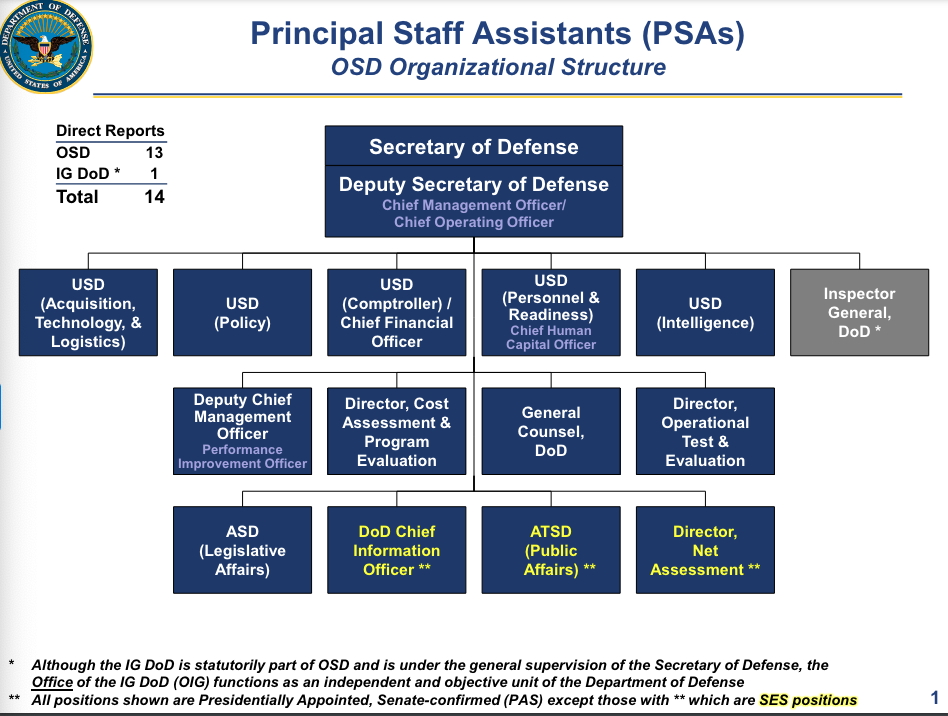
OSW org chart. Somewhat outdated; for example, it doesn’t reflect that USD (Acquisition Technology & Logistics) (USD(ATL)) was split into Research & Engineering (R&E) and Acquisition & Sustainment (A&S).
OSW and AI policy
OSW runs several AI-relevant lines of effort, including:
- investing in and conducting AI research, development, testing, and evaluation (RDT&E),
- integrating AI into military programs and budget planning,
- implementing national AI policies (e.g. the AI EO) as they apply to OSW,
- coordinating with academic, industrial, and international partners on responsible AI development,
- establishing DOW strategic directives, policies, and guidelines for AI adoption,
- prioritizing and streamlining emerging technology procurement, and
- assessing national security risks and opportunities associated with AI and other emerging technologies.
Over the last few years, new offices were created within OSW to coordinate the procurement of and strategic response to AI technologies. In 2022, DOW set up a new hub for AI—the Office of the Chief Digital and Artificial Intelligence Officer (CDAO)—by combining several existing offices: the Joint AI Center (JAIC), Defense Digital Services (DDS), the Chief Data Officer, and the enterprise platform Advana. CDAO oversees DOW’s strategy and policy development for accelerating data, analytics, and AI adoption across the department, and it manages the technical implementation of digital infrastructure and services that support DOW components’ development, adoption, and scaling of AI and analytics. CDAO reports to the Deputy Secretary of War and is led by a Chief Digital AI Officer (CDAO) and a Deputy CDAO (DCDAO). Several Acting DCDAOs oversee specific functional offices, such as Algorithmic Warfare, Acquisitions, Policy, Mission Analytics, Enterprise Platforms and Services, and Advanced C2 Acceleration.
In 2023, the Department established the new Force Development and Emerging Capabilities Office (FDEC) under OSW’s Policy office. The office performs strategic and budgetary planning for DOW investments in the new and existing technologies needed for the department’s mission. It also conducts force planning assessments to identify strategic and operational risks posed by emerging technologies and how to mitigate them, and it leads interagency work associated with AI and would lead on international engagements that involve military uses of AI.
The Biden Administration’s October 2023 Executive Order on AI includes requirements for OSW to investigate AI-related biosecurity risks, launch a project on using AI to remediate cybersecurity threats to defense networks, and submit a report on securing noncitizen defense-relevant AI talent, among other things. (For more detail, see this December 2023 3-pager from the Congressional Research Service)
See our DOW agency profile for a list of major AI-related developments at DOW and for information on working at DOW and OSW.
AI-relevant offices within OSW
OSW contains several offices that impact AI in different ways, including (not necessarily comprehensive):
- Office of the Under Secretary of War for Policy (OUSD-P): provides the Secretary with policy-relevant advice and strategic insight
- Assistant Secretary of War for Strategy, Plans, and Capabilities (OASD-SPC): provides leadership with strategic guidance, including review of major operations; produces the National Defense Strategy (NDS), Global Force Posture policy, and Quadrennial Defense Review (QDR); co-led DOW Directive 3000.09 on Autonomy in Weapon Systems
- Force Development and Emerging Capabilities Office (FDEC): tasked with strategizing, coordinating, and implementing the adoption of emerging technologies in the annual Planning, Programming, Budgeting, and Execution (PPBE) cycle; conducts force planning assessments to identify strategic and operational risks posed by emerging technologies and how to mitigate them; leads interagency work associated with AI and would lead on international engagements that involve military uses of AI
- Deputy Assistant Secretary of War for Cyber Policy (ASD-CP): establishes and oversees the implementation of DOW cyberspace policy and strategy in guidance with national cyberspace policy. Provides guidance and oversight on foreign cyberspace threats and international partnerships; established in Mar 2024
- Assistant Secretary of War for Space Policy (ASD-SP) (previously the Assistant Secretary of War for Homeland Defense & Global Security (HDHA))
- Nuclear and Countering Weapons of Mass Destruction Policy (NCWMD): focuses on improving defenses and reducing the threat of weapons of mass destruction (WMD); in the 2023 Countering WMD strategy, AI was added to the list of potentially disruptive technologies in their remit, and they work closely with FDEC on AI and biosecurity policy
- Defense Technology and Security Administration (DTSA): administers the development and implementation of DOW technology security policies on international transfers of defense-related goods, services, and technologies; reviews the export licensing of dual-use commodities and munitions items and provides technical and policy assessments on export license applications; heavily involved in semiconductor export controls
- Assistant Secretary of War for Strategy, Plans, and Capabilities (OASD-SPC): provides leadership with strategic guidance, including review of major operations; produces the National Defense Strategy (NDS), Global Force Posture policy, and Quadrennial Defense Review (QDR); co-led DOW Directive 3000.09 on Autonomy in Weapon Systems
- Office of the Chief Digital and Artificial Intelligence Officer (CDAO): oversees DOW’s strategy and policy development for accelerating data, analytics, and AI adoption across the department; manages the technical implementation of digital infrastructure and services that support DOW components’ development, adoption, and scaling of AI and analytics; reports to the Deputy Secretary of War.
- Strategy & Policy Directorate: develops CDAO’s strategies and harmonizes them with the Department’s strategies; advises the rest of DOW on implementing data, analytics, and AI policies; engages international partners on responsible AI policies
- Responsible AI (RAI) Team: drafts, coordinates, and implements the Responsible AI Pathway; they additionally publish a public RAI Toolkit that provides software and best practices for implementing responsible AI policies
- International Affairs and Strategic Engagement: leads international engagements like the AI Partnership for Defense to learn, share, and promulgate policies for international cooperation on responsible AI
- CJADC2 Division: provides data-driven decision-making capabilities and services to the Combatant Commands and Joint Staff; led by the Director of CJADC2
- Defense Digital Service (DDS): develops software solutions across the Department; team is made up of software and data engineers, data scientists, product managers, and designers; led by the Director of DDS
- Digital Talent Management Team: leads, oversees, supports, and educates the DOW data, analytics, and AI workforce; led by the Special Advisor to the CDAO
- Task Force Lima: stood up in August 2023 to explore risks and opportunities associated with generative AI across DOW; headed by a member of the CDAO’s Algorithmic Warfare Directorate
- Chief Technology Officer
- Strategy & Policy Directorate: develops CDAO’s strategies and harmonizes them with the Department’s strategies; advises the rest of DOW on implementing data, analytics, and AI policies; engages international partners on responsible AI policies
- Defense Innovation Unit (DIU): works to identify, prototype, and scale technology from the commercial sector, including AI, for DOW missions; helps companies that don’t traditionally interact with or sell to DOW get their foot in the door, after which they would be ‘passed on’ to other, larger DOW customers. As of the 2024 NDAA, DIU is a principal staff assistant and is the primary adviser to Department leadership on how commercial technology should be leveraged to support DOW objectives
- Strategic Capabilities Office (SCO): DOW’s rapid prototyping office for emerging technologies; embeds teams in combatant commands to identify strategic and tactical problems that emerging technologies can solve, then funds prototypes and works with combatant commands to adopt them; ~$1B annual budget; reports to the Deputy Secretary of War
- Office of Cost Assessment and Program Evaluation (CAPE): drives the annual budget process, making it important for all S&T-related activities; conducts department-wide cost estimates, analysis of program effectiveness, and data-driven analysis of DOW programs, including all AI-related initiatives
- Office of Net Assessment (ONA): provides long-term comparative assessments of trends, key competitors, risks, opportunities, and future prospects of US military capability; assessments are typically classified, tightly controlled in distribution, and provide strategic-level management insights for the SecWar and other senior DOW leaders; mission is not AI-specific, but it may do AI-relevant work, e.g. on long-term technological trends and/or weaponization
- Privacy, Civil Liberties and FOIA Directorate (PCLT): responsible for the formulation and implementation of the Freedom of Information Act Policy for DOW; leads much of DOW’s AI ethics implementation work, including monitoring internal DOW oversight bodies to ensure DOW AI usage complies with internal guidelines; led by the Assistant to the SecWar (ATSD) for PCLT who serves as the DOW Privacy and Civil Liberties Officer, reports to SecWar, and coordinates with ODNI’s Office of Civil Liberties, Privacy and Transparency
- Office of the Under Secretary of War for Intelligence & Security (USD (I&S)): principal advisor to OSW on intelligence, counterintelligence, and security matters; exercises authority, direction, and control over DOW intelligence and security agencies, field activities, policies, processes, procedures, and products; AI-related activities include adopting AI capabilities for intelligence, counterintel, and security purposes; reports to SecWar and the Director of National Intelligence
- Office of the Under Secretary for Research and Engineering (OUSD-R&E): DOW’s Chief Technology Officer; promotes research, technology, and science to maintain the military’s tech edge (org chart on p. 2)
- Defense Advanced Research Projects Agency (DARPA): funds early-stage, defense-relevant research on science and technology—designed to make long-term investments for the sake of breakthrough tech; organized into six “Offices”, which employ program managers and other staff to design and manage research programs; at least four of its Offices have AI-relevant programs:
- Information Innovation Office (I2O), apparently the main home for AI projects (see here);
- Strategic Technology Office (STO) (e.g. AlphaDogfight);
- Tactical Technology Office (TTO) (e.g. CAML); and
- Defense Sciences Office (e.g. SAIL-ON)
- Office of the Deputy CTO for Science & Technology (DCTO(S&T)): contains various programs including those focused on basic research funding, emerging technologies, and the defense industrial base; specific offices may have their own websites, e.g. the Basic Research Office (which administers programs and weighs in on research security and talent policy)
- Office of the Deputy CTO for Critical Technologies (DCTO(CT)): contains various programs including ones focused on “Trusted AI & Autonomy”, “Microelectronics” (e.g. semiconductors), and “Human-Machine Interfaces”
- Defense Innovation Board (DIB): provides recommendations to OSW and others in DOW about how to address challenges with technology and capabilities; recommended ethical AI principles for DOW to operate under, which were officially adopted in 2020; typically has high-profile members, currently chaired by Michael Bloomberg.
- Defense Science Board (DSB): advisory board that provides DOW with recommendations related to science and technology
- Test Resource Management Center (TRMC): conducts an array of AI-relevant projects, such as OUSD R&E Autonomy & AI Pathfinder Project and Repository of Autonomy and AI T&E Data Enterprise
- Office of Strategic Capital (OSC): develops and implements strategies and partnerships to accelerate and scale private investment in critical supply chain technologies needed for national security. Critical tech areas include biotech, AI, quantum, human-machine interfaces, integrated sensing, and cyber, among others.
- Defense Advanced Research Projects Agency (DARPA): funds early-stage, defense-relevant research on science and technology—designed to make long-term investments for the sake of breakthrough tech; organized into six “Offices”, which employ program managers and other staff to design and manage research programs; at least four of its Offices have AI-relevant programs:
- Office of the Under Secretary of War for Acquisition and Sustainment (OUSD-A&S): creates regulations and policy, and oversees the logistics of all purchases for DOW (org chart)
- Office of the Assistant Secretary of War for Industrial Base Policy (OASD-IBP): principal advisor to OUSD-A&S on all matters related to defense contractors, incl. monitoring developments in the private sector
- Deputy Assistant Secretary of War for Industrial Base Resilience (DASD(IBR)): coordinates DOW’s response to EO 14017 on defense-critical supply chains, which include semiconductors; oversees the Policy, Analysis, and Transition (PA&T) Program and the Global Investment and Economic Security (GIES) program; DOW’s industrial policy offices lead in implementing the Defense Production Act (DPA), which can be used to support or control US companies in scenarios of national security significance
- PA&T office conducts analyses of the defense industrial base and supply chains, including issuing an annual report to Congress
- GIES delivers national security risk analyses and mitigation proposals to decision makers to resolve national security concerns around foreign investment in US companies (as DOW’s representative to CFIUS) and mergers and acquisitions (M&A) activity
- Deputy Assistant Secretary of War for Industrial Base Resilience (DASD(IBR)): coordinates DOW’s response to EO 14017 on defense-critical supply chains, which include semiconductors; oversees the Policy, Analysis, and Transition (PA&T) Program and the Global Investment and Economic Security (GIES) program; DOW’s industrial policy offices lead in implementing the Defense Production Act (DPA), which can be used to support or control US companies in scenarios of national security significance
- Office of the Assistant Secretary of War for Nuclear, Chemical and Biological Defense Programs (OASD-NCB): leads DOW’s efforts to ensure safety from weapons of mass destruction and is chair of the biodefense council.
- Deputy Assistant Secretary of War for Threat Reduction and Arms Control (DASD(TRAC)): treaty manager for all chemical, biological, nuclear, and conventional treaties. It currently does not appear to have AI-related activities but may be part of an interagency effort—along with the State Department and OUSD(Policy) offices—if there are ever serious arms control negotiations on AI
- Deputy Assistant Secretary of War for Chemical and Biological Defense (DASD(CBD)): counterpart to CDAO on defending against chemical, biological, and nuclear risks
- Office of the Assistant Secretary of War for Industrial Base Policy (OASD-IBP): principal advisor to OUSD-A&S on all matters related to defense contractors, incl. monitoring developments in the private sector
- Office of the Director for Operational Test & Evaluation (DOT&E): tests and evaluates DOW equipment and systems to ensure they are capable of operating smoothly; tasked by DOW’s 2022 Responsible AI Strategy and Implementation Plan with “Develop[ing] a TEVV framework to articulate how test and evaluation (T&E) should be intertwined across an AI capability’s lifecycle and pathways for continuous testing and standards for documenting and reporting” (LOE 2.1.2) among other assignments (org chart)
- Office of the General Counsel (OGC): principal legal advisor to DOW; helps OSW adjudicate some AI-related policies, but most work is not AI-related
OSW and biosecurity policy
Many of the DOW offices and programs most directly involved in biosecurity and biodefense-related initiatives sit within OSW. These efforts include:
- Developing strategic policy and guidance for the SecWar and ensuring DOW-wide readiness and resilience against biothreats
- Strategizing and coordinating the adoption of emerging biotechnologies to mitigate strategic and operational risk
- Safeguarding military personnel through comprehensive programs focused on detection, diagnostics, and response to chemical, biological, radiological, and nuclear (CBRN) threats
- Leading advanced biotechnology research and overseeing the development of critical biosecurity technologies
- Regulating and managing export controls to prevent the proliferation of dual-use biotechnology (incl. with international partners via the Australia Group)
- Enhancing medical capabilities to address infectious disease threats to ensure total force readiness
- Improving partner nations’ healthcare capacity and pandemic response through international cooperation and support programs
- Managing the acquisition and sustainment of defense systems related to chem-bio defense.
In 2022, the White House published the National Biodefense Strategy and Implementation Plan and DOW published the National Defense Strategy. Both of these announce efforts to better prepare for biosecurity threats following the COVID-19 pandemic. Building on these, in 2023 DOW released the first Biodefense Posture Review (BPR), which outlined comprehensive reforms to address biological threats through 2035. The BPR highlighted that DOW has the requisite authorities and resources, but needs a more collective and unified approach to its coordination of biosecurity efforts. Given OSW’s responsibility for policy development, planning, resource management, and program evaluation, much of the coordination work laid out in the BPR falls to OSW components.
Biosecurity-relevant offices within OSW
OSW contains several offices that impact biosecurity in different ways, including (not necessarily comprehensive):
- Office of the Under Secretary of War for Policy (OUSD-P): provides the Secretary with policy-relevant advice and strategic insight
- Assistant Secretary of War for Strategy, Plans, and Capabilities (OASD-SPC): provides leadership with strategic guidance, including review of major operations; produces the National Defense Strategy (NDS), Global Force Posture policy, and Quadrennial Defense Review (QDR)
- Force Development and Emerging Capabilities Office (FDEC): is tasked with strategizing, coordinating, and implementing the adoption of emerging technologies in the annual Planning, Programming, Budgeting, and Execution (PPBE) cycle; conducts force planning assessments to identify strategic and operational risks posed by emerging technologies and how to mitigate them.
- Deputy Assistant Secretary of War for Nuclear and Countering Weapons of Mass Destruction Policy (DASD NCWMD): focuses on improving defenses and reducing the threat of weapons of mass destruction (WMD). This office contributes to biosecurity policy such as the National Biosurveillance Strategy (NBS), Defense Planning Guide (DPG) for CBRN, and the Biodefense Posture Review (BPR). It also works to advance the Biological Weapons Convention (BWC) and leverages DOW’s Cooperative Threat Reduction Program (CTR) to reduce threats and build partner capacity to respond to biological threats.
- Defense Technology Security Administration (DTSA): aims to prevent the export of critical technologies that could threaten national security and undermine foreign policy. The DTSA provides policy and expertise in multilateral and export control forums to help regulate and manage the export controls of sensitive and dual use technologies related to biodefense and other critical areas.
- Assistant Secretary of War for Strategy, Plans, and Capabilities (OASD-SPC): provides leadership with strategic guidance, including review of major operations; produces the National Defense Strategy (NDS), Global Force Posture policy, and Quadrennial Defense Review (QDR)
- Office of the Under Secretary of War for Research and Engineering (USD(R&E)): is responsible for DOW’s research and engineering efforts, including biotechnology initiatives.
- Defense Advanced Research Projects Agency (DARPA): DARPA’s mission is to make pivotal investments in breakthrough technologies for national security. Their biodefense-related programs focus on developing innovative methods for rapid detection, prevention, and response to biological threats, enhancing military readiness, and ensuring resilience against emerging infectious diseases and bioterrorism. These programs leverage advanced technologies such as synthetic biology, gene editing, bioinformatics, and molecular analysis to create robust defense mechanisms and on-demand therapeutic solutions for warfighters and civilian populations.
- Office for Science and Technology (S&T): advances technology solutions for national defense, including biodefense technologies.
- OSW’s Manufacturing Technology program (ManTech) oversees the Manufacturing Innovation Institutes (MIIs), which are spending on biomanufacturing capabilities, including BioFabUSA.
- Office of the Under Secretary of War for Acquisition and Sustainment (USD(A&S)): oversees the acquisition and sustainment of defense systems, including those related to chemical and biological defense.
- Office of the Assistant Secretary of War for Nuclear, Chemical, and Biological Defense Programs (ASD(NCB)): the principal adviser to SecWar, DepSecWar, and the USD(A&S) on matters related to nuclear, chemical, and biological defense programs.
- There are three Deputy Assistant Secretaries of Defense (DASD) reporting to the ASD(NCB). Most notable for biosecurity is the DASD for Chemical and Biological Defense (DASD(CBD)). The additional two DASDs are for Nuclear Matters (DASD(NM)) and for Threat Reduction and Arms Control (DASD(TRAC)).
- Deputy Secretary of War for Chemical and Biological Defense Program (CBDP): focuses on safeguarding military personnel and the nation from CBRN threats. The program includes advanced research in life and physical sciences, the development of detection, diagnostic, and therapeutic technologies, and comprehensive response and decontamination strategies.
- Joint Program Executive Office for Chemical, Biological, Radiological and Nuclear Defense (JPEO-CBRN): manages the development and fielding of CBRN defense equipment and is one of the four components of the CBDP.
- Office of the Assistant Secretary of War for Nuclear, Chemical, and Biological Defense Programs (ASD(NCB)): the principal adviser to SecWar, DepSecWar, and the USD(A&S) on matters related to nuclear, chemical, and biological defense programs.
- Defense Threat Reduction Agency (DTRA): focuses on countering WMD and emerging threats by deterring strategic attacks; preventing, reducing, and countering threats; prevailing against WMD-armed adversaries. Their efforts include several biosecurity programs, including the Joint Science and Technology Office (JSTO), which serves as the Department’s hub for chem-bio defense science and technology efforts.
- Military Health System (MHS): supports combat readiness and medical research, as well as provides healthcare to active-duty military personnel, retirees, and their families.
- Health Readiness Policy and Oversight (HRP&O): leads policy formulation and program oversight of the Military Health System clinical policies and programs and provides medical information, advice and consultation to senior DOW officials, Congress, other government agencies and stakeholders. Its policy portfolio includes biosurveillance, medical countermeasures, and emergency response logistics.
- Defense Health Agency (DHA): aims to improve health and build readiness for the nation’s defense forces. DHA leads biosurveillance efforts for the Department. DHA also has programs that focus on enhancing knowledge and capabilities that address infectious disease threats, supporting operational readiness through research and development of new therapeutics, vaccines, and medical technologies.
- Defense Innovation Unit (DIU): works to identify, prototype, and scale technology from the commercial sector, including biosecurity, for DOW missions; helps companies that don’t traditionally interact with or sell to DOW get their foot in the door, after which they would be ‘passed on’ to other, larger DOW customers. As of the 2024 NDAA, DIU is a principal staff assistant and is the primary adviser to Department leadership on how commercial technology should be leveraged to support DOW objectives.
- Strategic Capabilities Office (SCO): DOW’s rapid prototyping office for emerging technologies; embeds teams in combatant commands to identify strategic and tactical problems that emerging technologies can solve, then funds prototypes and works with combatant commands to adopt them; ~$1B annual budget; reports to the DepSec.
- Office of Cost Assessment and Program Evaluation (CAPE): drives the annual budget process, making it important for all S&T-related activities; conducts department-wide cost estimates, analysis of program effectiveness, and data-driven analysis of DOW programs, including all biosecurity-related initiatives.
- Defense Security Cooperation Agency (DSCA) – Overseas Humanitarian, Disaster, and Civic Aid (OHDACA) program: aims to enhance partner nations’ ability to provide essential services, addressing issues like disease and unexploded ordnance. The DOW’s Humanitarian Assistance Program supports pandemic response and long-term healthcare capacity by providing medical supplies and infrastructure. These efforts help reduce reliance on international disaster relief and promote regional stability.
- Office of Net Assessment (ONA): ONA is responsible for conducting long-term strategic assessments to inform US defense policy and planning. It produces highly classified reports that analyze potential future threats and opportunities to inform military strategy and capabilities.
Further reading
DOW/OSW and AI
- [DOW memo] DOW Data, Analytics, and Artificial Intelligence Adoption Strategy
- [video] The State of DOW AI and Autonomy Policy
- [DOW memo] Terms of Reference – Defense Science Board Task Force on Balancing Security, Reliability, and Technological Advantage in Generative Artificial Intelligence for Defense
- [DOW memo] USD(R&E) Technology Vision for an Era of Competition
- [DOW resource] Responsible Artificial Intelligence (RAI) Toolkit
DOW/OSW and biosecurity
- [DOW news] DOW Chemical, Biological Defense Program Adapts to Emerging Threats as it Marks 30-Year Anniversary
- [DOW report] 2023 Biodefense Posture Review
- [White House report] 2022 National Biodefense Strategy