
National Science Foundation (NSF)

NSF is an independent federal agency that advances US science and engineering progress through competitive research grants, partnerships, education, and workforce development. NSF investments drive developments across AI, biosecurity, and other emerging technologies.
Overview
The National Science Foundation (NSF) is an independent federal agency that advances US science and engineering progress through competitive research grants, partnerships, education, and workforce development initiatives. As the second largest federal funder of basic research, NSF provides ~25% of all such funding to US universities, particularly in physical sciences, mathematics, social sciences, and computer science. NSF investments have driven the development of key technologies, including 3D printing, kidney transplant matching, artificial neural networks, LASIK eye surgery, and the internet. NSF grants have supported the early work of numerous Nobel Prize winners, over half of all Turing awardees, and many startups, including Google and Duolingo.
NSF frequently leads government-wide science and technology initiatives and is critical in shaping US research priorities. The agency has recently expanded its focus to include translational research and commercialization, working increasingly with state and local governments, industry, venture capital, and other partners. On AI, NSF funds research on machine learning, robotics, advanced cybersecurity, and other areas, and supports workforce training and computing infrastructure. On biotechnology, NSF invests in synthetic biology, bioinformatics, and biosecurity, funding initiatives like Predictive Intelligence for Pandemic Prevention and BioFoundries to accelerate biotech innovation. These examples illustrate NSF’s much broader portfolio of AI and biotechnology efforts—visit NSF’s award search portal for a comprehensive view of projects across all topics.
Background on NSF
- Government context: NSF is one of 56 independent agencies of the US government; it often operates with greater autonomy than executive departments.
- Mission: to maintain US leadership in scientific discovery while ensuring broad participation; to promote the progress of science, advance national health, prosperity, and welfare; and secure national defense.
- Main activities: funding scientific research through competitive grant programs, supporting education and training in STEM fields, fostering innovation through public-private partnerships, maintaining research infrastructure and facilities, coordinating with other federal agencies on cross-cutting science initiatives, and advising on science and technology policy.
- Budget: ~$10.8 billion annually, with ~$7.5 billion as research funding.
- Staff: ~1,500 permanent federal staff and ~200 visiting scientists on temporary assignments from research institutions, giving NSF one of the highest funding-to-staff ratios in the US government.
- Brief history: During WWII, President Franklin D. Roosevelt commissioned a report arguing that basic scientific research was essential for national prosperity and security and proposing the creation of a federal agency to facilitate post-war scientific innovation. President Harry Truman signed the National Science Foundation Act in 1950, formally establishing NSF. In 2021, NSF created the Technology, Innovation, and Partnerships (TIP) Directorate, focused on bringing emerging technologies from lab to market.
Organizational structure
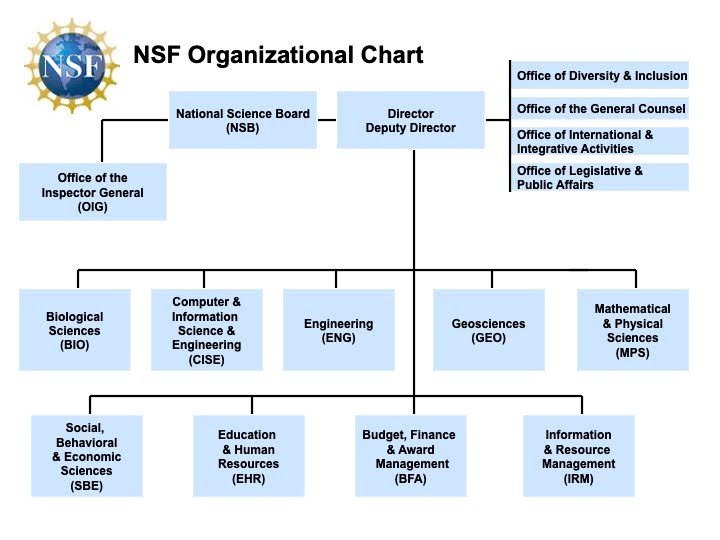
Source (lightly edited). This org chart is missing the Directorate for Technology, Innovation, and Partnerships (TIP). Here is an up-to-date (though unwieldy) version.
NSF is governed jointly by the National Science Board (NSB) and the NSF Director, who is presidentially appointed and Senate-confirmed. The NSB, a board of 25 presidentially appointed members from industry and academia, establishes NSF-wide policies, approves major NSF programs and awards, and serves as an independent advisory board to the president and Congress on science and engineering policy. The Office of the Director (OD) supports NSF leadership and provides strategic and administrative support across the agency, including on legal issues, legislative affairs, and NSF-wide programs.
Most of NSF’s core work happens through scientific directorates, each led by an Assistant Director and Deputy Assistant Director and guided by an advisory committee. Each directorate supports its field through basic research grants, public partnerships, and workforce development programs:
- Biological Sciences (BIO)
- Computer and Information Science and Engineering (CISE)
- Engineering (ENG)
- Geosciences (GEO)
- Mathematical and Physical Sciences (MPS)
- Social, Behavioral, and Economic Sciences (SBE)
- Directorate for STEM Education (EDU)
- Directorate for Technology, Innovation and Partnerships (TIP)
Grantmaking occurs through all scientific directorates and the Offices of International Science and Engineering (OISE) and of Integrative Activities (OIA).
Several administrative offices support the directorates, including the Office of Budget, Finance, and Award Management and the Information and Resource Management Office.
NSF and AI policy
NSF has long served as a primary AI research funder through its CISE Directorate, which supports foundational work in machine learning, robotics, computing infrastructure, and human-computer interaction. CISE also runs the National AI Research Institutes program, funding multi-institution research centers focused on use-inspired AI across domains like agriculture and cybersecurity. Many pivotal AI breakthroughs trace back to NSF-funded basic research in AI and computing.
NSF’s TIP Directorate—its first new directorate in over 30 years—works agency-wide to accelerate emerging technology development and deployment by supporting commercialization, workforce development, and cross-sector partnerships. TIP’s initiatives have focused on privacy-enhancing technologies, novel protein design approaches, and advancing cell-free systems, among many other emerging technologies.
AI-related developments at NSF
- August 2025: NSF partners with NVIDIA and the Allen Institute for AI (Ai2), committing $75 million to the Open Multimodal AI Infrastructure to Accelerate Science (OMAI) project, which aims to build fully open-source, multimodal AI models trained on scientific data.
- March 2025: NSF-funded researcher Andrew Barto receives the Turing Award for co-developing reinforcement learning.
- October 2024: Two NSF-funded researchers receive the 2024 Nobel Prize in Physics “for foundational discoveries and inventions that enable machine learning with artificial neural networks.”
- September 2024: NSF launches the $15 million Safe-OSE program to help established open-source ecosystems address vulnerabilities.
- September 2024: NSF and the Department of Commerce announce $30 million in funding to advance US semiconductor talent as part of the CHIPS and Science Act.
- July 2024: NSF announces an AI testbeds initiative to allow researchers to study new AI methods and systems in secure, real-world settings.
- April 2024: NSF launches its ReDDDoT program to support the responsible design, development, and deployment of key technologies, focusing on those in the 2022 CHIPS and Science Act.
- January 2024: NSF launches its National AI Research Resource Pilot to provide computing resources to researchers.
- May 2023: NSF develops the National AI Research and Development Strategic Plan in collaboration with the White House Office of Science and Technology Policy and other committees.
- May 2023: NSF awards $140 million to establish seven new National AI Research Institutes.
- December 2022: NSF appoints a new special assistant for AI to the NSF Director.
- September 2022: NSF TIP launches the Regional Innovation Engines program to support regional innovation ecosystems across the US, including for semiconductors and AI. (See award distribution by topic here).
- March 2022: NSF establishes the TIP directorate to accelerate emerging technology development and strengthen US competitiveness.
AI-relevant offices at NSF
NSF has several offices contributing AI-relevant efforts (non-exhaustive):
- National Science Board (NSB): oversees NSF, establishes NSF policies, approves NSF’s strategic budget directions, and approves new major programs and awards. It comprises 25 presidentially appointed members, often prominent academic researchers, university presidents, and industry leaders.
- Office of the National Science Board (ONSB): a team of ~19 policy, communications, legal, and executive secretariat staff supporting NSB’s work; has formerly hosted AAAS fellows.
- Office of the Director (OD): supports the Director and Deputy Director in NSF’s management, operations, and strategic planning. A Special Assistant to the Director for AI leads the implementation of US policies, initiatives, and executive orders.
- Office of International Science and Engineering (OISE): funds projects connecting US researchers with global partners; coordinates international efforts involving AI.
- Directorate for Computer and Information Science and Engineering (CISE): funds basic research and supports workforce development in computer science, information science, and computer engineering.
- Division of Information and Intelligent Systems (IIS): funds projects in human-centered computing, informatics, and intelligence.
- Division of Computing and Communication Foundations (CCF): funds projects in theoretical computer science, algorithmic improvements, and hardware design.
- Office of Advanced Cyberinfrastructure (OAC): funds projects in advanced computing, data and software infrastructure, networking capabilities, and cybersecurity.
- Directorate for Technology, Innovation and Partnerships (TIP): funds applied research in emerging technologies; supports regional growth and innovation and emerging technology workforce development. Its main programs include a training and mentorship program (I-Corps) and partnerships to translate NSF-funded research into applications.
NSF and biosecurity policy
NSF’s main contributions to biosecurity stem from its research funding programs, primarily housed in its Directorate of Biological Sciences (BIO). BIO manages research competitions in biological sciences with a dual focus on advancing knowledge and risk mitigation. NSF broadly supports US biosecurity and biotechnology through investments in biological research, education, and scientific infrastructure and by partnering with other federal agencies to coordinate a national approach to biological threats.
The National Institutes of Health, part of the Department of Health and Human Services, serves as NSF’s biomedical counterpart, funding medical and public health research.
Biosecurity-related developments at NSF
- September 2024: NSF and the National Institutes of Health (NIH) establish a joint program to accelerate the translation of fundamental synthetic and engineering biology advances to early-stage biomedical technologies.
- August 2024: NSF announces $75 million in awards to create five BioFoundries—facilities to help researchers rapidly design, build, and test biotechnology tools.
- August 2024: NSF announces $72 million in funding for pandemic preparedness research through its Predictive Intelligence for Pandemic Prevention (PIPP) program.
- February 2024: NSF partners with NIH to support research on RNA-based methods for biotech innovations.
- December 2023: NSF encourages research proposal submissions related to biotech as an emerging industry.
- April 2023: NSF updates proposal guidelines for potential life sciences dual-use research of concern, strengthening risk-benefit assessment requirements and clarifying restrictions on gain-of-function research.
- September 2022: Biden’s Executive Order on the Bioeconomy tasks NSF with submitting “a report identifying high-priority fundamental and use‑inspired basic research goals to advance biotechnology and biomanufacturing.”
Biosecurity-relevant offices at NSF
NSF has several offices contributing to biosecurity-relevant efforts (non-exhaustive):
- Directorate for Biological Sciences (BIO): supports research and education to advance understanding of all life forms; oversees funding programs, implements biosecurity guidelines, and coordinates biosafety initiatives across the US government.
- Division of Molecular and Cellular Biosciences (MCB): supports research on the fundamental properties of living systems at the atomic, molecular, subcellular, and cellular levels, including synthetic biology.
- Division of Biological Infrastructure (DBI): supports the development of biological research infrastructure, including human capital, technologies, and research centers.
- Office of Research Security Strategy and Policy (OCRSSP): protects US research from security threats in partnership with law enforcement and the intelligence community.
- Office of International Science and Engineering (OISE): works across all NSF directorates to promote global science collaboration; coordinates international efforts involving dual-use concern, biotechnology, and biosecurity.
- Directorate for Technology, Innovation and Partnerships (TIP): funds applied research in emerging technologies, focusing on regional growth and innovation, technology development and translation to market, and workforce development. On biotechnology, TIP has invested in novel approaches to protein design and accelerating the adoption of cell-free systems.
- Directorate for Engineering (ENG): invests in novel engineering approaches; supports engineering education and workforce development; fosters strategic partnerships to strengthen US research capacity. On biotechnology, ENG supports NSF’s interagency Smart Health program for high-risk, high-reward research in biomedical and public health issues.
Working at NSF
NSF primarily hires into the following occupational categories:
- Scientists, engineers, and technologists serve as program directors, overseeing funding programs, evaluating grant proposals, and advancing scientific research.
- Program administrators support NSF’s research funding programs, build data analytics tools, coordinate grant processes, and manage logistics.
- Communications and public affairs staff support NSF’s engagement with the public, policymakers, and the scientific community. NSF is increasingly hiring people with private sector and start-up expertise to support public-private partnership projects.
To find open positions at NSF, visit USAJOBS and filter for “National Science Foundation,” or check NSF’s Careers page. Some positions, including certain temporary roles, may not always be listed on USAJOBS. You can also follow NSF on LinkedIn for updates on hiring and research funding.
NSF offers opportunities for mid-career STEM professionals to serve as temporary program directors through its rotator programs, including its Visiting Scientist, Engineer, and Educator (VSEE) and Intergovernmental Personnel Act (IPA) programs. NSF also offers Federal Temporary Appointments, which do not require an institutional affiliation.
NSF participates in the Pathways Program, which brings early-career professionals into the civil service. For internships, fellowships, and other early-career opportunities, check the Federal Internship Finder and the USAJOBS Federal Internship Portal, filtering for NSF positions. Opportunities for students and recent graduates include:
- NSF Summer Scholars Internship Program – a full-time, paid, 10-week summer internship for underrepresented undergraduate and graduate students, hybrid with several days of in-person work in Alexandria, VA.
- AAAS Science & Technology Policy Fellowship (STPF) – a 1-2 year fellowship in DC for STEM PhD holders to serve in the US government or a nonprofit.
- Presidential Innovation Fellowship (PIF) – a 1-2 year full-time fellowship for mid-to-senior-level technology experts.
- US Digital Corps – a 2-year full-time fellowship for early-career technologists.
- Horizon Fellowship – a 6-24 month full-time US emerging technology policy fellowship facilitating job placements in the US executive branch, Congress, and think tanks for early- and mid-career individuals.
Further reading
- US National Science Foundation Strategic Plan 2022 – 2026, NSF (2022)
- Science: The Endless Frontier 75th Anniversary, NSF (2020)
- The National Science Foundation: An Overview, Congressional Research Service (2021)
- Computing and the National Science Foundation, 1950-2016: Building a Foundation for Modern Computing, Peter A. Freeman, et al. (2019)







Notes
-
On average, NSF program officers oversee portfolios of ~80 active research awards totaling $10–15 million annually, though this varies by program and grant size. With ~600 program officers managing over 50,000 active projects, each is responsible for dozens of new and continuing grants at any given time. On the administrative side, NSF grants officers process thousands of award actions per year, implying oversight of hundreds of grants annually per officer. These figures are based on NSF reports and data from the mid-2010s through 2020.
↩︎ -
Both OISE and OIA are located in the Office of the NSF Director.
↩︎ -
Note that this website is a project of the Horizon Institute for Public Service, which also runs the Horizon Fellowship.
↩︎