

Export controls
Overview
Export controls are regulations that restrict which goods, technologies, and services can be sold or transferred to foreign countries, entities, or individuals. The US government primarily uses export controls to protect national security by limiting access to the most sensitive US technologies and weapons. More than a dozen federal agencies administer export controls across a vast range of goods and technologies, including advanced semiconductors, conventional weapons, and nuclear materials.
Export controls have long been a core tool of US national security policy and have recently attracted particular attention in the context of emerging technologies. Since October 2022, the US has enacted multiple rounds of controls affecting global access to AI-related technologies, from semiconductor manufacturing equipment to AI chips. The US has also recently expanded bio-related controls—which cover pathogens, toxins, and related—to include items such as nucleic acid synthesis software with potential biological weapons applications.
This guide explains the reasons and mechanisms for export controls, outlines the key institutions and processes, and discusses considerations and opportunities for working on export controls.
Why does the government use export controls?
Export controls generally serve one or more of these primary policy goals:
- Preventing adversaries from acquiring sensitive goods: The US restricts the flow of conventional weapons, nuclear materials, dual-use technologies, and technical knowledge to hostile actors—including designated countries of concern and non-state actors like terrorist organizations—often in coordination with allies through multilateral export control regimes.
- Preserving strategic advantages: Beyond denying specific dangerous capabilities, export controls can aim to maintain broader advantages over strategic competitors by restricting their access to advanced technologies. This rationale has become increasingly prominent in recent years.
Export control basics
Export controls can be categorized by what gets controlled, who can receive controlled items, and what they can be used for. Controls can apply to both tangible exports (physical goods) and intangible transfers like software, services, and technical know-how.
Controls vary in breadth. Comprehensive embargoes—typically imposed through sanctions programs—restrict nearly all exports to certain countries, such as North Korea, Cuba, or Iran. Selective controls, which comprise the majority of export controls and are the focus of this guide, restrict only certain items or technologies to specific actors.
What gets controlled
The US controls three main types of exports:
- Dual-use items are goods that can be applied for both civilian and military purposes (e.g. software, semiconductors, biotech). These comprise most US export control activity, and their control falls under the Export Administration Regulations (EAR), administered by the Department of Commerce’s Bureau of Industry and Security (BIS).
- Munitions (e.g. weapons, satellites, spacecraft, and defense services) are controlled by the International Traffic in Arms Regulations (ITAR) under the Department of State’s Directorate of Defense Trade Controls (DDTC).
- Nuclear technologies are controlled primarily by the Department of Energy’s National Nuclear Security Administration (NNSA) and the Nuclear Regulatory Commission (NRC). NNSA oversees the transfer of nuclear technologies abroad, including reactor design, enrichment technologies, and related services. NRC maintains licensing authority for exports of reactors and nuclear-grade materials.
These agencies and their roles are covered in more depth below.
How controls work
For each controlled item, the US may set restrictions or conditions based on where it is going, who will receive it, and how it will be used:
- List-based controls define explicit parameters for what items may require an export license. These controls apply nationwide to one or more countries and have a licensing policy depending on the reason for control. For some destinations, exporters may be required to obtain a license, which agencies review to determine whether the export should be allowed and under what conditions.
- End-use controls restrict exports based on how items might be used. These controls are designed to prevent items from supporting adversaries’ activities like chemical and biological weapons development, nuclear weapons programs, or other restricted military applications. Even when an item and destination might otherwise be permissible, exports can be blocked if there’s evidence the item will support a prohibited end use.
- End-user controls restrict exports to specific persons or entities identified as posing national security or foreign policy risks. For example, BIS’s Entity List designates foreign entities to which exports require a license, often with a presumption of denial. The Department of the Treasury’s Office of Foreign Assets Control (OFAC) administers related restrictions through sanctions programs, which can also prohibit transactions with specific designated parties.
BIS also has the authority to write “is-informed letters”—a flexible tool that allows BIS to impose a license requirement on specific exports or activities subject to US jurisdiction. Because these letters are non-public and do not require the same interagency review process as updates to list-based or end-use/end-user controls, they allow BIS to act quickly on targeted transactions.
The US maintains several lists of specific entities subject to export restrictions. Foreign persons, companies, and organizations on these lists may face license requirements, additional scrutiny, or outright prohibitions on receiving controlled items. US exporters must screen potential customers against these lists before completing transactions.
The Consolidated Screening List (CSL) combines lists maintained by the Departments of Commerce, State, and Treasury into a single searchable database. These include:
Commerce’s Bureau of Industry and Security (BIS) (roughly from most to least severe):
- Denied Persons List: Individuals and entities (both US and foreign) stripped of export privileges due to violations. Denied persons can’t participate in export-controlled transactions in any capacity, and no one may export to them without special authorization.
- Military End-User List: Foreign entities identified as developing, producing, using, or maintaining military items in support of the military capabilities of countries of concern. Exports of specified items (e.g. electronics, encrypted devices, and commercial aircraft parts) to MEU-listed entities require a license, which is often denied. The list is not exhaustive; exporters must still conduct due diligence to determine whether unlisted entities meet the military end-user definition.
- Entity List: Foreign entities that pose national security or foreign policy risks. Exports to listed entities require a license. The license review policy varies by entity, but often involves a presumption of denial. BIS adds entities based on intelligence assessments, proliferation concerns, violations of US export controls, and other factors.
- Unverified List: Entities that BIS has been unable to verify through end-use checks (inspections confirming the legitimacy of the end-user and end-use). This is not a punitive measure—entities are added when verification cannot be completed for reasons outside US government control (such as host government denial of inspection access). Exporters must conduct extra due diligence when dealing with these entities and cannot use most license exceptions.
Treasury’s Office of Foreign Assets Control (OFAC):
- Specially Designated Nationals (SDN) List: Individuals and entities owned or controlled by, or acting on behalf of, countries subject to US sanctions programs (such as Iran, North Korea, Syria, and Cuba), as well as designated terrorists, narcotics traffickers, and other threats. SDN-listed parties have their assets blocked, and US persons are generally prohibited from doing business with them.
State’s Directorate of Defense Trade Controls (DDTC):
- Debarred Parties List: Individuals and entities convicted of violating or conspiring to violate the Arms Export Control Act. As a result, they are subject to “statutory debarment” and prohibited from participating directly or indirectly in the export of defense articles (including technical data) and defense services.
Controls beyond US borders
US export control jurisdiction extends beyond direct exports from the US. Several mechanisms extend US authority to transactions that occur entirely abroad:
- De minimis rules extend US jurisdiction to certain foreign-produced items that contain a specified amount of US content.
- Foreign Direct Product Rules (FDPRs) extend US jurisdiction to certain products manufactured abroad using US goods, software, or technologies. This allows BIS controls to apply in scenarios like advanced semiconductors made in Taiwan using American equipment and intellectual property.
- Re-export controls require authorization when a controlled item that has already left the United States is transferred onward to a third country, or when a foreign-made product incorporating US-origin items above certain thresholds is exported to a restricted destination (e.g. a country purchasing US defense equipment cannot resell it to another nation without US approval).
- In-country transfer controls require authorization when a controlled item remains in the same country but is transferred to a different end user, since the original export license is typically tied to a specific recipient and intended use.
- US person controls restrict the activities of US citizens and permanent residents regardless of where they are located. For example, a US engineer working abroad could be prohibited from providing technical assistance to a foreign government’s weapons program, even if the work occurs entirely outside the United States.
Unilateral and multilateral controls
The US enacts export controls both unilaterally (independently) and multilaterally (with other countries). Unilateral controls typically cover items or supply chains for which the US dominates market share. Multilateral controls are coordinated between the US and other states primarily through four major regimes:
- The Wassenaar Arrangement (1996) coordinates controls on conventional arms and dual-use goods and technologies among 42 participating states, with an emphasis on transparency among member states.
- The Missile Technology Control Regime (1987) covers 35 states seeking to limit the spread of missiles, drones, and delivery systems for nuclear weapons.
- The Australia Group (1985) includes 43 states aiming to limit chemical and biological weapons proliferation.
- The Nuclear Suppliers Group (1974) coordinates 48 states in preventing nuclear weapons proliferation.
Export controls and emerging technology
In recent years, the US has enacted multiple landmark controls aimed at restricting access to advanced technologies, most prominently advanced semiconductors and semiconductor manufacturing equipment.
AI-related export controls have attracted particular attention because of the unusual structure of the AI compute supply chain. Training and deploying frontier AI systems requires enormous computing power provided by specialized AI chips, and the supply chain that produces these chips has chokepoints that are largely dominated by the US and its allies. This concentration means that restricting access at one stage of the supply chain can in principle constrain downstream AI capabilities. The accordion below explains this supply chain and its relevance to export controls in more detail.
Training a single frontier AI model can cost hundreds of millions of dollars in compute alone, and the infrastructure needed to support it requires substantial capital investment. This is why AI chips and the supply chain that produces them have become the central focus of AI-related export controls.
The supply chain for AI chips involves several steps: design (where companies architect chip designs), fabrication (where foundries manufacture chips), and assembly, testing, and packaging (where firms prepare finished chips for use). Fabrication requires highly specialized semiconductor manufacturing equipment (SME) built by a small number of firms. These chips then flow through system integrators into data centers operated by cloud providers and AI companies, where they deliver the computing power used to develop and deploy AI systems.

What makes this supply chain unusual is its extreme concentration. A handful of firms dominate each chokepoint: Nvidia (American) designs the dominant share of AI chips; ASML (Dutch) is the sole supplier of extreme ultraviolet (EUV) lithography machines required for the most advanced fabrication; and TSMC (Taiwanese) manufactures roughly 90% of the world’s most advanced chips. The US and its close allies control these chokepoints, giving them significant leverage. Restricting access at any single stage by limiting exports of chips or manufacturing equipment can constrain downstream AI capabilities.
Compared to other key inputs to AI development, compute has several properties that are uniquely governable. Unlike training data and algorithms, which are non-rivalrous, easily copied, and difficult to track, computing hardware is a physical good that is:
- detectable (large AI data centers consume hundreds of megawatts of power and are visible via satellite),
- excludable (access can be restricted at the point of sale or export), and
- quantifiable (chip performance can be measured in operations per second and other technical parameters).
These properties help explain why recent export controls have targeted computing hardware rather than AI software or algorithms directly, and why such controls can define their scope using measurable technical thresholds like chip processing speed.
As the diagram above illustrates, US controls can target multiple points along this supply chain: restricting exports of advanced AI chips, limiting access to the semiconductor manufacturing equipment needed to produce them, and restricting transfers of certain AI model weights. These and other developments are covered in the timelines below.
- January 2026: BIS revises the licensing policy for the NVIDIA H200 and AMD MI325X to permit exports of the chips to China when certain security conditions are met (and a 25% tariff can be imposed).
- November 2025: BIS suspends the Affiliates Rule for one year (until November 9, 2026) as part of US-China trade negotiations. The suspension temporarily halts the extension of export controls to entities 50% or more owned by listed parties.
- September 2025: BIS issues the Affiliates Rule (also called the 50% Rule), automatically extending Entity List, Military End-User List, and certain SDN-related export controls to foreign entities that are 50% or more owned by designated entities.
- August 2025: BIS revokes the Validated End User status for multinational chip fabrication facilities in China. BIS states an intention to grant export license applications to allow former VEU participants to operate their existing fabs in China.
- August 2025: The Trump administration reaches an agreement with Nvidia and AMD permitting the sale of the Nvidia H20 and AMD MI308 chips to China, with the US government receiving 15% of revenue from these sales.
- July 2025: President Trump releases the AI Action Plan with an accompanying Executive Order on “Promoting the Export of the American AI Technology Stack,” launching the American AI Exports Program to promote full-stack AI technology packages to allies. While not itself an export control action, the plan signals forthcoming executive and agency actions affecting AI export policy.
- May 2025: BIS alerts industry that it is a violation of the EAR to purchase Chinese-produced advanced AI chips for purposes other than technical analysis. This places pressure on countries outside of China not to purchase Huawei AI chips.
- May 2025: BIS instructs enforcement officials not to enforce the AI Diffusion Rule before its provisions take effect, reversing the Biden administration’s planned framework for AI chip distribution.
- April 2025: BIS sends an “is-informed” letter to Nvidia effectively blocking export of the H20 chip to China under supercomputer end-use restrictions.
- January 2025: The Biden Administration’s BIS releases the Foundry Due Diligence Rule, placing a presumption that advanced chips are advanced AI chips destined for China unless certain evidence can be produced to overcome the presumption. The rule follows reports that TSMC-manufactured chips ordered by Chinese chip designer Sophgo were found inside Huawei’s AI processors.
- January 2025: BIS announces its AI Diffusion Rule, codifying a framework for exporting chips globally. This included a comprehensive set of guidelines for how many chips can be exported to geopolitical swing states and under what security conditions.
- December 2024: BIS expands controls on advanced computing and semiconductor manufacturing items, adding high-bandwidth memory (HBM) and relevant manufacturing technologies to the controlled items list.
- October 2023: BIS updates its October 2022 rules on advanced computing semiconductors, semiconductor manufacturing equipment, and supercomputing items. Updates expand the controlled items list, close previous loopholes, and introduce a “gray zone” requiring manual approval for certain chip specifications before export to China.
- January 2023: The US, Japan, and the Netherlands reportedly reach an agreement to align export controls on semiconductor manufacturing equipment. Japan and the Netherlands subsequently update their domestic export controls, with full implementation by September.
- October 2022: BIS releases landmark controls on advanced computing and semiconductor manufacturing items to China, covering advanced types of chips, semiconductor manufacturing equipment, and design software for advanced semiconductors.
- December 2020: BIS adds Semiconductor Manufacturing International Corporation (SMIC), China’s leading semiconductor manufacturer, to the Entity List due to concerns about connections to the Chinese military. BIS states that items uniquely required for the production of semiconductors at advanced nodes (10 nanometers and below—the most cutting-edge chip designs) face a presumption of denial for export.
- August 2020: BIS adds Huawei, a leading Chinese technology and telecommunications company, to the Entity List due to national security concerns.
- 2018-2020: The Netherlands withholds licenses for exporting extreme ultraviolet (EUV) lithography machines to China, reportedly under US diplomatic pressure. EUV lithography is a key bottleneck for advanced semiconductor manufacturing.
- December 2025: President Trump signs the BIOSECURE Act into law as part of the FY 2026 National Defense Authorization Act 2026. The Act restricts US federal procurement and grants involving biotechnology products or services from “biotechnology companies of concern.”
- January 2025: BIS establishes new controls on advanced laboratory equipment used to analyze biological data, including instruments that can rapidly sort and measure cells and that can identify proteins at scale. These instruments can generate large biological datasets that, when combined with AI and biological design tools, could support military applications, including biological weapons development. Exports to China face a presumption of denial.
- January 2025: DOJ issues a final rule that effectively establishes export controls on Americans’ bulk sensitive personal data, including human genomic data (DNA sequences and related biological data). The rule prohibits or restricts certain data transactions, such as selling, licensing, or providing access to large-scale genetic datasets, with countries of concern (China, Russia, Iran, North Korea, Cuba, and Venezuela). The rule, which took effect in April 2025, is administered by DOJ rather than BIS and operates under separate legal authority (IEEPA), but functions similarly to traditional export controls.
- December 2024: BIS establishes new export controls on automated peptide synthesizers—machines that can rapidly produce chains of amino acids, including protein toxins relevant to biological weapons. Recent advances in peptide synthesis technology have increased both the speed of production and the length of proteins that can be synthesized, raising proliferation concerns. The controls implement decisions agreed to by the Australia Group, a multilateral regime coordinating controls on chemical and biological weapons-related items.
- October 2021: BIS implements a multilateral Australia Group agreement controlling biotechnology software that could be misused for biological weapons purposes, including nucleic acid assembler and synthesizer software.
Why (not) work on export controls?
The case for impact
- Geopolitical influence: US export controls affect the development and use of technologies globally. Given America’s technological dominance and broad extraterritorial jurisdiction, US export controls are a leveraged tool for shaping the technological trajectories of foreign actors and their relations with the US.
- Responsiveness and flexibility: Regulatory updates and licensing decisions take place in the executive branch, allowing continuous policy refinement without new legislation. The White House and certain agencies have significant authority over export controls, making them one of the few tools the US can rapidly employ to respond to fast-emerging technological and geopolitical shifts.
- Technical specifications that shape broader AI governance: Many proposed domestic AI regulations reference specific export control definitions and technical thresholds (e.g. the compute thresholds used in chip classification). Getting these specifications right in the export control context can have spillover effects across AI governance, as the same metrics and definitions can be adopted in other policy domains.
- Size relative to mandate: BIS (the primary agency administering US export controls) operates with relatively modest resources: ~530 staff and a ~$330 million budget to administer controls over a vast range of goods, software, and technology in global commerce, including some of the most consequential emerging technologies.
The case for professional growth
- Interdisciplinary vantage point: Export controls require a combination of expertise on technology for setting control parameters, law for drafting rules, economics for understanding the impact on supply chains, and geopolitics for understanding which technologies will be important. For AI-related controls, for instance, the work requires understanding which chips matter, how models are trained, and the structure of the semiconductor supply chain.
- Proximity to major decisions: Agency specialists often draft and evaluate export controls directly, putting them close to high-stakes decisions on the flow of US technology that directly impact billion-dollar industries and sectors critical to national security.
- Interagency experience: Export control work spans Commerce, State, Defense, Treasury, and the intelligence community, providing cross-agency exposure that translates well to broader national security and technology policy roles.
- Supply chain visibility and situational awareness: Working on AI-relevant export controls provides unusual insight into where chips are produced, deployed, and who is using them. This visibility into compute infrastructure (e.g. chip inventories, data center locations, and the capabilities they enable) is directly applicable to assessing AI company capabilities, projecting what models can be produced, and informing broader technology governance discussions.
- Diplomatic experience: The US often coordinates export controls with other countries either through direct negotiation and multilateral agreements, so working on export controls can provide first-hand experience in diplomacy and multilateral cooperation.
Factors limiting the effectiveness of some export controls
- Enforcement challenges: Detecting illicit exports or end-use violations can be difficult, especially when buyers use intermediaries or shell companies to disguise transactions. Multiple investigations have documented chip smuggling to China, though both the scale of smuggling and its significance for Chinese AI capabilities remain contested. BIS has ~11 Export Control Officers posted globally to monitor compliance with US export rules.
- Pace of policy change: As noted above, the concentration of export control authority in the executive branch means policies can shift significantly between or even within administrations. This enables flexible, timely response to developments but also means that controls you work on may be rapidly revised or replaced as priorities change.
- Diplomatic relationships: Many supply chains span multiple countries, which creates diplomatic tradeoffs when relevant items are made in other countries. The US can control these items unilaterally through the Foreign Direct Product Rule—which applies US controls to items made abroad using US technology. Some countries view this as a violation of their sovereignty. Another option is coordinating export controls with other nations. These negotiations preserve diplomatic capital and leverage other countries’ enforcement capabilities, but may also delay implementation or result in weaker controls.
- Economic costs for US companies: Export controls prevent American firms from selling to restricted foreign buyers, which can hurt their revenue. This tension is acute in semiconductors and chipmaking equipment, where China represents a major market. Companies have argued that lost sales weaken their ability to fund research and development, potentially undermining the technological advantages that controls aim to protect.
- Limited domestic application: Export controls primarily restrict what can be sent abroad, which means they do not directly address policy concerns related to how AI is developed or deployed within the US.
- Diminishing effectiveness over time for a given capability level: As algorithms improve and hardware efficiency increases, the amount of compute required to achieve any given AI capability tends to decrease. This means that compute-based controls become less effective over time at restricting access to a specific capability level, as the targets become less detectable and harder to exclude. This dynamic means export controls may need continuous updating to remain effective and may not be a durable solution for some categories of risk.
The export controls process: Who’s involved?
The following sections cover key actors at each stage of the export control policymaking process. While the process details vary by administration, broadly export control policymaking happens through these five stages:
- Strategy and agenda-setting: The presidential administration determines export control priorities as part of its national security strategy. Key players include Presidential advisors, the National Security Council (NSC), and the Office of Science and Technology Policy (OSTP). Congress also has oversight of the relevant export control agencies, and is increasingly proposing legislation to more directly influence export controls.
- Developing controls: Federal agencies translate high-level strategy into specific export restrictions. For dual-use export controls, the Department of Commerce (BIS) has the regulatory authority and in many cases will develop the technical language and parameters, but regulations need to be approved by the Departments of State (DDTC), Energy (NNSA), and Defense (DTSA). Other agencies may be able to review if they have equities, including Treasury (OFAC).
- License review: Agencies review applications from exporters seeking permission to export controlled items. The Departments of Commerce, State, Energy, and Defense will typically be entitled to review the applications, though the departments may delegate their authority to review to another agency, if the license is not relevant to their equities.
- Enforcement: Agencies implement controls through licensing systems, compliance monitoring, and enforcement actions. Key actors include the analysts and agents in BIS Export Enforcement (EE), who investigate violations and conduct end-use checks, and the Department of Justice (DOJ), which prosecutes criminal cases. The intelligence community also supports enforcement by producing information such as leads that trigger end-use checks of exported products.
- Oversight: Congress, Inspectors General, and external groups monitor export control effectiveness, identify gaps in enforcement, and evaluate whether controls achieve their intended national security goals.
Strategy and agenda-setting
Congress has delegated extensive power to the executive branch to impose, modify, and remove controls without new legislation. As a result, the White House and federal agencies play a central role in setting priorities and balancing tradeoffs between national security and economic impact. Congress retains a role through authorizing legislation, oversight, and funding. The executive branch may also coordinate with allies and multilateral regimes to align policy goals.
Congress delegates significant export control authority to the executive branch through several statutes, including the Export Control Reform Act of 2018 (ECRA), the Arms Export Control Act (AECA), and the International Emergency Economic Powers Act (IEEPA). This delegation is notably extensive: ECRA has no expiration date, and from 1994 to 2018—aside from a brief reauthorization in 2000-2001—the entire dual-use export control system operated under presidential emergency declarations rather than specific legislation.
Congress defines the scope of export control authorities, specifies which technologies require special review processes, and sets procedural requirements for how controls are developed. For example, ECRA requires the President to establish a formal interagency process to identify and control emerging and foundational technologies critical to national security (though many of the most impactful controls on AI did not follow this process, avoiding limitations such as requiring a notice and comment period).
Congressional committees hold hearings on control decisions, licensing patterns, and enforcement actions, and request agency reports and classified briefings on sensitive matters. Congress also influences priorities through the federal budget, increasing or decreasing funding for specific export control programs or enforcement activities.
Two committees have the most direct and consistent jurisdiction over export controls:
Committee | Export control involvement | Example activities |
|---|---|---|
House Foreign Affairs (HFAC) | International implications of controls; coordination with allies; sanctions policy | March 2024 hearing: “Countering China on the World Stage: Empowering American Businesses And Denying Chinese Military Our Technology” hearing with BIS Undersecretary Estevez; Nov 2025 hearing: “Export Control Loopholes: Chipmaking Tools”; Jan 2026: Markup advancing chip export bill |
Sanctions authority; export financing; dual-use technology controls; oversight of BIS licensing processes | Hearing on “Advancing National Security Through Sanctions and Export Controls”; April 2024: Treasury update on sanctions evasion; April 2025: BIS nominee Landon Heid testimony on Entity List enforcement |
The House Select Committee on the CCP has also played a significant role in export control policy, including by conducting research on China’s semiconductor manufacturing supply chain, writing letters to BIS, and coordinating with other committees on legislation. Unlike standing committees, the Select Committee does not have direct legislative jurisdiction over export controls.
Several other committees engage with export controls through their broader mandates on defense, technology, finance, or homeland security, though export controls are not a primary focus:
Office of Foreign Assets Control (OFAC) sanctions implementation; financial institution compliance | Jan 2024 hearing: “Better Investment Barriers: Strengthening CCP Sanctions and Exploring Alternatives to Bureaucratic Regime” | |
House Armed Services (HASC) | Defense technology transfers; arms export regulations (ITAR) administration; military applications | Annual National Defense Authorization Act (NDAA) markups including export control provisions |
Dual-use technology controls; impact on US technology industry and competitiveness | Feb 2025: “AI in Manufacturing: Securing American Leadership” | |
Senate Foreign Relations (SFRC) | International agreements; multilateral regime coordination; treaty obligations | Confirmation hearings for export control officials; oversight of State Department export policies |
Senate Armed Services (SASC) | Defense articles and services; military end-use concerns; arms export policy (ITAR) | Annual NDAA defense authorization with export provisions |
Emerging technology; Commerce Department oversight; competitiveness impacts | Oversight hearings on Commerce Department programs including BIS; jurisdiction over technology competitiveness legislation | |
Export controls enforcement coordination; interagency cooperation; DHS and Homeland Security Investigations oversight | April 2024: “Improving Export Controls Enforcement” hearing by Subcommittee on Emerging Threats and Spending Oversight with DOJ, Commerce, and HSI officials; S.4085 Export Controls Enforcement Improvement Act of 2024 (Romney-Hassan bill to establish Export Enforcement Coordination Center in DHS) |
As authorized by Congress, the White House formulates export control strategy and coordinates decisions across agencies. Bodies like the Office of Science and Technology Policy (OSTP) or National Security Council (NSC) can drive this process by convening senior officials to deliberate on export control priorities. The White House can lead interagency working groups on specific technology areas, where agencies present their assessments and evaluate control options. When agencies disagree on licensing decisions or broader policy questions, the White House provides a forum for resolving disputes at increasingly senior levels.
Key agencies also provide strategic input:
- Department of Commerce’s Bureau of Industry and Security (BIS) administers dual-use export controls and leads the formal process to identify emerging and foundational technologies under ECRA.
- Department of War, through the Defense Technology Security Administration (DTSA), assesses how technologies could enhance adversary military capabilities, informing arms and munitions control decisions.
- Department of State coordinates with allies through multilateral export control regimes like the Wassenaar Arrangement and the Missile Technology Control Regime, working to align US controls with allies. State’s Bureau of International Security and Nonproliferation (ISN) leads US diplomatic efforts to prevent the proliferation of weapons of mass destruction (WMDs).
- Department of Treasury’s Office of Foreign Assets Control (OFAC) administers sanctions programs that often operate alongside export controls, particularly for countries or entities subject to both regimes.
- Department of Energy provides input on how technology like advanced AI chips can be used in military applications such as nuclear weapons.
Throughout this process, the intelligence community provides threat assessments, intelligence on foreign entities, and information on potential evasion or violations.
Think tanks, nonprofits, companies, and other external groups often engage with the government on export control decisions, including via congressional testimony, public comments, briefings to key policymakers, and published analysis. These efforts commonly:
- Predict the impact of controls: Industry groups or individual companies often advise regulators on the potential or realized economic impact of controls, including data on lost revenue and competitive disadvantages relative to foreign competitors. Because controls involve tradeoffs between economic growth and national security, this information helps decision-makers understand the costs of different control options.
- Identify gaps and recommend changes: Think tanks can supplement government capacity by investigating loopholes and how entities may be circumventing existing controls. They also conduct forward-looking research arguing for controls on new technologies or the removal of controls that no longer serve national security purposes.
- Respond to new developments: Think tanks often provide early analysis of technological developments relevant to regulators and of industry responses to controls (e.g. companies developing workaround products that may undermine controls’ objectives). Their analysis helps agencies assess emerging developments and refine controls.
Examples of organizations that regularly publish export control research and analysis include:
- Center for Strategic and International Studies (CSIS): Publishes extensive security-focused research and analysis, including the Double-Edged Sword series (analyzing Chinese efforts to reduce dependence on controlled US technologies) and reports on the impact of allied export controls on the US and Chinese semiconductor manufacturing equipment industries and effects of controls on US innovation.
- Center for Security and Emerging Technology (CSET): Publishes in-depth research and analysis on export controls, including a series on controlling access to advanced compute via the cloud (co-authored with CNAS), analysis of China’s semiconductor manufacturing equipment progress over time, and congressional testimony on export control policy.
- Center for a New American Security (CNAS): Publishes policy and technical analysis including recent pieces on potential loopholes in chip export controls and on whether selling US chips to China builds dependency.
- Information Technology & Innovation Foundation (ITIF): Publishes export control analysis particularly focused on domestic industry impacts, including on how semiconductor export controls could harm US chipmakers and innovation.
- Semiconductor Industry Association (SIA): Regularly submits public comments on BIS export control rules and other semiconductor-relevant policies, publishes policy positions on export control and national security policy, and advocates for controls that are narrowly tailored to national security objectives while minimizing harm to US industry competitiveness.
- Institute for Progress (IFP): Publishes technical analysis on export control decisions and their strategic implications, including detailed assessments of specific chip exports to China and the compute implications of proposed policy changes; provides congressional testimony and analysis frequently cited in legislative oversight of export control policy.
- RAND: Publishes in-depth research on AI compute governance and export control policy, including an analysis of the AI Diffusion Framework, research on hardware-enabled governance mechanisms for AI chips, and a report on interagency challenges in AI and UAS export controls. RAND researchers have also published influential work on the role of compute in AI governance more broadly.
Regulatory development, license review, and enforcement
Typically, multiple agencies are involved in export controls, from drafting regulations to reviewing license applications to enforcing restrictions. The table below shows the lead agency for each jurisdiction; the sections below give more detail on each stage. The Department of Justice (DOJ) handles criminal prosecution across all export control regimes, often supported by the FBI.
Jurisdiction | Lead agency |
|---|---|
Dual-use items (EAR) | Bureau of Industry and Security (BIS) in Commerce |
Defense items (ITAR) | Directorate of Defense Trade Controls (DDTC) in State |
Nuclear technology | National Nuclear Security Administration (NNSA) in Energy |
Nuclear materials | Nuclear Regulatory Commission (NRC) |
Sanctions programs | Office of Foreign Assets Control (OFAC) in Treasury |
Developing controls
Export controls are typically published in regulations, and creating or updating them follows a rulemaking process similar to other federal regulations (for more on rulemaking, see our regulatory policy guide). But export control rulemaking has several unique features, including:
- BIS and other export control agencies frequently use interim final rules—regulations that take effect immediately while still soliciting public comments afterward. This “regulate first, collect comments later” approach differs from the standard notice-and-comment process used in most federal rulemaking, where agencies publish a proposed rule and gather feedback before it takes effect. Agencies justify this approach on national security grounds: publishing proposed controls in advance could prompt adversaries to stockpile restricted items or restructure transactions to circumvent controls before they take effect.
- Technical Advisory Committees (TACs) composed of industry and government experts provide BIS with recommendations on technical parameters for export controls and help identify technologies that may warrant controls. BIS established the Emerging Technology Technical Advisory Committee (ETTAC) in 2018 to support its work identifying critical emerging and foundational technologies under ECRA. The involvement of the TACs varies by administration.
Beyond controlling specific items, agencies also periodically make structural changes to the export control system itself—such as creating new screening lists, expanding extraterritorial jurisdiction, or aligning BIS practices with other agencies’ standards. Recent examples include the creation of the Military End-User List (2020), the Affiliates Rule (2025), and repeated expansions of the Foreign Direct Product Rule.
License review
Exporters seeking to send controlled items to restricted destinations or end users must apply for a license, which agencies review to determine whether the export should be allowed.
The process below focuses on BIS, which handles the largest volume of license applications. Other export control agencies (DDTC, NNSA, NRC, and OFAC) follow broadly similar procedures for items under their jurisdictions.
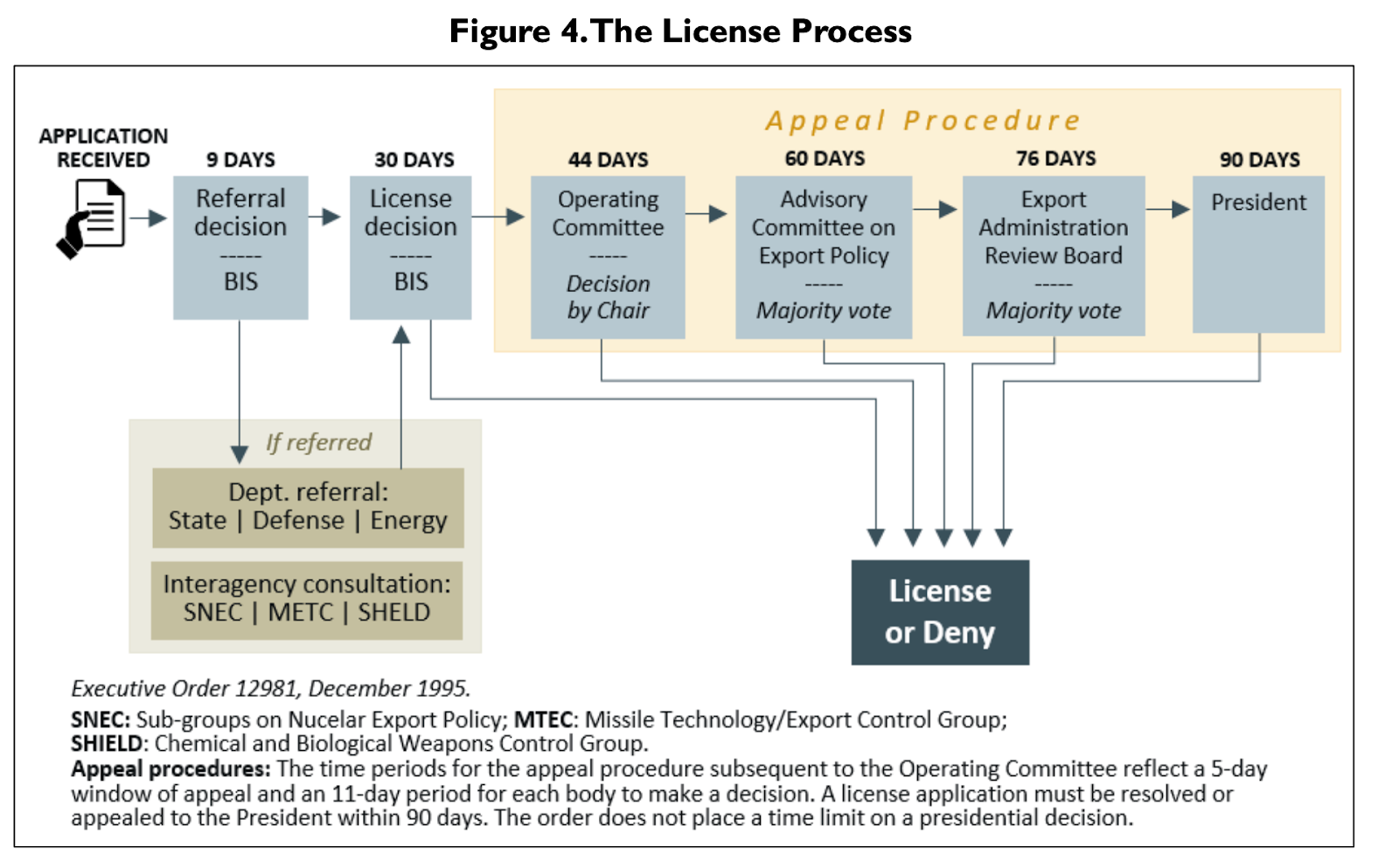
For dual-use items, BIS receives and processes license applications. On paper, the process is that within 9 days, BIS should decide whether to refer the application to other agencies, typically one or more agencies from the Departments of State, Defense, and Energy, for review. BIS is supposed to aim to reach a licensing decision within 30 days, though complex cases can take significantly longer.
When agencies disagree, a structured escalation process allows disputes to be elevated through increasingly senior interagency bodies—from the Operating Committee, to the Advisory Committee on Export Policy, to the Export Administration Review Board—and ultimately to the President. A license application is supposed to be resolved or appealed to the President within 90 days, though the order does not place a time limit on a presidential decision (see figure below).
Enforcement
Enforcement of export controls involves monitoring compliance and investigating and penalizing violations. The lead enforcement agency depends on the item’s jurisdiction (see the table above), but several agencies play cross-cutting enforcement roles:
- Department of Homeland Security (DHS): Homeland Security Investigations (HSI) has broad statutory authority to investigate export control violations across all regimes and leads the interagency Export Enforcement Coordination Center (E2C2); Customs and Border Protection (CBP) screens and seizes shipments at ports.
- Federal Bureau of Investigation (FBI): Leads counterintelligence and technology transfer investigations with national security implications.
- Department of Justice (DOJ): The National Security Division prosecutes criminal violations of EAR, ITAR, IEEPA, and sanctions laws. In 2023, DOJ and BIS jointly launched the Disruptive Technology Strike Force to coordinate investigations targeting illicit technology transfers to adversaries.
Enforcement tools range from administrative actions (e.g. warning letters, compliance agreements) through civil penalties (e.g. fines, denial of export privileges) to criminal prosecution (potentially resulting in imprisonment and substantial fines). BIS also encourages voluntary self-disclosures, where exporters who discover their own violations report them to BIS, typically resulting in significantly reduced penalties. BIS’s Office of Export Enforcement (OEE) also conducts end-use checks—pre- and post-shipment inspections to verify that exported items reach their intended recipients and are used as authorized. BIS’s Office of Enforcement Analysis (OEA) will also study a wide range of sources including export data to produce leads for enforcement actions.
Oversight
Multiple institutions monitor export control policy to ensure effectiveness, accountability, and alignment with national security objectives:
- The White House Office of Management and Budget (OMB) exercises significant influence over export control programs through the federal budget. By adjusting agency funding levels—including staffing, enforcement resources, and technology investments—OMB can shape the scale and priorities of export control activities.
- Congress exercises oversight through hearings, reporting requirements, and investigations. Congressional committees with jurisdiction over export controls organize hearings on control effectiveness, licensing patterns, and enforcement gaps. Congress also requires agencies to submit reports on license applications, denials, and enforcement actions (e.g. ECRA mandates regular reporting on emerging technology controls and their implementation). In December 2024, the Senate Permanent Subcommittee on Investigations released a report on semiconductor diversion to China, finding that BIS failed to prevent thousands of advanced semiconductors from reaching Chinese military and intelligence agencies through inadequate enforcement and third-country transshipment.
- Congress’ Government Accountability Office (GAO) also conducts independent audits of export control programs to assess their efficacy and recommend improvements.
- Inspectors General operate within each agency to investigate waste, fraud, abuse, or mismanagement. The Commerce IG audits BIS operations, while the State IG reviews DDTC programs. Their reports can uncover compliance issues or procedural weaknesses in how agencies implement controls.
- External groups, including think tanks, industry associations, and civil society organizations, evaluate export control effectiveness by tracking enforcement patterns, analyzing regulatory impacts, and highlighting unintended consequences. These assessments often inform congressional oversight and shape public understanding.
Working on export controls: types of roles and career opportunities
Type of role | Responsibilities | Typical background (for full-time roles) | Security clearance | Location | Career guides & opportunities |
|---|---|---|---|---|---|
Analyze and advance legislation related to export controls; prepare hearings and briefings; advise Members of Congress; engage with think tanks, advocacy groups, and industry stakeholders; draft reports and memos that shape legislative priorities. | BA for junior roles; BA/MA/JD for mid-career/senior roles; strong communication skills | Rarely required (e.g. some Armed Services/Intelligence committee staff). | Washington, DC | Working in Congress (+ internships, fellowships, & full-time roles) | |
Think tank researchers or advocates | Conduct policy research and analysis; track regulatory and enforcement developments; develop recommendations; advocate for policy changes; engage with policymakers and media | BA or MA for junior roles; MA/JD/PhD for mid-career/senior; subject matter expertise; experience in policy analysis or communications | Rarely required | Primarily Washington, DC; some in major cities or remote | Working in think tanks (+ fellowships, think tanks working on emerging tech policy, & resources) |
BIS staff | Develop technical parameters for export controls; analyze policy impacts; review license applications and determine export control compliance | BS or PhD for technical/engineering roles; BA/MA/JD/LLM for compliance or policy analysis roles; degrees can often be substituted for sufficient experience | Typically required | Washington, DC | |
Advise the White House on S&T policy; provide technical and scientific input that can inform export control decisions; coordinate with agencies like Commerce, Defense, State, and Energy; draft policy memos and National Strategy documents. | MA/JD/PhD depending on role; fellowship or federal agency experience; relevant background (e.g. STEM) | Typically required | Washington, DC | OSTP guide | |
Administer and enforce financial sanctions (OFAC) and munitions sanctions (State); review export license applications | BA in relevant areas (e.g., economics for OFAC); BS in relevant areas (Energy); experience in policy analysis | Typically required | Washington, DC; some nationwide (Energy) or overseas (State) | ||
DOJ or FBI staff | Investigate and prosecute export control violations (DOJ); Analyze potential export controls evasion and enforce them (FBI) | JD for attorney positions (DOJ); experience in policy analysis; some BA required (FBI) | Typically required | Washington, DC and field offices nationwide | DOJ opportunities; FBI opportunities |
Preparing for export control work
While requisite skills and experience vary widely across export control roles (e.g. control drafting vs. enforcement), two qualifications stand out as broadly valuable: subject-matter expertise and policy analysis experience. To build these and prepare for export control roles, consider:
- Complete an S&T policy internship or fellowship: Internships or fellowships at BIS or other export control agencies, congressional committees with export control jurisdiction, or think tanks focused on trade and technology policy can provide direct exposure to the field. See opportunities for specific agencies and organizations linked above.
- Gain subject-matter expertise: Many export control roles expect strong technical depth in the relevant field—whether it be biotech, AI, or nuclear technologies. Graduate degrees in STEM fields are often expected or a significant advantage in such roles. Policy fellowships in such fields are also helpful to build relevant technical expertise.
- Publish research or policy articles: Demonstrate technical credibility through peer-reviewed publications, conference talks, or patents. If you’re a student or early-career, consider co-authoring research with a professor or publishing a science policy article in a relevant outlet.
- Network with relevant professionals: Reach out to current and former staff at your institutions of interest for informational interviews. These conversations can help you navigate the hiring process, clarify your fit, and gain valuable professional connections. If you’re able, consider attending events hosted by think tanks on relevant topics to connect with professionals in the space and deepen your subject-matter knowledge.
- Follow export control developments: Subscribe to newsletters and alerts tracking export control activity (e.g. BIS press releases). Commercial law firms often provide detailed, apolitical breakdowns of new rules and their implications.
- Participate in public comment periods: Submitting comments on proposed or interim final export control rules helps you engage directly with the rulemaking process and build familiarity with how controls are developed. You can find open comment periods on Regulations.gov.
- Understand the export control legal framework: Familiarize yourself with key authorities like ECRA, ITAR, and IEEPA, and the basics of how control lists, licensing, and enforcement work (see resources below). Some law schools and policy programs offer courses on export controls or trade law.
Appendices: Brief history of export controls
US export controls began even before the country’s independence, when the First Continental Congress outlawed exports to Great Britain. Early in the country’s history, export controls were largely the prerogative of the legislative branch: the Embargo Act of 1807 banned all exports from US ports, and during the Civil War Congress passed legislation restricting exports to the Confederacy.
Congressional control over exports continued through both World Wars until the Export Control Act of 1949, which delegated export control administration and enforcement to the Department of Commerce. The Act also established the foundation for interagency cooperation in export controls, with multiple agencies coordinating on enforcement.
During the Cold War, export controls expanded significantly for two main reasons: embargoes against the Soviet bloc and nuclear nonproliferation. A number of multilateral export control agreements emerged from this era, including the Coordinating Committee for Multilateral Export Controls (CoCom, established 1949), which was later replaced by the Wassenaar Arrangement (1996). These agreements established multilateral frameworks for controlling dual-use technologies and nuclear materials, forming a lasting legacy that shifted export controls from blanket ideological embargoes toward more targeted controls based on specific security and proliferation concerns.
The export control system has undergone revisions since the Cold War era, particularly toward greater interagency coordination, but its core focus remains the same: restrictions on arms, nuclear weapons and materials, and dual-use technologies. In 2018, Congress passed the Export Control Reform Act of 2018 (ECRA), which replaced the lapsed Export Administration Act of 1979 as the permanent statutory authority for dual-use export controls and mandated new controls on emerging and foundational technologies, expanding the scope of the US export control regime.
Driven by concerns about China’s military modernization and AI ambitions, the US has since 2022 significantly strengthened export controls on dual-use products, most notably advanced semiconductors. These items have significant commercial applications but can also advance military capabilities, creating ongoing tensions between trade and security objectives. Export controls on AI-related technologies have evolved rapidly since 2022 and are likely to remain a central tool in US technology and national security policy.
Further reading
- Bureau of Industry and Security news, BIS
- Federal Register, BIS
- US Export Controls and China: Advanced Semiconductors, Congressional Research Service (2025)
- Export Controls Are a Defining Instrument of US National Security, Center for New American Security (2025)
- Promoting the Export of the US AI Technology Stack, The White House (2025)
- Export Controls: The Perennial Debate Continues, Center for Strategic & International Studies (2025)
- Advances in AI and Increased Biological Risks: Responsibly Deploying Export Controls as Part of the Solution, Council on Strategic Risks (2024)
- The tension between AI export control and US AI innovation, Brookings (2024)
- Computing Power and the Governance of AI, Girish Sastry, Lennart Heim, et. al., 2024
- Export Controls—International Coordination: Issues for Congress, Congressional Research Service (2023)
- Optimizing Export Controls for Critical and Emerging Technologies: Semiconductors, Quantum Technology, AI, and Biotechnology, Center for Strategic & International Studies (2023)
- The U.S. Export Control System and the Export Control Reform Act of 2018, Congressional Research Service (2021)


Notes
-
Export controls can also serve other purposes, including advancing domestic economic interests (e.g. restricting petroleum exports during shortages), signaling foreign policy positions (e.g. restricting exports to authoritarian regimes to communicate disapproval rather than to meaningfully curtail their access to something), and creating leverage for international negotiations (e.g. restricting access to critical technologies to incentivize other countries to make concessions they might otherwise reject).
↩︎ -
The US also controls deemed exports, where sharing controlled technology with foreign nationals within the US requires authorization. For example, US companies may be restricted from employing foreign nationals in roles involving controlled semiconductor manufacturing technology, or US persons may be prohibited from providing technical assistance to foreign entities on controlled technologies.
↩︎ -
Sanctions and export controls are related but distinct tools. Export controls restrict specific items (goods, software, technology) based on what’s exported, where it’s going, who receives it, and how it will be used. Sanctions impose broader economic restrictions on countries or entities, including asset freezes, transaction prohibitions, and trade embargoes. While export controls are administered by Commerce (BIS), State (DDTC), and Energy (NNSA), sanctions are administered by Treasury (OFAC). Many sanctions programs include export restrictions, and entities can appear on both export control lists and sanctions lists—exporters must comply with both, typically the more stringent restrictions.
↩︎ -
While nuclear technologies are also dual-use in nature (with both civilian energy and weapons applications), they are controlled under separate legal authorities and administered by different agencies than the items BIS classifies as ‘dual-use’ under the EAR.
↩︎ -
BIS chairs a committee with representatives from State, Defense, Energy, and intelligence agencies that reviews which entities should be added to, modified on, or removed from the below lists. Entities can request removal from lists by demonstrating changed circumstances or stronger compliance measures.
↩︎ -
The US also coordinates export controls through ad hoc bilateral and multilateral arrangements outside these formal regimes. For example, the US, Japan, and the Netherlands reportedly reached an agreement in 2023 to restrict exports of advanced semiconductor manufacturing equipment to China.
↩︎ -
Wassenaar’s transparency provisions are voluntary—participating states agree to exchange information on their export control decisions, but are not legally obligated to do so.
↩︎ -
Cloud computing complicates this picture: companies can rent remote access to AI chips installed in data centers abroad, potentially circumventing controls on physical chip exports. Investigations have documented Chinese entities accessing restricted chips through cloud providers, and Congress has moved to extend export control authority to cover remote compute access—though as of March 2026, this remains a gap in the existing legal framework.
↩︎ -
SDN stands for Specially Designated Nationals, a list maintained by the Department of the Treasury’s Office of Foreign Assets Control (OFAC). While the SDN List is primarily used for sanctions enforcement, certain SDN-listed entities are also subject to export control restrictions under the Export Administration Regulations when they meet specific criteria related to weapons proliferation or national security.
↩︎ -
The law does not explicitly name companies but defines them through entities on the Department of War’s 1260H list of Chinese military companies involved in biotechnology, entities designated by the Office of Management and Budget, and their subsidiaries or successors. BGI and MGI are currently on the 1260H list. The law provides a five-year safe harbor for existing contracts and includes a process for designated companies to challenge their designation.
↩︎ -
Congressional delegation of trade authority has been extensive since the Reciprocal Trade Agreements Act of 1934, which Congress enacted to insulate tariff policy from protectionist pressures. Export controls share this pattern of broad delegation but are distinctive in combining permanent statutory authority with a prolonged period of operation under emergency powers. For comparison of congressional delegation across trade policy areas, see CRS Report R48435, Congressional and Presidential Authority to Impose Import Tariffs.
↩︎ -
For example, ECRA (passed by Congress in 2018) requires the President to establish a formal interagency process to identify and control emerging and foundational technologies critical to national security.
↩︎ -
Congress retains several oversight mechanisms including: (1) annual reporting requirements on license applications and enforcement actions for entities on the Entity List and Military End-User List; (2) notification requirements for certain export control actions; (3) the ability to terminate national emergencies declared under IEEPA through joint resolutions under expedited procedures in the National Emergencies Act; and (4) appropriations authority. However, courts have applied highly deferential standards of review to presidential actions under export control authorities, generally requiring only that the President not “clearly misconstrue” statutory authority.
↩︎ -
In practice, these timelines are frequently exceeded. Highly contentious license applications can sit for well over 90 days without a decision, and disputes are often resolved through informal interagency negotiations outside the formal escalation structure described here.
↩︎ -
For example, a 2020 GAO report on export control performance measurement found that BIS lacked systematic processes to assess whether export controls achieved their intended objectives and recommended improved performance measurement. A 2024 report on foreign researcher screening examined how agencies screen foreign researchers’ access to emerging technologies, finding coordination gaps between export control agencies and research security programs.
↩︎ -
Congress is generally less credentialist than think tanks and the executive branch. While graduate degrees in public policy, law, or a technical field are valuable for mid-career to senior roles, they’re rarely required. Prior congressional experience matters far more than formal credentials—senior roles rarely get filled by people without prior Hill experience. Fellowships can allow early- to mid-career professionals to bypass this typical requirement and move directly into substantive policy roles.
↩︎