
National Institute of Standards and Technology (NIST)
NIST develops standards, measurements, and technology to support US economic competitiveness, technological progress, improved product reliability, and technical security and safety.
This profile focuses on the National Institute of Standards and Technology (NIST) within the Department of Commerce (DOC). For a more general overview of DOC and its relevance to AI and biosecurity, see our DOC profile.

Overview
The National Institute of Standards and Technology (NIST) is a non-regulatory agency in the Department of Commerce that serves as the US national measurement institute. NIST develops standards, measurements, and technology to support US economic competitiveness, technological progress, improved product reliability, and technical security and safety. NIST carries out this work through internal research labs, where it develops and evaluates new measurement methods and tools in collaboration with industry, academia, and other agencies. This work ultimately supports widely used guidance documents, including NIST “Special Publications” (SPs), which many organizations reference in their internal policies, contracts, and audits.
In AI, NIST’s Center for AI Standards and Innovation (CAISI) partners with companies and federal agencies to test systems, develop security guidance, and lead international standards efforts. NIST also maintains the AI Risk Management Framework and related practice guides that organizations can implement. In bio, NIST’s Material Measurement Laboratory (MML) supplies widely used reference materials and methods that underpin US bioscience and biomanufacturing, including benchmark materials like Genome in a Bottle, biomanufacturing testbeds, and measurement science that supports biosurveillance and the broader bioeconomy.
Background on NIST
- Government context: The National Institute of Standards and Technology (NIST) is an agency in the Department of Commerce (DOC). It is led by a Director, who also serves as the Under Secretary of Commerce for Standards and Technology.
- Mission: to promote US innovation and industrial competitiveness by advancing measurement science, standards, and technology to enhance economic security and improve the quality of life.
- Main Activities: conducting measurement science and applied research; developing and maintaining standards, reference materials, and calibrations; publishing NIST Special Publications (SPs), frameworks, and practice guides; building and running testbeds and evaluations; operating internal research labs; coordinating standards and data work with industry, academia, and other agencies; providing trusted reference data and tools; supporting technology transfer and manufacturing programs.
- Budget: ~$1.16 billion (FY 2025)
- Staff: ~3,400 employees
- Brief history: Congress established NIST (then the National Bureau of Standards) in 1901 to create a unified national measurement system. Congress renamed it in 1988 and expanded its mission to include advanced technology, manufacturing, and later cybersecurity and AI. NIST remains the federal government’s primary authority on measurement science and technical standards, spanning technologies from atomic clocks to AI and biotechnologies.
Organizational structure
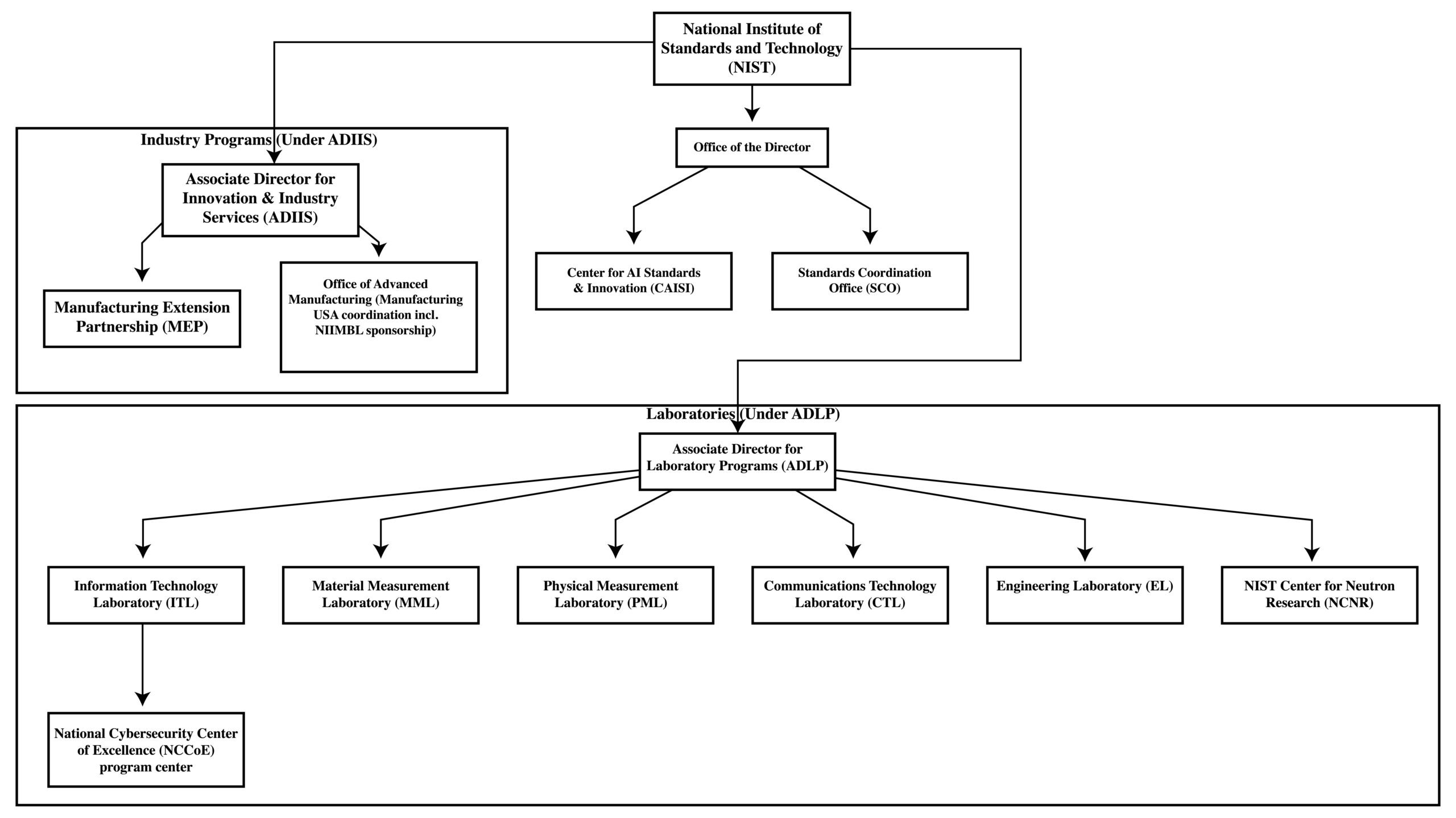
Created based on source
NIST’s core program work is organized around three top-level offices: the Office of the Director, the Associate Director for Laboratory Programs (ADLP), and the Associate Director for Innovation & Industry Services (ADIIS).
- Office of the Director: Sets NIST’s priorities and budget, represents the agency across government and in international standards bodies, and oversees cross-cutting initiatives, including:
- Center for AI Standards and Innovation (CAISI): Serves as industry’s primary point of contact within the US government (including for frontier AI labs) to facilitate testing and collaborative research related to harnessing and securing the potential of commercial AI systems.
- Associate Director for Laboratory Programs (ADLP): Oversees NIST’s science and engineering laboratories, which conduct measurement research and build the standards foundation for industry and government. These are:
- Information Technology Laboratory (ITL): computer science, cybersecurity, and AI measurement; maintains the AI Risk Management Framework and SP 800 cybersecurity guidance.
- Material Measurement Laboratory (MML): chemistry, biology, and materials science; produces reference materials like Genome in a Bottle.
- Physical Measurement Laboratory (PML): time, frequency, and fundamental physical constants used across science and industry.
- Communications Technology Laboratory (CTL): wireless and spectrum testing, including 5G/6G research.
- Engineering Laboratory (EL): building safety, resilience, and advanced manufacturing standards.
- NIST Center for Neutron Research (NCNR): user facility supporting advanced materials and structural biology research.
- Information Technology Laboratory (ITL): computer science, cybersecurity, and AI measurement; maintains the AI Risk Management Framework and SP 800 cybersecurity guidance.
- Material Measurement Laboratory (MML): chemistry, biology, and materials science; produces reference materials like Genome in a Bottle.
- Physical Measurement Laboratory (PML): time, frequency, and fundamental physical constants used across science and industry.
- Communications Technology Laboratory (CTL): wireless and spectrum testing, including 5G/6G research.
- Engineering Laboratory (EL): building safety, resilience, and advanced manufacturing standards.
- NIST Center for Neutron Research (NCNR): user facility supporting advanced materials and structural biology research.
- Associate Director for Innovation and Industry Services (ADIIS): Leads NIST’s industry-facing and technology transfer programs, connecting research to US manufacturing and business innovation. Key components include:
- Manufacturing Extension Partnership (MEP): supports small and medium-sized manufacturers in adopting best practices.
- Office of Advanced Manufacturing (OAM): coordinates NIST’s role in Manufacturing USA, a network of national manufacturing innovation institutes that bring together industry, academia, and the public sector to advance American manufacturing.
- CHIPS for America Program Offices: House the CHIPS Program Office and CHIPS R&D Office, which administer funding for semiconductor manufacturing incentives and R&D programs under the CHIPS and Science Act.
NIST and AI standards
NIST develops measurement science, test methods, and standards frameworks for safe, secure, and trustworthy AI systems. Its work guides how agencies, companies, and researchers assess AI capabilities and risks. Its core AI-relevant functions include:
- AI risk management and governance: maintains the AI Risk Management Framework (AI RMF) and its Generative AI Profile, which provide voluntary guidance for identifying, measuring, and mitigating AI risks across sectors.
- Testing and evaluation: coordinates public–private collaborations to design and test evaluation methods for robustness, security, and transparency in AI systems through the Center for AI Standards and Innovation (CAISI). These include cyber, chemistry, and biology evaluations to understand impacts on national security.
- AI system security: develops control overlays and related guidance to help organizations secure AI systems and address AI-specific vulnerabilities such as data poisoning and adversarial attacks.
- International standards coordination: helps coordinate US participation in international AI standards and governance efforts (e.g. through the International Organization for Standardization).
- Cross-agency coordination: develops AI frameworks and standards, establishes AI testbeds, and works with other agencies on AI security, evaluation, and governance under mandates from the CHIPS and Science Act of 2022 and the National AI Initiative Act of 2020.
- Assessing the state of AI: producing reports, briefings, and memos on the AI landscape.
- December 2025: CAISI launches a research blog, with initial posts on accelerating AI innovation through measurement science and cheating on AI agent evaluations.
- September 2025: CAISI partners with OpenAI and Anthropic to identify security issues with their advanced AI systems and strengthen methods for measuring AI security.
- September 2025: CAISI publishes an evaluation of DeepSeek AI models, finding they lag behind US models in performance, cost, and security, were far more susceptible to jailbreaking and agent hijacking attacks, and echoed four times as many CCP narratives as US reference models.
- July 2025: President Trump’s AI Action Plan tasks NIST with revising the AI Risk Management Framework, leading domain-specific standards convenings, and developing deepfake forensic guidelines, among other responsibilities. CAISI is the most-mentioned sub-agency in the plan, tasked with evaluating Chinese AI models for CCP alignment, partnering with DARPA and NSF on interpretability and control research, assessing frontier models for national security risks, collaborating on an AI threat-sharing center for critical infrastructure, and more.
- August 2025: NIST publishes a concept paper and action plan to develop SP 800-53 Control Overlays for Securing AI Systems and launches a Slack channel for public input. The paper outlines planned overlays for generative, predictive, and multi-agent AI systems, and invites stakeholders to join the Slack workspace to share feedback, follow updates, and contribute to the development process.
- June 2025: The Secretary of Commerce reforms the US AI Safety Institute (AISI) into the Center for AI Standards and Innovation (CAISI) and emphasizes its role in “harnessing and securing the potential of commercial AI systems.”
- April 2025: A draft update to NIST’s Privacy Framework incorporates AI risk management practices to help organizations protect individuals’ privacy when deploying AI systems.
- January 2025: President Trump’s Executive Order on Removing Barriers to American Leadership in AI rescinds Biden’s Executive Order on AI (EO 14110) and directs agencies to review prior AI safety and testing initiatives. NIST is tasked with reassessing activities launched under EO 14110 and aligning its AI standards and evaluation programs with the new emphasis on innovation, competitiveness, and reducing regulatory barriers.
- July 2024: NIST releases the AI RMF Generative AI Profile to help organizations manage the unique risks posed by frontier models.
- February 2024: NIST establishes the AI Safety Institute Consortium (AISIC), convening over 200 leading AI developers, academics, and civil society groups to collaborate on the science of AI safety.
- October 2023: President Biden’s Executive Order on AI tasks NIST with leading national efforts on AI safety, testing, and evaluation, and expanding coordination with international standards bodies.
- March 2023: NIST launches the Trustworthy and Responsible AI Resource Center to support the implementation of the AI RMF and promote international alignment on responsible AI.
- January 2023: NIST publishes the AI Risk Management Framework (AI RMF) 1.0, designed to help organizations and individuals manage AI-related risks.
- September 2022: Biden’s implementation strategy for the CHIPS for America Program tasks NIST with distributing $39 billion in incentives and $11 billion in R&D investments to develop US semiconductor manufacturing.
- Office of the Director: Sets NIST’s strategic priorities and represents the US in national and international standards bodies; directs NIST’s response to executive orders and oversees cross-cutting initiatives like CAISI.
- Center for AI Standards and Innovation (CAISI): Coordinates the federal government’s technical work on trustworthy AI standards and testing; leads evaluations of foundation models, develops AI security guidance, and engages with industry, academia, and international partners to align AI measurement and assurance practices.
- Information Technology Laboratory (ITL): Conducts research in computer science, cybersecurity, and AI measurement; maintains the AI Risk Management Framework (AI RMF), a key reference for AI governance, and develops technical methods for evaluating AI system performance and reliability.
- National Cybersecurity Center of Excellence (NCCoE): A collaborative hub for building and testing applied cybersecurity solutions; works with industry partners to produce SP 1800 ‘practice guides’ that provide step-by-step examples for securing AI systems and managing risks such as data poisoning and adversarial manipulation.
NIST and bio standards
NIST supports the US bioeconomy by developing the measurement science, reference materials, and data standards that enable safe, reliable, and scalable biotechnology. Its work provides the technical foundations that regulators, manufacturers, and researchers rely on for quality control, biosurveillance, and innovation in biomanufacturing, genomics, synthetic biology, and other areas.
- Reference materials and benchmark datasets: produces biological and chemical reference materials—such as Genome in a Bottle (GIAB) and microbiome standards—used globally to validate sequencing and measurement methods.
- Measurement assurance and quality control: creates tools and methods to make biological measurements consistent and reliable, supporting work in cell and gene therapy manufacturing, diagnostics, and biosurveillance.
- Interlaboratory studies and standards consortia: coordinates collaborative studies and multi-stakeholder groups to establish consensus measurement methods and best practices.
- Data and interoperability standards: publishes open, plain-language resources and data standards that promote reliability and comparability across bioindustry applications.
- Coordination with industry and agencies: works with the National Institute for Innovation in Manufacturing Biopharmaceuticals (NIIMBL), FDA, and other partners to align biomanufacturing standards and workforce development efforts.
- September 2025: NIST introduces NISTCHO, the first living reference material (RM) that produces monoclonal antibodies (modified proteins used to treat diseases such as breast cancer and rheumatoid arthritis). The cell line provides a continuous source of material for testing and quality assurance, supporting more efficient biopharmaceutical development.
- July 2025: NIST releases a new research-grade test material to support quality control for mRNA therapies.
- March 2025: President Trump signs Executive Order (EO) 14236, rescinding 19 executive actions, including former President Biden’s September 2022 EO 14081, “Advancing Biotechnology and Biomanufacturing Innovation for a Sustainable, Safe, and Secure American Bioeconomy.”
- December 2024: The National Cybersecurity Center of Excellence (NCCoE) releases draft guidance for securing genomic data. The profile integrates NIST’s Cybersecurity and Privacy Frameworks to protect sensitive biological information used in research and healthcare.
- September 2022: President Biden’s Executive Order on the Bioeconomy establishes a national bioeconomy strategy and tasks NIST with developing a shared vocabulary and measurement methods to support bioscience innovation and industry growth.
- November 2020: NIST establishes the Flow Cytometry Standards Consortium to standardize how advanced cell therapies are measured.
- May 2020: NIST awards $8.9 million in CARES Act funding to the National Institute for Innovation in Manufacturing Biopharmaceuticals (NIIMBL) for COVID-19 response projects.
- Office of the Director: Sets priorities and budget; coordinates interagency bioeconomy work; represents NIST in national and international standards forums.
- Material Measurement Laboratory (MML): National reference lab for chemical, biological, and materials measurements; delivers reference materials, datasets, and methods used by labs, companies, and regulators.
- Biomolecular Measurement Division: Develops genomics and proteomics measurement methods and produces Genome in a Bottle (GIAB) reference materials.
- Biosystems & Biomaterials Division: Advances cell and gene therapy measurement science, bioprocess analytics, and biosurveillance methods.
- Chemical Sciences Division (bio-relevant parts): Establishes standards for diagnostics, metabolites, and environmental measurements that intersect with biological systems.
- Associate Director for Innovation & Industry Services (ADIIS): Runs industry partnerships and tech transfer; oversees Manufacturing USA coordination.
- Office of Advanced Manufacturing (OAM): Manages NIST’s role in Manufacturing USA, including sponsorship of the National Institute for Innovation in Manufacturing Biopharmaceuticals (NIIMBL) for biopharma manufacturing standards and workforce projects.
- Standards Coordination Office (SCO): Manages US participation in standards bodies and aligns NIST lab work with external biosurveillance, diagnostics, and biomanufacturing standards.
- Center for Neutron Research (NCNR): User facility that supports structural biology and soft-matter measurements relevant to biologics, formulations, and advanced materials.
Working at NIST
To find open full-time positions at NIST, visit USAJOBS and filter for NIST or check NIST’s Careers page. You can express interest in working at CAISI and see example initiatives here.
For internships, fellowships, and other early-career opportunities, check the Federal Internship Finder and the USAJOBS Federal Internship Portal, filtering for NIST positions. Opportunities for students and recent graduates include:
- NIST Graduate Student Measurement Science and Engineering (GMSE): A graduate fellowship providing multi-year funding and summer guest researcher appointments at NIST.
- Summer Undergraduate Research Fellowship (SURF): a 9- or 11-week summer NIST lab research program for undergraduate students. Participants work full-time at a NIST campus and receive a ~$7800 stipend.
- NRC/NIST Postdoctoral Research Associateships: 2-year paid research appointments for postdocs in chemistry, physics, materials science, math, computer science, or engineering.
- Professional Research Experience Program (PREP): University partnerships placing undergrads, grads, postdocs, and faculty in NIST labs.
- Domestic Guest Researcher Program: Time-limited appointments for external researchers on joint projects.
See our federal agency application advice section for guides to USAJOBS, federal resumes, interviewing for federal positions, and more.
Further reading
General NIST resources
- About NIST
- Careers at NIST
- NIST: An Appropriations Overview, Congressional Research Service (2022)
NIST and AI
- AI Risk Management Framework (AI RMF 1.0), framework and resources
- Cybersecurity Framework (CSF) 2.0
- National Cybersecurity Center of Excellence (NCCOE), SP 1800 practice guides
- Center for AI Standards and Innovation (CAISI)
- The International AI Standards Landscape and ITL’s Role, Priorities, and Progress, NIST Information Technology Laboratory AI webinar series



Notes
-
As the US national measurement institute, NIST maintains the country’s primary standards for units like time, mass, and temperature; provides “traceability” so that measurements used by labs, companies, and regulators can be linked back to those standards; represents the United States in the international system of units for trade and science; advances measurement science; and uses that expertise to help develop technically sound standards.
↩︎ -
USASpending.com reports “total budgetary resources” for NIST in FY2025 of ~$43.5B. That figure includes large, multi-year CHIPS for America incentive and R&D appropriations recorded to NIST accounts, which sit outside NIST’s base operations. The amount shown in the main text refers to NIST’s core operating budget.
↩︎ -
Under the Associate Director for Laboratory Programs (ADLP), several cross-cutting offices support NIST-wide work beyond the individual labs: the Special Programs Office builds partnerships with other agencies, academia, and industry in areas such as forensic science, greenhouse gas measurement, and open data; the Standards Coordination Office (SCO) helps agencies, companies, and standards bodies navigate standards and conformity assessment; and the Research Data and Computing Office promotes common standards and best practices for data management, data science, and computing across NIST research programs.
↩︎ -
Control overlays are pre-packaged sets of security and privacy safeguards tailored to a specific type of system or use case (i.e. AI systems). They start from a “baseline catalog” like NIST SP 800-53—a large menu of standard controls—and then add, remove, or interpret items from that menu so organizations know which safeguards are most relevant for that particular context.
↩︎ -
NIST’s SP 800-53 catalog lists hundreds of baseline security and privacy controls used across federal systems. Because not every system faces the same risks, overlays define how those baseline controls should be interpreted, modified, or supplemented for a specific context (e.g. cloud services, healthcare systems, AI systems). For example, an “AI overlay” might specify additional requirements for protecting model training data, verifying the integrity of machine learning models, or logging and auditing automated decision processes.
↩︎ -
Reference materials (RMs) are well-characterized substances that laboratories use to check the accuracy of their instruments and measurement methods. For example, pharmaceutical companies can use NISTCHO cells to test their production equipment, calibrate lab instruments, or troubleshoot manufacturing problems without risking expensive drug batches. Unlike traditional reference materials that get used up, NISTCHO cells can be grown continuously, providing an unlimited supply for testing.
↩︎