
Policy fellowships

Policy fellowships

Fellowships are one of the best entryways into US policy work. This page includes:


What are policy fellowships?

There are dozens of US policy fellowships aiming to help people with different backgrounds and career stages gain first-hand policy experience. Some of these programs support recent graduates in exploring their fit for policy, while others target mid-career professionals from non-policy fields (e.g. STEM, business, law) to help them pivot into public service work.

These fellowship programs can boost your professional development and provide employment opportunities in all the major policy institutions (see congressional fellowships, think tank fellowships, and executive branch fellowships). Other common fellowship benefits include funding, training, mentoring, networking opportunities, application support, and the possibility of post-fellowship employment. Also, policy fellowships are often competitive and prestigious, providing a valuable credential.

What is meant by a “fellowship” can differ substantially as the term is not used consistently. The structure, benefits, and eligibility requirements may vary widely depending on the program. Many fellowships offer full-time placements in host organizations, while others provide part-time training and mentoring, and some “fellowships” are simply scholarships or internships. Occasionally, “fellowships” are just titles to confer an association or endorsement of a fellow by the fellowship-granting organization.

Alternatives to fellowships for those seeking to work in US policy include doing a policy-relevant graduate degree (ideally in Washington DC) and applying directly for policy jobs or internships. Potential advantages of policy fellowships over these alternatives include that they are:

  • Often less competitive than many full-time roles if you don’t have prior policy experience (many fellowships are designed as bridge programs for people from non-traditional backgrounds such as tech or academia);
  • Better paid than most internships and entry-level jobs;
  • Providing more post-completion employment opportunities;
  • Better and cheaper for career exploration than graduate school; and
  • Offering additional benefits (e.g. training, networking, prestige).

Tips for a successful fellowship


Fellowship database

We created a database of US policy fellowships listing more than 50 opportunities.
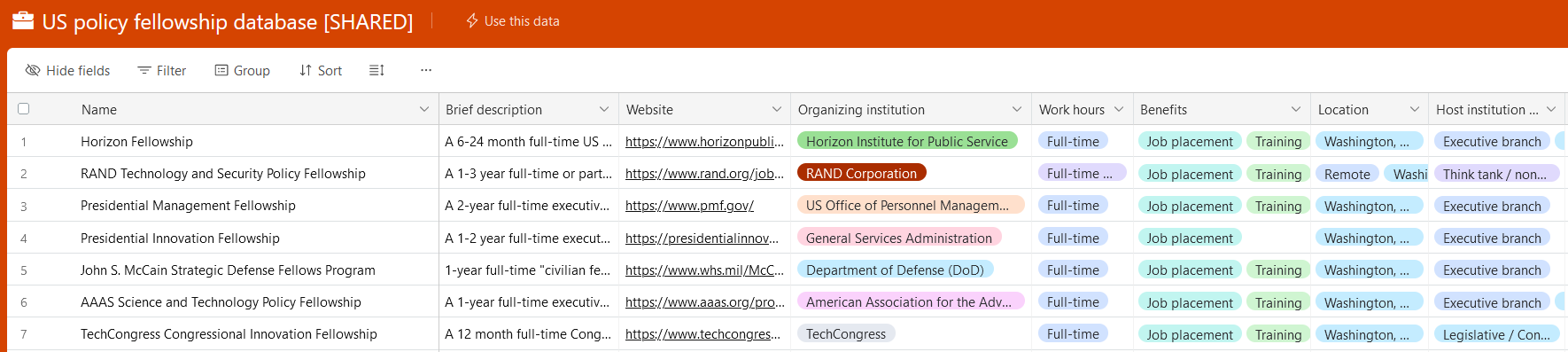
Other databases:

How to use the database

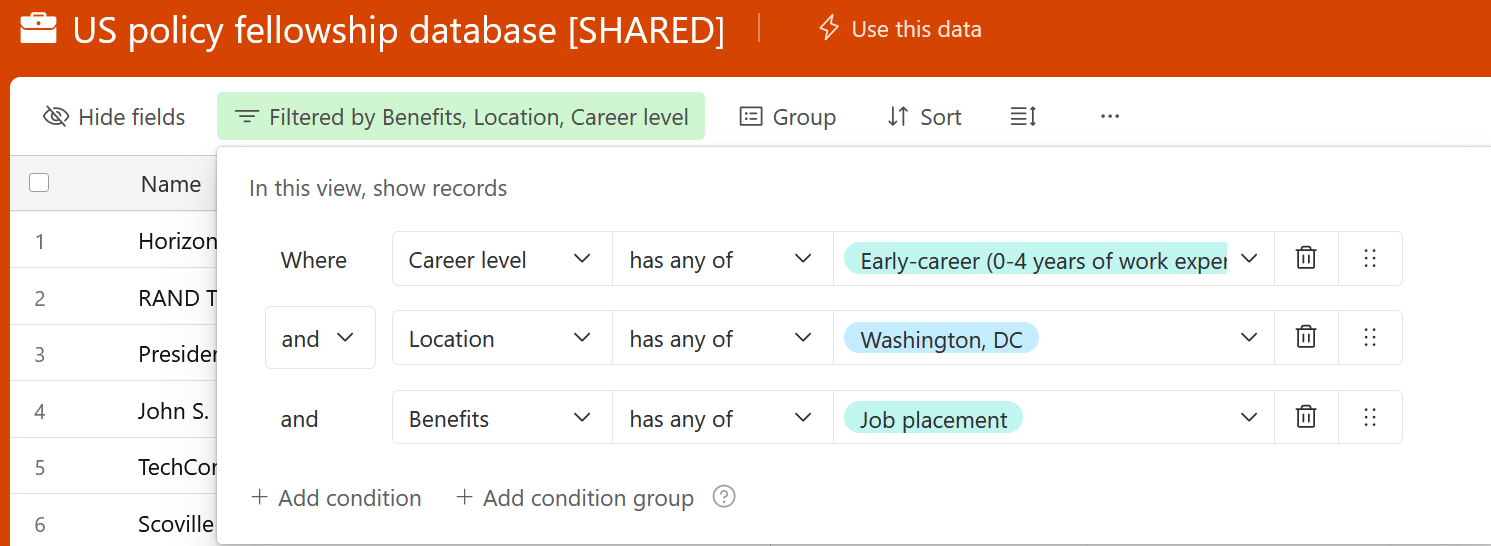
When using the database, you may find it helpful to use the ‘Filter’, ‘Group’, and ‘Sort’ functions to look only at fellowships relevant to your situation.

For example, you may use the ‘Filter’ function to only see Washington DC-based fellowships involving a job placement for early-career individuals.

Fellowship guides

These in-depth guides provide information and advice on several select fellowships, drafted by former fellows otherwise unaffiliated with this website.

Fellowship highlights

These are fellowships we particularly recommend for those seeking to work in emerging technology policy or advance their professional development for policy work.


Fellowships by policy area

The below is a list of fellowships for different emerging technology policy areas (AI, biosecurity, China and tech, civic tech, cyber, nuclear weapons, and space).


Fellowships by policy institution

Our pages on working in Congress, think tanks, and the executive branch include lists of fellowships facilitating work in these institutions.


Part-time fellowships

Many policy organizations host part-time fellowships, which typically involve some combination of networking sessions, workshops, and sometimes a (fairly) small writing commitment. They usually target professionals and are thus compatible with full-time work.

These programs can be very competitive, especially if they’re prestigious and have existed for a long time; they often target mid-career professionals but some may also be open to junior fellows.

Here are some examples of part-time fellowships or professional networks relevant to emerging technology policy and national security:
General science and technology policy

  • Paragon Fellowship – a part-time (5 hours/week) fellowship aiming to “connect students with opportunities in the science and tech policy space [by] researching and writing a policy brief on key issues for their state and local governments”.
  • US Google Public Policy Fellowship – semester-long fully-funded fellowship for ~20 US college and graduate students per year offering both part-time and full-time work opportunities in the summer, fall, and spring at a tech policy-related host organization (a mix of nonprofits, think tanks, and industry groups)
  • Arms Control Negotiation Academy – “a 12-month, high-level professional development program for a competitively selected cohort of [16] rising international security experts and practitioners” involving three week-long workshops.

AI policy

  • FAI Conservative AI Policy Fellowship (Foundation for American Innovation) – a six-week, part-time (work-compatible) paid program for conservative early- and mid-career professionals in DC interested in AI and emerging technology. Fellows receive mentorship, gain specialized expertise, and build their networks through weekly lunch sessions, evening workshops, and a weekend retreat.
  • Future Impact Group Fellowship – a 5-10 hour/week program matching postgraduate students from diverse academic backgrounds with senior researchers on AI policy projects, including on national and international policy.
  • Tech Policy Press Fellowship – “we are looking to support five reporting fellows in researching and writing on issues and questions related to artificial intelligence (AI) policy, governance, and regulation. Selected fellows will receive a stipend of $10,000 to support their work.”

Biosecurity

  • Emerging Leaders in Biosecurity (ELBI) Fellowship (Johns Hopkins Center for Health Security) – a 10-month part-time program allowing talented graduate students and professionals to deepen their expertise, expand their network, and build their leadership skills through in-person workshops and other events.
  • Ending Bioweapons Fellowship (Council on Strategic Risks) – a 12-month part-time program, allowing early-career fellows to work with leading experts from CSR’s team and network to generate ideas for ending the threat of state biological weapons programs.
  • Mid-Career Biodefense Bootcamp (Council on Strategic Risks) – a 2-month part-time hybrid fellowship involving a virtual course, a 3-day in-person workshop in DC, and a vibrant network for mid-career citizens of NATO countries and certain other US allies (i.e. typically 10+ years of professional and/or academic experience).
  • Biosecurity Game Changers Fellowship (Brown University Pandemic Center) – a 1-year half-time (~50%) fellowship for mid-career African and US American health security experts (i.e. at least 5 years of experience) with leading biosecurity and global health organizations (CEPI, GAVI, IBBIS, BWC ISU, etc.)

Cyber policy

  • Cyber Policy Leadership Institute (POPVOX Foundation) – a part-time networking and educational program for US college and graduate students of all disciplines “from historically marginalized groups, with the aim of cultivating the next generation of diverse cyber policy leaders.”

Nuclear security

  • Fellowship for Reducing Nuclear Weapons Risks (Council on Strategic Risks) – a 6-month part-time networking and research program on nuclear risk reduction.
  • Nuclear Scholars Initiative (Center for Strategic and International Studies) – “Fellows are hosted once per month over the course of six months at CSIS in Washington, DC where they participate in daylong workshops…with senior experts on nuclear weapons issues”
  • Project on Nuclear Issues Mid-Career Cadre (Center for Strategic and International Studies) – a 3-year part-time networking and professional development program for nuclear professionals with at least 7 years of relevant experience in the field.
  • New Voices on Nuclear Weapons Fellowship (Federation of American Scientists) – a 4-month research fellowship for people from diverse demographic and socioeconomic backgrounds.
  • Public Policy Fellowship (Nonproliferation Policy Education Center) – eleven lunchtime seminars “designed to give congressional, executive, and diplomatic staff and journalists the scientific, technological, legal, and historical background needed to gain a deeper understanding of civil and military nuclear policy.”

Space policy

  • Space Policy Fellowship (Nonproliferation Policy Education Center) – a “six-lecture virtual fellowship on the fundamentals of civil and military space policy followed by an additional round table policy discussion and a space war game.”

Demographic programs

  • The Public Leadership Education Network (PLEN) aims to “empower, educate, and engage women and marginalized gender groups in public policy”, including by organizing multi-day policy seminars in DC (scholarships are available).
  • Make Room initiative (Center for a New American Security) – an “inclusive professional development network…aim[ing] to train, empower, and amplify the voices of underrepresented communities in the national security and foreign policy spheres…There are no costs nor prerequisites to join.”
  • NatSecGirlSquad is a community that aims to “build and support competent diversity in national security and defense through its professional development community and strategic advisory services.”
  • Foreign Policy for America’s NextGen Initiative “works to spotlight and support diverse young leaders from across the country…Cohort members benefit from four pillars of activities: knowledge building, political engagement, professional development and social connections.”
  • Women of Color Advancing Peace, Security, and Conflict Transformation (WCAPS) is a community that seeks to “cultivate a strong voice and network for its members while encouraging dialogue and strategies for engaging in policy discussions on an international scale.”
  • The Leadership Council for Women in National Security is an organization seeking to advance “gender parity in national security and foreign policy decision-making.” While largely focused on experienced policy professionals, they also organize some events and highlight opportunities relevant to early-career professionals.
  • Women’s Global Leadership Program (Center for Strategic and International Studies) – “year-long program designed for rising executives [with at least 15 years of experience] who wish to deepen their understanding of critical geopolitical trends”; tuition cost of ~$25,000
  • Editorial Fellows (Bulletin of the Atomic Scientists) – a 1-year program for diverse authors with experience in nuclear risk, climate change, or disruptive technologies to produce a regular column, including financial compensation
  • UNIDIR Women in AI Fellowship (United Nations Institute for Disarmament Research) – program for junior to mid-career women diplomats comprising “a week-long, in-person training programme in Geneva, as well as a series of engagements with relevant experts and stakeholders.”
  • Rising Experts Program (Young Professionals in Foreign Policy) – a virtual writing workshop to help early professionals from diverse and underrepresented backgrounds refine their analytical writing, publish in major outlets, and build their policy expertise. Fellows commit approximately 5 hours/week for a term to publishing bi-monthly articles and leading discussions in their specialization, which spans regional and functional foreign policy topics. Applications typically open in mid-November and close in mid-December.

Other programs

  • Millenium Fellowship (Atlantic Council) – a 12-month program consisting of “engaging virtual content and an in-person Study Tour…Other key components…include monthly master classes with distinguished senior leaders and subject matter experts, individualized executive coaching, and intentional networking.”
  • Rising Leaders Program (Aspen Strategy Group) – over 10 months, fellows (with a “passion for national security and foreign policy”) participate in monthly meetings with high-level officials and work on policy papers to be published on the Aspen Institute’s website and/or newsletter.
  • Next Generation National Security Leaders (Center for a New American Security) – a 1-year part-time program for 20-25 “emerging national security leaders between the ages of 27 to 35” who participate in a monthly dinner series and other events to “learn best practices and lessons in leadership” from “thought leaders on leadership principles and national security.” The program is capped by a week-long international study tour.
  • National Security Fellows (Foundation for the Defense of Democracy) – a 12-month program supporting 30-40 year-old professionals with a “minimum of seven years of employment in national security or foreign policy.” The program provides “networking, skill-building workshops, and roundtable conversations with high-level experts”; opportunities include dinners and mentorship and collaboration opportunities with policy professionals.
  • Young Leaders Program (Pacific Forum) – aims “to enhance cross-cultural opportunities for young scholars and foreign policy professionals to improve their policy analysis skills at an early juncture in their careers….Young Leaders [between 25 and 35] will have access to the 15-20 conferences and events that Pacific Forum organizes each year.”
  • International Strategy Forum (Schmidt Futures) – “seeks out non-traditional talent […] then knits that talent together into a lifelong community, pairing fellows with mentors and providing them with a framework to better analyze and tackle hard strategic problems in global affairs.”
  • Young Professionals Network (Eurasia Foundation) – “identifies emerging Eurasia specialists [between 22 and 33] in the DC area…and connects them with more established professionals from a variety of fields.”
  • George C Marshall Fellowship (Heritage Foundation) – a national security-focused education program for “25 exceptional conservative, DMV based, mid-level congressional staff, executive branch personnel, policy analysts, and defense industry employees.”
  • Penn Keble Forum on Democracy (National Endowment for Democracy) – “promotes bipartisan conversation among young foreign policy leaders in Washington, DC…The Forum convenes monthly for off-the-record dinner conversations led by foreign policy experts, government officials (past and present), and democracy practitioners.”

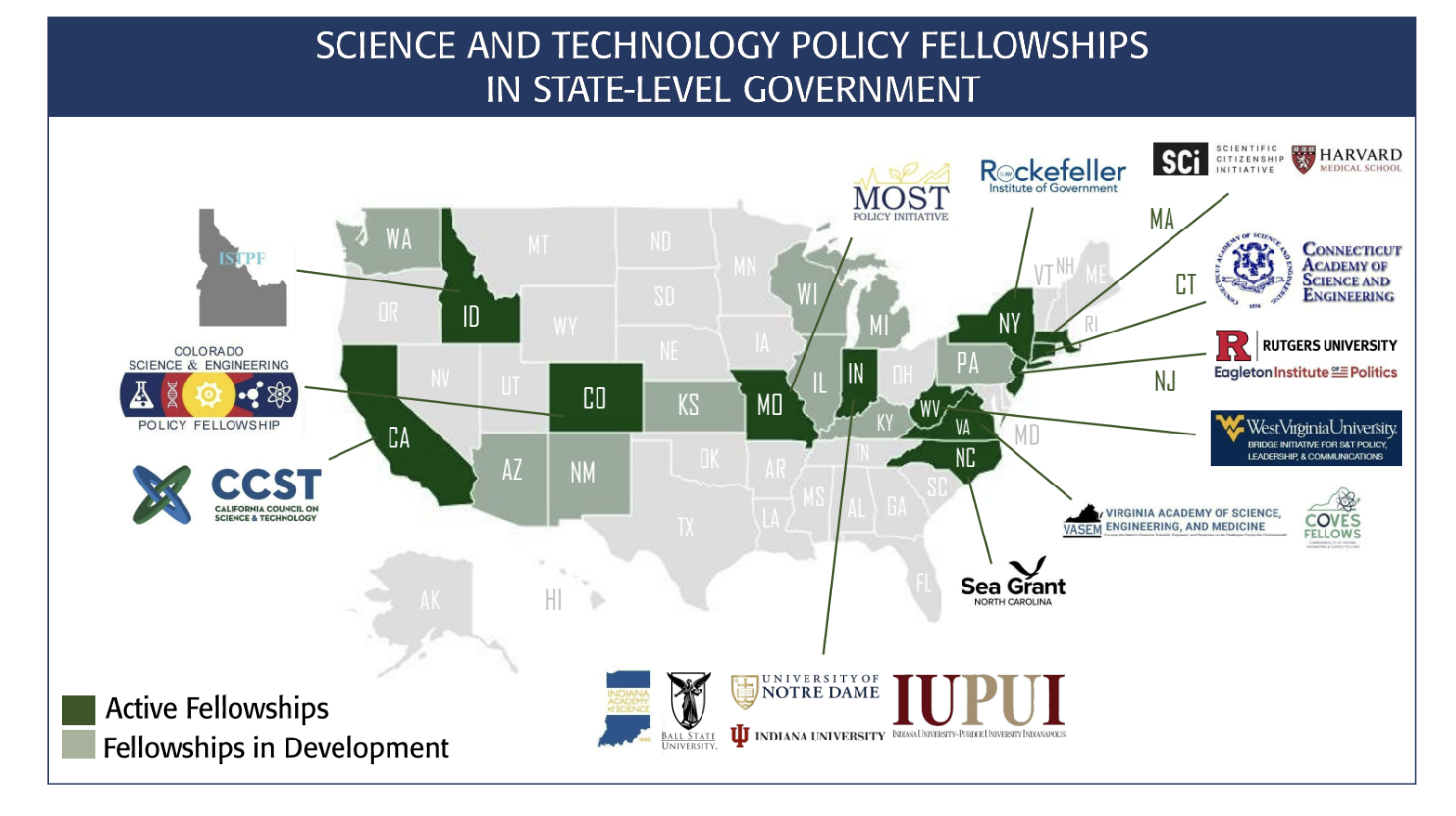
State-level science and tech policy fellowships

Source: Rockefeller Institute (February 2024).


Subscribe to the Emerging Tech Policy Careers Newsletter

And stay up to date with the latest policy resources, career tips, and new career opportunities:


No pages selected. Please add pages in the settings.

Get career support
Get career support